
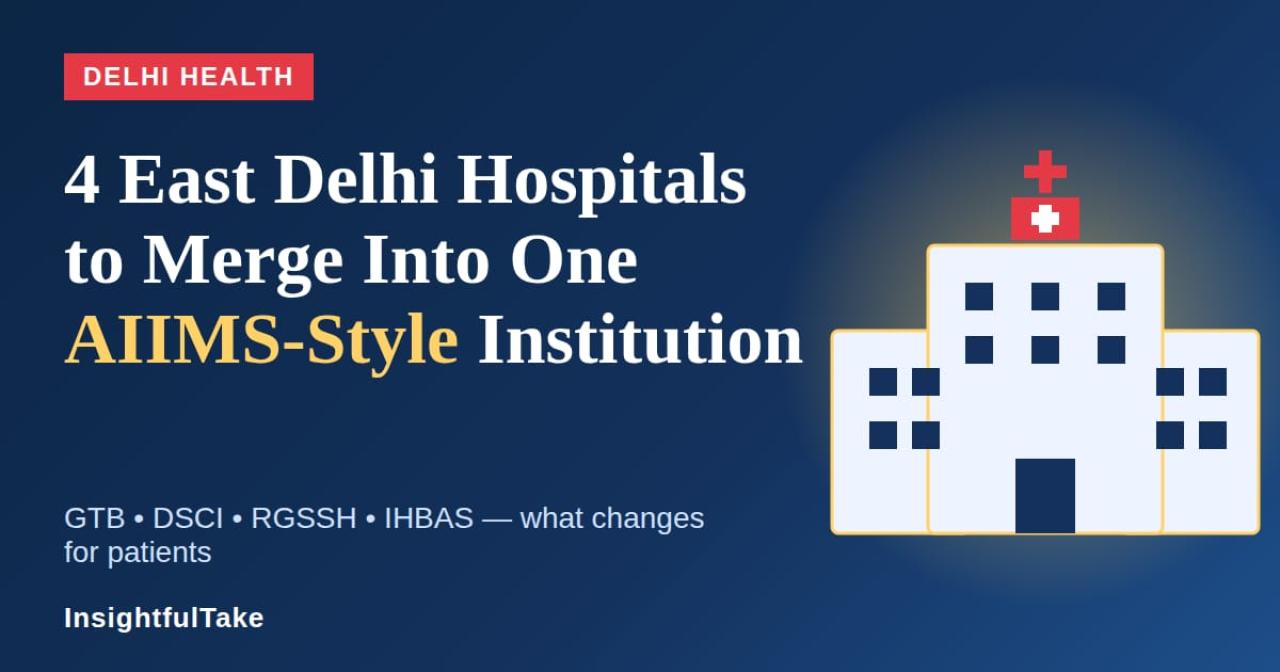
Four major hospitals in east Delhi are set for a merger aimed at improving specialist treatment, patient referrals and affordable healthcare for millions.
The proposed merger of four major government hospitals in Dilshad Garden aims to improve specialist care, simplify patient referrals and expand medical education facilities.
The Delhi government has cleared the way for a major restructuring of public healthcare in east Delhi. Four government hospitals in and around Dilshad Garden are proposed to be merged into a single autonomous, multi-speciality institution modelled on the All India Institute of Medical Sciences (AIIMS).
Delhi Health Minister Pankaj Singh confirmed the decision on October 23, saying the government intends to fast-track the project.
The four institutions identified for the merger are Guru Teg Bahadur (GTB) Hospital, Delhi State Cancer Institute (DSCI), Rajiv Gandhi Super Speciality Hospital (RGSSH) and the Institute of Human Behaviour and Allied Sciences (IHBAS).
GTB Hospital, DSCI and IHBAS occupy adjoining campuses, while RGSSH is located approximately half a kilometre away.
The proposed integration could significantly change how patients access specialist treatment, how doctors coordinate care and how medical education is organised across these institutions.
One Governing Body to Replace Four Administrative Systems
Currently, the four hospitals operate under different administrative arrangements.
GTB Hospital is directly administered by the Delhi government and is associated with the University College of Medical Sciences. The other three institutions function through separate registered societies, each with its own governing structure.
Under the proposed merger, these societies would be dissolved and replaced by a unified governing body based on the administrative model followed by AIIMS Delhi.
The objective is to bring hospital management, specialist services, infrastructure planning and academic activities under a common institutional framework.
According to the proposal, a unified administration would help eliminate overlapping responsibilities and improve coordination among departments that currently operate independently.
Health Minister Singh said the government had received approval from Lieutenant Governor Taranjit Singh Sandhu for the integration. Tenders for the next stage of the project are expected to be invited shortly.
The Lieutenant Governor's office had not responded to requests for comment at the time of the original report.
How the Merger Could Benefit Patients
One of the most important proposed benefits concerns patient referrals.
At present, the four institutions have separate administrative systems, which can complicate formal referrals and coordination between specialist departments.
A patient receiving treatment at GTB Hospital, for example, may require advanced cancer care at DSCI or specialised neurological and psychiatric services at IHBAS.
Although these institutions are geographically close, their separate management structures can create administrative difficulties.
The proposed merger aims to establish a coordinated referral system in which patients can move between specialist departments under one institutional arrangement.
This could reduce paperwork, improve communication between doctors and make better use of available medical equipment and specialist expertise.
The government also expects the integration to reduce duplication of services and improve the utilisation of existing hospital buildings, diagnostic facilities and healthcare personnel.
However, the actual benefits will depend on how effectively the new institution coordinates appointments, medical records, referrals and treatment.
More Medical Seats and Better Teaching Facilities
The proposed institution is also expected to strengthen medical education.
According to the government proposal, teaching positions and academic resources across the four hospitals could be pooled to support additional postgraduate medical seats.
Shared laboratories, clinical facilities, faculty members and hospital infrastructure may also create opportunities to expand undergraduate MBBS training.
This could help address the growing demand for medical education while improving the availability of trained healthcare professionals.
The merger may also encourage greater cooperation between specialists working in oncology, psychiatry, neurology, general medicine and other disciplines.
However, any expansion in medical seats would require the necessary regulatory approvals, faculty strength and infrastructure standards.
Healthcare Access for Nearly Six Million Residents
The government has presented the proposed institution as a major healthcare investment for the trans-Yamuna region.
According to Health Minister Singh, approximately six million people living across east Delhi and neighbouring areas could benefit from a large multi-speciality public healthcare institution closer to their homes.
The government intends to provide subsidised treatment through the new institution, making advanced medical services more accessible to patients who cannot afford expensive private hospitals.
For many residents, access to specialised public healthcare often involves long waiting periods, multiple hospital visits and additional travel expenses.
A coordinated medical institution could reduce some of these difficulties, particularly for patients requiring treatment from more than one specialist department.
Nevertheless, the proposed merger does not automatically guarantee shorter waiting times or increased treatment capacity. These improvements would require adequate staffing, funding and effective hospital management.
Cabinet Approval and Infrastructure Planning Still Pending
Despite the government's announcement, the merger has not yet been completed.
Several administrative and regulatory steps remain before the proposed institution can begin functioning under a unified structure.
The next major requirement is approval from the Delhi cabinet. The proposal estimates that this process could take approximately six months.
Before submitting the plan for cabinet consideration, the health department intends to appoint a transaction adviser and an infrastructure consultant through a tendering process.
These consultants will assess how existing buildings, equipment and services can be integrated. They will also help develop the new institutional framework, prepare governing rules and draft the cabinet proposal.
Once the necessary approvals are secured, an administrative order would formally bring the merger into effect.
The government has indicated that the project will be pursued quickly, although a final operational timeline has not been announced.
Staff Conditions and Specialised Services Need Clarity
The proposed integration also raises important administrative and healthcare questions.
Employees of the three society-run hospitals may have different recruitment rules, salary structures and service conditions from those working at GTB Hospital.
The government will need to clarify how these differences will be addressed under the new governing body.
Another concern involves the specialised identities of the institutions being merged.
DSCI focuses on cancer treatment, while IHBAS provides specialised mental health and neurological services. Their existing clinical priorities, research activities and patient-care systems will need protection within the larger organisation.
There is also the question of affordability.
Although the government has promised subsidised healthcare, the new institution's financial arrangements and treatment charges will require clear public guidelines.
Transparent policies on staffing, specialist services, patient rights and hospital fees will be essential to maintaining public confidence during the transition.
An AIIMS-Style Institution Must Deliver Beyond Its Name
AIIMS Delhi is widely recognised for its medical expertise, research, teaching facilities and public healthcare services.
However, adopting a similar administrative model does not automatically reproduce the institution's clinical standards or academic achievements.
The proposed east Delhi institution will require sustained government funding, qualified medical professionals, modern infrastructure and accountable leadership.
Equally important will be the ability to maintain uninterrupted patient services while four established hospitals undergo administrative integration.
For residents of east Delhi and neighbouring areas, the merger offers the possibility of better specialist coordination, improved access to treatment and expanded medical education.
The government's immediate challenge is to turn the proposal into a workable institutional structure without disrupting existing healthcare services.
The success of the merger will ultimately be measured not by its comparison with AIIMS, but by whether patients receive timely, affordable and effective treatment.

















Leave a Comment