
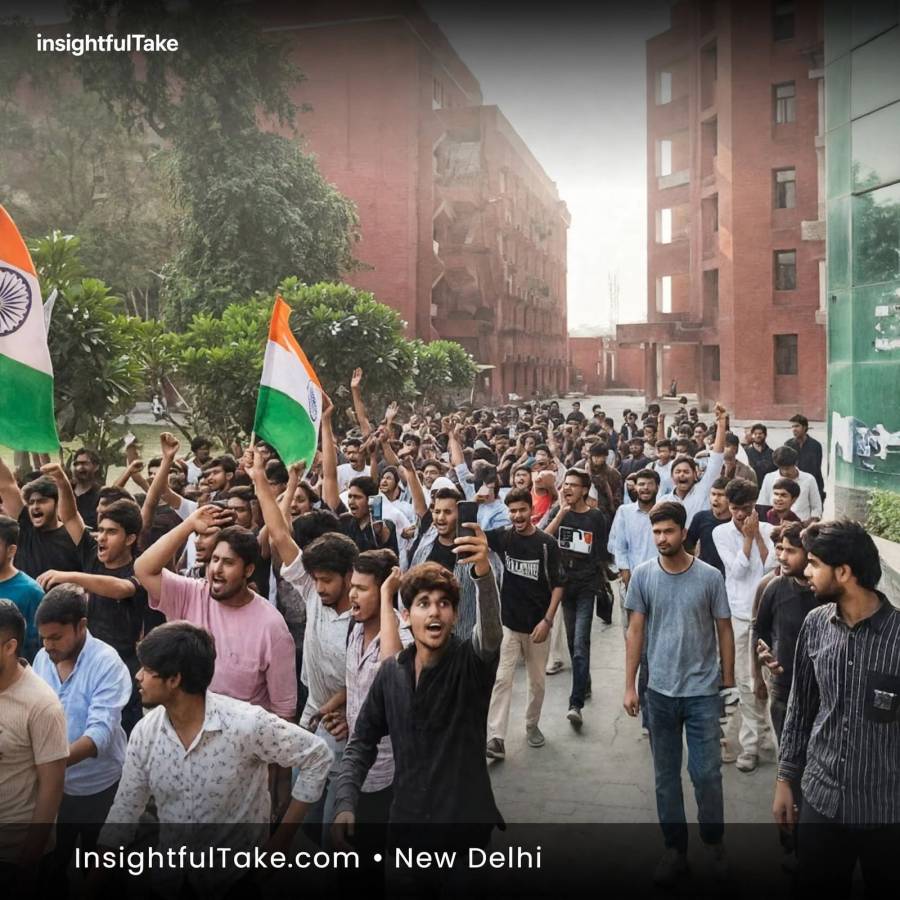
The university's decision to suspend physical classes raises concerns over student representation, academic disruption and the growing use of online teaching to manage campus unrest.
Jamia Millia Islamia has shifted all classes online with immediate effect following intensified student protests demanding the restoration of the students' union. The decision has raised concerns about how universities balance students' right to protest with their responsibility to ensure uninterrupted education.
In a notice issued on October 24, 2026, Registrar Mohd Mahtab Alam Rizvi announced that all courses would be conducted online until further notice. The administration cited the safety and security of bona fide students as the reason for the move.
The announcement followed a tense day on campus. Teachers and university staff reportedly attempted to persuade protesting students to end their sit-in. However, tensions escalated near Gate No. 7 after students reclaimed a protest site that had allegedly been dismantled earlier.
The developments have brought a familiar question back into focus. How should universities respond when student protests begin affecting regular academic activities?
Student Union Demand at the Centre of Protest
The ongoing agitation centres on the demand to restore an elected students' union at Jamia Millia Islamia.
Students have been pressing for a representative body through which they can raise academic, administrative and welfare concerns. Their methods have included sit-ins, hunger strikes and demonstrations.
The demand reflects a wider debate across Indian universities, where student unions have often faced restrictions, prolonged suspension or administrative resistance.
For protesting students, an elected union represents more than a political organisation. It offers a formal platform for participation in decisions affecting campus life.
The administration, meanwhile, has a responsibility to maintain order and ensure that academic activities continue without disruption.
The latest confrontation suggests that communication between the two sides has failed to produce an acceptable solution.
Why Moving Classes Online Raises Concerns
Online education became essential during the COVID-19 pandemic. Universities developed digital teaching systems to continue academic activities when physical classrooms were inaccessible.
However, using online instruction to manage student unrest presents a different challenge.
A university campus provides much more than classroom lectures. Students depend on libraries, laboratories, academic discussions, research facilities and direct interaction with teachers.
For students from economically disadvantaged backgrounds, these facilities can be particularly important.
Not everyone has reliable internet access, a suitable device or a quiet environment for attending online classes.
A prolonged shift to virtual teaching could therefore create unequal learning conditions, even if the administration intends to protect students.
The decision also raises concerns about whether online education is gradually becoming an administrative response to situations that require dialogue and negotiation.
The Right to Protest and the Right to Study
Student activism has played an important role in India's university culture.
Campuses have historically provided spaces for political debate, democratic participation and organised demands for institutional reform.
The right to peaceful protest remains an important part of that tradition.
However, universities must also protect the academic interests of students who may not participate in demonstrations.
When protests interfere with teaching, examinations or access to academic facilities, the consequences extend beyond those directly involved in the agitation.
This creates responsibilities for both sides.
Students have legitimate grounds to demand representation and accountability. At the same time, protest organisers must consider how their methods affect the wider academic community.
University authorities, for their part, cannot treat every demonstration as a security problem requiring restrictions on normal campus life.
A balanced response requires protecting peaceful dissent while ensuring that educational activities continue.
Gate No. 7 Confrontation Exposes Communication Gap
The reported confrontation near Gate No. 7 illustrates the growing mistrust between students and the administration.
Videos circulating from the campus reportedly showed the removal of protest arrangements, followed by students returning to occupy the area.
Teaching and administrative staff also reportedly spent considerable time attempting to persuade demonstrators to withdraw.
A 22-year-old student was reported to have been on hunger strike since mid-October, reflecting the seriousness with which some protesters view the demand.
These developments suggest that the dispute has moved beyond a disagreement over student union elections.
It has become a test of whether the university can address grievances through meaningful engagement before tensions escalate.
The immediate challenge is to prevent further confrontation while creating conditions for negotiations.
Universities Need Dialogue Rather Than Repeated Disruption
Moving classes online may temporarily reduce the possibility of confrontation on campus.
However, it does not resolve the demand that triggered the protest.
If the administration restores physical teaching without addressing student representation, the agitation could resume.
Similarly, if protesters continue demonstrations without considering academic disruption, they risk losing support among students who want regular classes to continue.
A more practical approach would involve structured negotiations between university authorities and student representatives.
Such discussions could establish a clear process for examining the demand for union restoration, including any legal or administrative requirements.
The university could also consider an agreed framework for peaceful demonstrations that protects academic spaces and essential services.
Time-bound discussions, transparent communication and clearly defined responsibilities would offer a more sustainable approach than repeated confrontation.
A Wider Test for Indian Higher Education
The Jamia dispute reflects a larger challenge facing higher education institutions across India.
Universities are expected to encourage independent thinking, democratic values and public debate. They are also responsible for maintaining academic standards and providing a stable learning environment.
These responsibilities need not conflict.
Students can participate in democratic activities without preventing others from attending classes. Administrations can maintain discipline without treating legitimate grievances as threats to institutional authority.
The difficulty arises when either side stops recognising the other's concerns.
Jamia's decision to move classes online may provide temporary administrative relief. Its longer-term consequences will depend on how quickly normal teaching resumes and whether meaningful discussions take place.
For now, the university faces two immediate tasks. It must protect students' academic interests while finding a credible way to address the demand for elected representation.
The outcome will matter beyond Jamia Millia Islamia.
Other universities facing similar disputes may draw lessons from how the administration and students manage this confrontation.
A university should not have to choose between democratic participation and uninterrupted education. Its responsibility is to create conditions in which both can coexist.


















Leave a Comment