
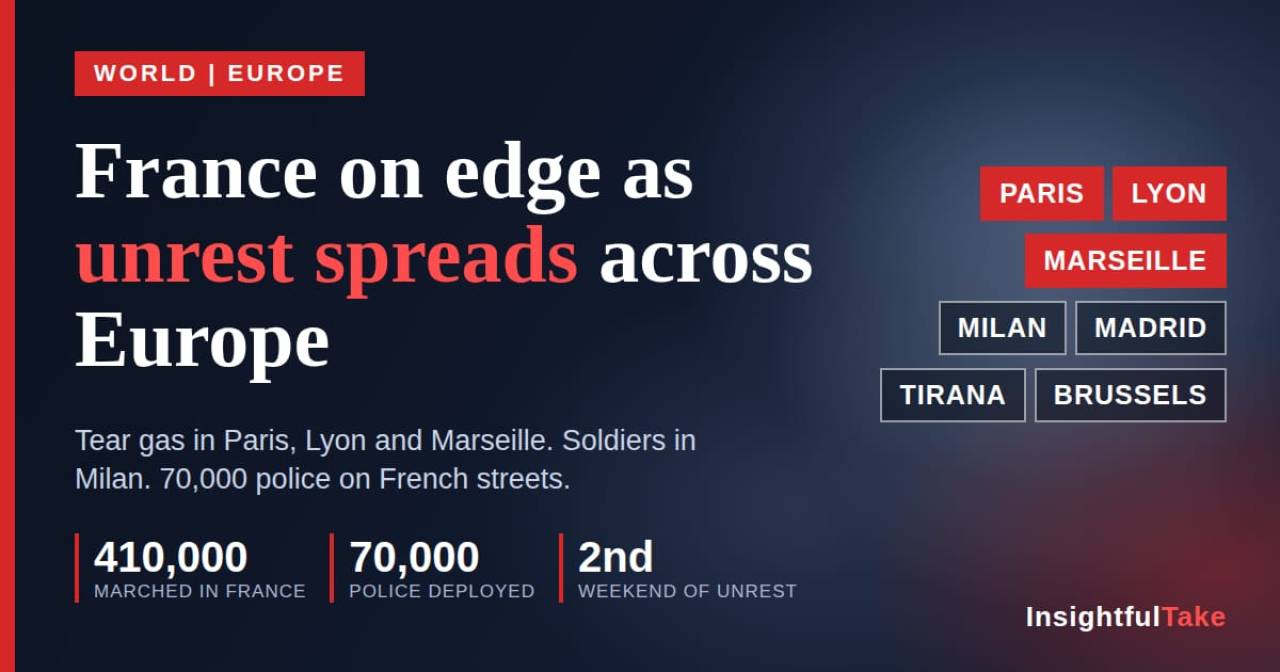
More than 410,000 demonstrators took to the streets across France as clashes with police erupted in several cities. Protests also spread across Italy, Belgium, Albania and Spain.
France witnessed another weekend of widespread protests as hundreds of thousands of people marched against rising living costs and growing economic inequality. While most demonstrations remained peaceful during the day, clashes broke out in Paris, Marseille and several other cities after nightfall, despite a massive police deployment.
The French interior ministry estimated that around 410,000 people participated in demonstrations across the country on October 25, 2026. Trade unions disputed the official figure, claiming that the actual turnout was nearly twice as high.
The protests marked the second consecutive weekend of major unrest in France, raising concerns about growing public dissatisfaction and the government's ability to contain street violence.
Paris Witnesses Clashes After Peaceful Demonstrations
Paris recorded the largest gathering, with authorities estimating that approximately 110,000 people joined the march.
Families, trade union members and younger demonstrators walked through the capital, demanding government action on rising prices, declining purchasing power and widening economic inequality.
The atmosphere remained largely peaceful throughout the afternoon. However, tensions increased after the official demonstration ended.
Riot police fired tear gas and deployed a water cannon to disperse a group of around 500 hooded individuals who confronted security personnel.
Later in the evening, police reported that two jewellery shops had been raided. Authorities had not immediately released confirmed figures for arrests or injuries.
The violence revived memories of the previous weekend, when looting and vandalism disrupted several French cities.
Violence Spreads Beyond the French Capital
Marseille, France's second-largest city, also witnessed clashes between protesters and riot police.
Groups of youths dragged large metal sheets onto roads to create barricades, set rubbish bins on fire and threw stones and bottles at security personnel.
Similar confrontations occurred in Lyon, Bordeaux and Grenoble.
Police used tear gas to disperse demonstrators in Clermont-Ferrand, Lille, Nantes and Nice.
In Lyon, protesters and police faced each other through thick clouds of tear gas as officers attempted to regain control of affected streets.
Although the latest disturbances were serious, the violence was reportedly less extensive than the unrest witnessed on October 17.
French authorities had acknowledged underestimating the scale of the earlier disorder and increased security arrangements ahead of the latest demonstrations.
France Deploys 70,000 Police Officers
The government mobilised approximately 70,000 police officers across France, an increase of 10,000 compared with the previous weekend.
Security was particularly tight in central Paris, where shopkeepers boarded up their storefronts to protect businesses against possible vandalism and looting.
Several museums also remained closed as a precaution.
The extensive deployment reflected the authorities' concerns about another outbreak of violence.
However, the heavy police presence did not prevent clashes in several cities.
The situation has created a difficult challenge for the French government. It must protect public safety while respecting the right to peaceful protest.
The distinction between peaceful demonstrators and groups involved in violence has become particularly important as trade unions continue to mobilise large crowds.
Italy Faces Protests and Heightened Security
France was not the only European country experiencing public unrest over the weekend.
In Italy, authorities deployed soldiers in Milan as businesses prepared for possible disturbances following earlier incidents of looting and clashes.
Several luxury boutiques boarded up their windows to prevent damage.
Demonstrations were also held in Rome, Turin and other Italian cities, with some gatherings turning violent.
In Rome, police maintained security lines near the Colosseum as demonstrators assembled on Sunday.
The security measures reflected concerns that large public gatherings could again lead to confrontations between protesters and law enforcement personnel.
Albania and Belgium Witness Fresh Clashes
In Albania, thousands of people gathered in the capital, Tirana, for another anti-government demonstration following several days of unrest.
Police used tear gas to disperse crowds as tensions escalated.
Belgium also witnessed confrontations between demonstrators and security forces.
In Brussels, police deployed tear gas and pepper spray during clashes with anti-government protesters on Saturday.
Although the political circumstances differed across these countries, the demonstrations highlighted growing tensions between sections of the public and their governments.
Thousands March in Madrid Over Pension Concerns
Spain witnessed a largely peaceful demonstration focused on the future of its state pension system.
Authorities estimated that approximately 25,000 people marched through central Madrid, demanding stronger protection for pensions.
The demonstration came ahead of parliamentary elections scheduled for the following month, making retirement security an important political issue.
Unlike the violent confrontations reported elsewhere in Europe, the Madrid protest appeared to remain peaceful.
The gathering nevertheless reflected public concern about economic security and the ability of governments to protect household incomes.
Economic Pressures Fuel Public Discontent
The demonstrations across Europe were driven by different national and political circumstances. However, economic insecurity emerged as a significant concern in several countries.
In France, rising living costs and inequality have become major sources of frustration.
Many households are struggling with expenses, while protesters argue that economic policies have failed to provide sufficient relief.
In Spain, pension security has become a central concern, particularly as voters prepare for parliamentary elections.
Elsewhere, anti-government sentiment has brought thousands of demonstrators onto the streets.
These protests should not be treated as a single coordinated European movement. Their demands, political backgrounds and immediate causes differ considerably.
However, the simultaneous demonstrations show how economic pressures and dissatisfaction with political leadership can contribute to public mobilisation across national boundaries.
France Faces a Difficult Political and Security Challenge
The French government now faces the possibility of further demonstrations after two consecutive weekends of unrest.
The deployment of additional police officers may help prevent widespread destruction, but security measures alone cannot resolve the grievances that brought hundreds of thousands of people onto the streets.
Trade unions have demonstrated their ability to organise large gatherings, while smaller groups involved in violence have complicated the authorities' response.
The government must also ensure that its efforts to prevent disorder do not unnecessarily restrict peaceful demonstrations.
For businesses, the immediate concern remains the possibility of further damage and disruption.
For political leaders, the challenge is broader. Public dissatisfaction over living costs, inequality and economic security requires responses beyond policing.
The coming days will test whether the French authorities can restore confidence and maintain public order without allowing tensions to escalate further.
Across Europe, the weekend's demonstrations have also shown that public frustration can take different forms, from peaceful marches over pensions to violent confrontations with police.
France's immediate challenge is to prevent another weekend of violence. Its longer-term challenge is to address the economic grievances that continue to bring large numbers of people onto the streets.























Leave a Comment