
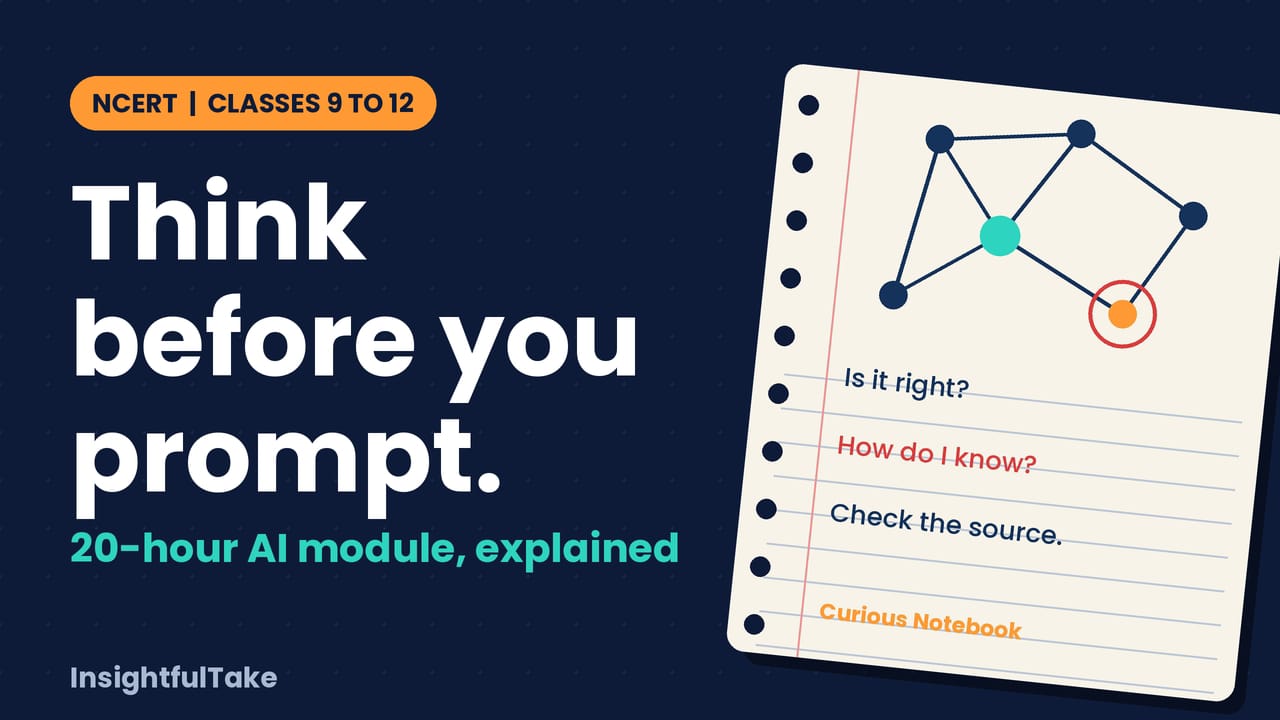
Developed by IIT Madras, IIT Jodhpur and NCERT, the 20-hour course for Classes 9 to 12 focuses on computational thinking, AI literacy, data privacy and responsible use of technology.
Students across India are increasingly turning to artificial intelligence for homework, explanations, project ideas and exam preparation. A chatbot can solve a mathematics problem within seconds, summarise a chapter or produce an essay on almost any subject. But how many students stop to check whether the answer is correct?
The National Council of Educational Research and Training (NCERT) has introduced a 20-hour, activity-based introductory module on computational thinking and artificial intelligence for students of Classes 9 to 12. Announced through a press release on October 23, 2026, the initiative seeks to familiarise schoolchildren with AI while encouraging them to question its outputs rather than accept them without verification.
The module goes beyond teaching students how to use AI tools. It introduces the technology's limitations, explains how machines identify patterns and places considerable emphasis on human judgement, creativity, privacy and ethical responsibility.
Developed by IITs and NCERT
Faculty members from IIT Madras, IIT Jodhpur and NCERT have jointly developed the module in alignment with the National Education Policy (NEP) 2020.
Designed as a foundational learning resource, the course does not require students to possess advanced programming knowledge. Instead, it introduces AI through familiar examples, practical exercises and classroom discussions.
The approach reflects a growing educational concern. Students can now generate answers almost instantly, but the ability to distinguish reliable information from misleading or inaccurate content remains essential.
NCERT's initiative attempts to address this gap by treating AI literacy as part of broader critical-thinking education.
Five Units That Explain AI Beyond Chatbots
The module is organised into five units covering the practical, technical and ethical dimensions of artificial intelligence.
1. Understanding AI in Everyday Life
The opening unit introduces students to AI systems they already encounter.
Video recommendations, predictive text on smartphones and other automated suggestions offer accessible examples of how algorithms identify patterns and generate predictions.
Students learn that these systems can produce useful results without necessarily understanding situations in the way humans do.
2. How Machines Learn From Data
The second unit explains how machine-learning systems recognise patterns from examples.
Through activities such as training an image classifier, students explore how computers distinguish between objects and how the quality of training examples influences results.
The module also introduces a "helper-stance" approach, encouraging students to treat AI as an instrument that supports their thinking rather than replaces it.
3. Why Artificial Intelligence Makes Mistakes
One of the most relevant sections examines AI errors, unreliable outputs and data bias.
Students are encouraged to test AI systems, identify weaknesses and deliberately explore situations in which they fail.
This exercise is particularly important when chatbots generate convincing explanations that contain factual inaccuracies.
The underlying lesson is straightforward: an answer delivered with confidence is not necessarily an answer supported by evidence.
4. Data Privacy, Consent and Digital Responsibility
The fourth unit examines the personal information people share through digital platforms.
Students explore app privacy policies, data collection practices, consent, fairness and online safety.
The module also introduces India's Digital Personal Data Protection Act, 2023, helping students understand the legal framework surrounding personal data.
At a time when young people routinely use educational apps, social platforms and AI services, awareness of data privacy is becoming an essential digital skill.
5. Learning to Use AI Tools Responsibly
The final unit introduces students to modern AI tools and effective prompting techniques.
However, the objective is not simply to teach them how to obtain better responses.
Students are encouraged to retain responsibility for their work, evaluate AI-generated material and use technology to improve understanding.
The distinction between receiving an answer and learning how to arrive at one remains central to the course.
How Schools With Limited Digital Resources Can Participate
A notable feature of the module is its flexible classroom design.
NCERT has provided three ways to conduct the activities: individual or paired device-based learning, teacher-led demonstrations using a shared screen, and unplugged exercises involving paper, observation and discussion.
This flexibility could be particularly useful in Indian schools where access to computers, reliable internet connections and digital infrastructure remains uneven.
Dr Jyoti Arora, principal of Mount Abu Public School in Delhi, has welcomed the unplugged approach, observing that it would allow schools with limited technological resources to participate.
She also believes the module can prepare students to use AI for innovation rather than as a shortcut to completing assignments.
The design acknowledges an important educational reality: understanding artificial intelligence should not depend entirely on owning a computer.
The 'Curious Notebook' Encourages Students to Question Technology
Another feature is the introduction of a "Curious Notebook", which students will maintain throughout the learning process.
The notebook serves as a portfolio of observations, questions, experiences and reflections.
Students can record instances in which AI produces useful information, makes unexpected predictions or generates incorrect responses.
Rather than focusing exclusively on memorising technical definitions, the activity encourages learners to examine how technology behaves.
For example, a student might ask a chatbot to explain a historical event, compare its response with a textbook and record any factual differences.
Such exercises can strengthen habits of verification, observation and independent reasoning.
What Educators Say About the Initiative
Praneet Mungali, a trustee at the Sanskriti Group of Schools in Pune, has described the introduction of AI education from Class 9 as an important development.
In the module's foreword, NCERT Director Prof. Dinesh Prasad Saklani emphasises that technology can expand human capabilities, but judgement, creativity, responsibility and ownership of learning must remain with students.
These observations highlight the educational philosophy behind the initiative.
AI may accelerate certain tasks, but students still need the intellectual ability to assess information, identify errors and make independent decisions.
Can AI Literacy Reduce Students' Dependence on Chatbots?
The module arrives at a time when generative AI is changing how students approach school assignments.
A student who previously spent an hour preparing a written response can now generate one within seconds. The convenience is undeniable, but excessive dependence on automated answers may weaken opportunities to practise writing, problem-solving and independent analysis.
NCERT's proposed approach offers a possible response by integrating AI into the learning process without treating it as a replacement for intellectual effort.
However, the effectiveness of the initiative will depend on classroom implementation.
Teachers will need sufficient preparation to explain AI concepts, conduct activities and encourage meaningful discussions. Schools will also have to ensure that students participate actively rather than simply follow instructions.
The module's flexible design addresses differences in digital access, but the quality of teaching will remain crucial.
A 20-hour introductory course cannot provide comprehensive technical expertise. It can, however, establish the foundation for more informed and responsible engagement with artificial intelligence.
What Students Can Start Practising Today
Students do not necessarily have to wait for the module to be introduced in their classrooms.
They can begin by checking AI-generated answers against textbooks and credible sources, reviewing the privacy policies of frequently used applications and keeping a record of occasions when AI tools provide incorrect information.
They can also use chatbots to understand difficult concepts before attempting assignments independently.
For teachers, the initiative creates an opportunity to discuss AI-generated misinformation, digital responsibility and the importance of original thinking within regular classroom activities.
AI Education Must Strengthen Human Intelligence
The introduction of NCERT's AI module reflects a shift in how technology education is being approached in Indian schools.
Learning to operate digital tools is no longer sufficient. Students must also understand how these systems work, why they make mistakes and when their outputs should be questioned.
Whether a student eventually becomes an engineer, doctor, journalist, teacher or entrepreneur, the ability to evaluate information critically will remain valuable.
NCERT's new module places that responsibility at the centre of AI education.
























Leave a Comment