
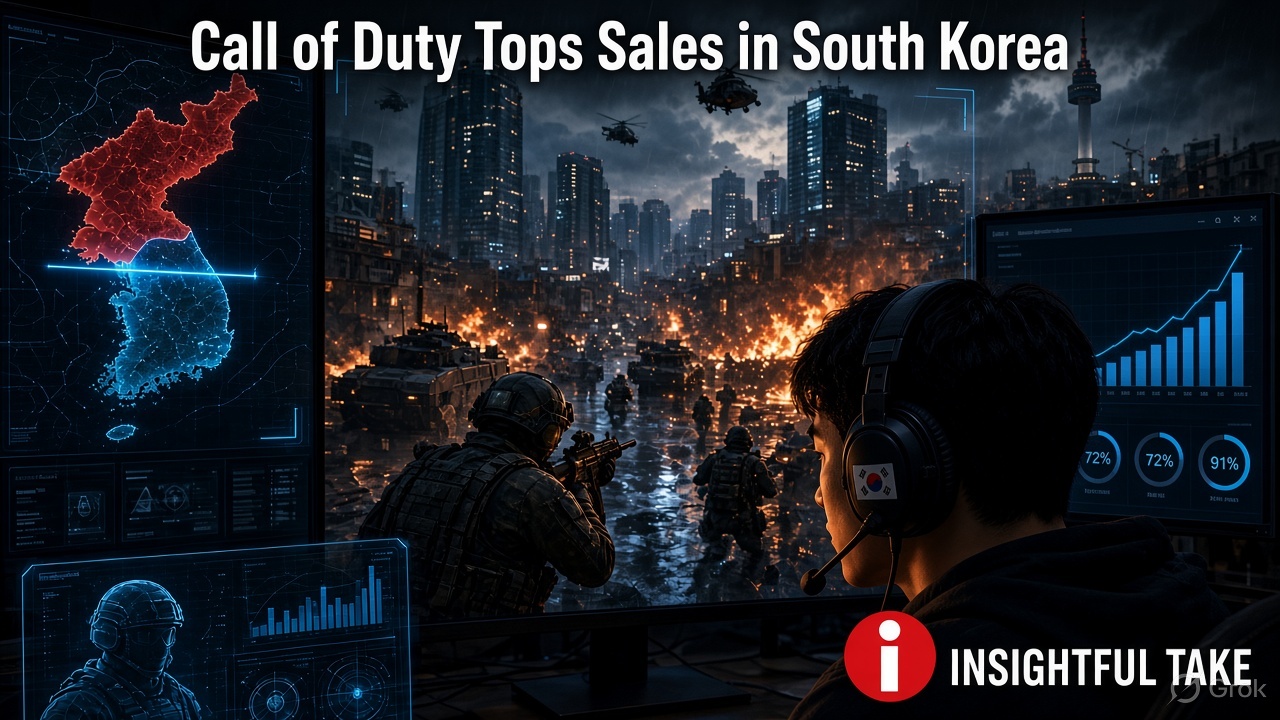
A fictional North Korean invasion has captured South Korea's gaming market, where memories of war and real border tensions make the storyline unusually personal.
A fictional North Korean invasion of South Korea has become the centre of attention in the gaming world, bringing the country's unresolved military conflict into an entertainment format familiar to millions of players.
The reported interest in a Call of Duty storyline depicting a full-scale invasion comes against a sensitive geopolitical backdrop. North and South Korea remain divided by one of the world's most heavily fortified borders, while military incidents and political disagreements continue to raise concerns about regional security.
For South Korean gamers, such a storyline carries a significance that extends beyond the usual excitement of a military action game.
When a Fictional War Feels Close to Home
The game narrative follows American and South Korean soldiers confronting a sudden military offensive from the North. Other storylines explore personal revenge, political rivalry and a leadership struggle inside North Korea.
By presenting the conflict from different perspectives, the narrative attempts to combine cinematic combat with the political complexity of the Korean Peninsula.
The premise is particularly relevant in South Korea, where military service remains compulsory for most able-bodied men.
Depending on their branch of service, recruits generally serve between 18 and 21 months. Military training, national defence and the possibility of confrontation with North Korea are therefore familiar subjects for many families.
An invasion scenario set in recognisable South Korean locations can consequently evoke reactions that a fictional battlefield elsewhere might not.
A Gaming Market Shaped by Military Experience
South Korea is one of the world's most established gaming markets, with a strong PC gaming culture, competitive esports industry and widespread high-speed internet access.
Military-themed games have long attracted international audiences, but a storyline involving North Korea offers South Korean players something unusually familiar.
The country has lived with the consequences of division since the Korean War of 1950–53. Although major fighting ended with an armistice, the two Koreas never signed a comprehensive peace treaty.
The United States also maintains approximately 28,500 troops in South Korea under its longstanding security alliance with Seoul.
These realities make the fictional depiction of another Korean war especially sensitive. For some players, it may be an action-packed gaming experience. For others, it can recall military service, family experiences and the history of a conflict that has never been formally settled.
Historical Memory Meets Digital Entertainment
The Korean War remains an important part of South Korea's national consciousness.
Families continue to preserve accounts of relatives who fought during the conflict, experienced displacement or lived through the country's postwar reconstruction.
A video game depicting another invasion can bring these memories into a contemporary setting, particularly for younger players who know the original war primarily through education and family stories.
The emotional appeal of such a narrative also raises questions about how entertainment represents actual human suffering.
Modern military games frequently use realistic environments, sophisticated graphics and dramatic storytelling to immerse players in combat. Their commercial success depends partly on making fictional conflict feel convincing.
But realism in a game is not the same as an accurate account of military history or present-day geopolitical realities.
The Political Sensitivity of a North Korean Invasion
North Korea's nuclear weapons programme, missile tests and confrontational exchanges with Seoul have repeatedly complicated efforts to reduce tensions on the peninsula.
South Korea, meanwhile, maintains a powerful conventional military supported by its alliance with the United States.
Any renewed large-scale conflict would carry enormous humanitarian, economic and strategic consequences, particularly for densely populated areas around Seoul.
A video game can compress these complexities into missions, objectives and dramatic combat sequences. Real military conflict, however, would involve civilian casualties, infrastructure destruction and potentially wider regional escalation.
This distinction matters when fictional military scenarios become part of popular discussions about national security.
Why the Storyline Matters Beyond Gaming
The appeal of a North Korean invasion narrative illustrates how closely popular entertainment can intersect with national experience.
In countries geographically removed from the Korean Peninsula, such a game may be received primarily as military fiction.
In South Korea, its setting introduces additional layers of meaning involving national defence, historical memory and the continuing division of the peninsula.
It also reflects a broader trend in video game storytelling, where developers increasingly draw on contemporary international tensions to create narratives that feel politically relevant.
The result can be compelling entertainment, but it can also shape perceptions of real countries and conflicts.
For South Korean audiences, the imagined invasion is not simply another battlefield on a screen. It draws on a history that remains unresolved and a security situation that continues to influence everyday life.




















Leave a Comment