
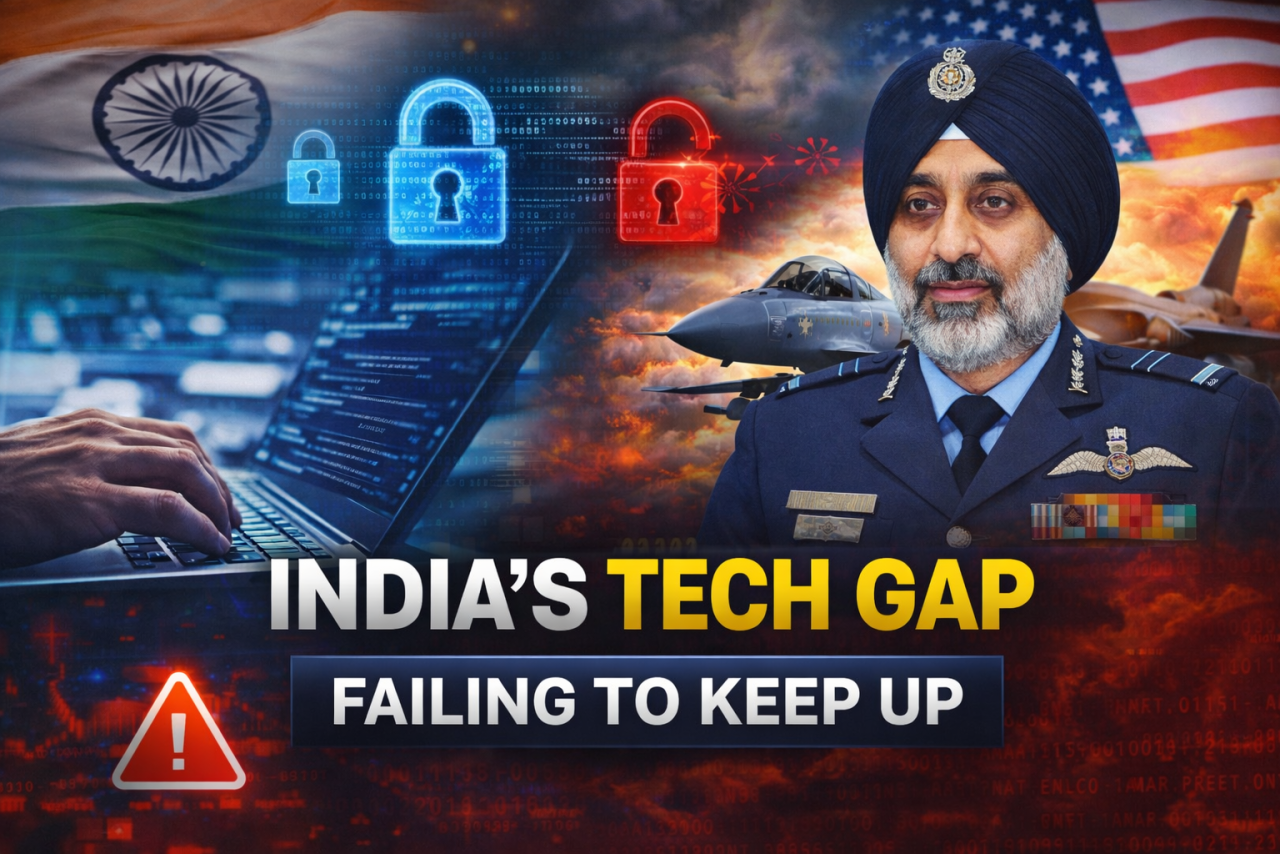
When the Air Chief himself admits that India needs foreign technology to meet future defence goals, it signals a deeper challenge facing the country’s technological ambitions...
India’s ambition to become a developed nation by 2047 rests heavily on technological strength, yet recent developments in national security and cybersecurity suggest the country is still struggling to match the technological depth of Western powers and the United States. What makes this moment significant is that the gap is no longer being flagged only by analysts—it is now being openly acknowledged by senior military leadership and industry experts.
The warning from the defence sector has come directly from the top. Speaking in New Delhi, Chief of the Air Staff Air Chief Marshal Amar Preet Singh said that while India has the mindset and human capital to become a strong military power, it lacks several key technologies required for next-generation warfare. Bridging this gap, he noted, would require strategic technology partnerships with other countries.
“We may be able to do it alone, but it will take longer,” the IAF chief said, underlining the risk of relying only on domestic development in a rapidly changing security environment where delays can translate into operational disadvantages.
His remarks are significant because they reflect a rare public admission from the country’s senior military leadership that India’s technological self-reliance remains incomplete. Despite years of emphasis on indigenisation and the Atmanirbharta push, India continues to depend on foreign technology for advanced fighter aircraft, engines, sensors, and electronic warfare systems.
Jet engine technology remains one of the clearest examples of this dependence. The government is considering a joint project involving French firm Safran and India’s Gas Turbine Research Establishment under DRDO to develop a 120-kilonewton thrust engine for future indigenous fighter jets. According to details shared in the report, the project aims to build nine prototypes over a 12-year period, with full transfer of technology and intellectual property rights to India. The extended timeline itself highlights how challenging it has been for India to master such complex systems independently.
The IAF chief also pointed to the delicate balance between self-reliance and operational readiness. While long-term investment in indigenous research is essential, he cautioned that India cannot afford to fall behind in deploying modern weapons and platforms. Western militaries, particularly the United States, benefit from decades of sustained investment in aerospace research and defence innovation—an advantage India is still working to overcome.
A similar technology gap is becoming increasingly visible in cyberspace, where threats are evolving faster than India’s capacity to respond. A recent report on AI-driven cyberattacks shows that India faces a serious shortage of skilled cybersecurity professionals at a time when attacks are becoming more automated, targeted, and sophisticated.
Industry estimates cited in the report suggest that India currently has around 3.5 lakh professionals working in cybersecurity roles, while demand is close to 10 lakh engineers. Staffing firms have noted that although the number of cyber professionals has grown in recent years, the pace of skill development is not sufficient to meet the needs of industry or national security.
The nature of cyber threats has also changed sharply. Experts point out that artificial intelligence is now being used to automate malware creation, phishing campaigns, and system intrusions. Data from the India Data Security Council’s 2025 Cyber Threat Report indicates that between 2022 and 2024, behaviour-based cyber threats rose significantly, reflecting the growing role of AI in cybercrime.
At the same time, India’s cyber defence posture remains largely reactive. Aditya Verma, former director of transformation and cybersecurity at Indian Oil, has observed that most cybersecurity training programmes focus on short-term certifications rather than deep, hands-on expertise. As a result, India lacks professionals who are prepared to take on senior roles such as Chief Information Security Officers across large enterprises and critical infrastructure sectors.
Salary trends further reveal the imbalance. Entry-level cybersecurity engineers earn around ₹20 lakh annually, while senior professionals with more than a decade of experience can command salaries of up to ₹60 lakh. Despite these attractive pay packages, organisations continue to struggle to hire and retain skilled talent, particularly in public-sector and infrastructure-related roles.
In contrast, Western countries and the United States treat cybersecurity as a core element of national defence, investing consistently in long-term research, advanced training, and coordination between government agencies and private firms. In India, while efforts are underway, they remain fragmented across ministries, states, and institutions.
What connects the challenges in defence and cybersecurity is the changing nature of power itself. Modern conflicts are no longer fought only along physical borders. Cyberattacks can disrupt power grids, financial systems, air traffic, and military communications without a single shot being fired, leaving technologically weaker nations vulnerable on multiple fronts.
India’s problem is not a lack of talent or intent, but the absence of a strong ecosystem that can convert talent into advanced capability. Universities, research institutions, industry, and government bodies often operate in silos, while long-term technological planning gives way to short-term fixes.
Taken together, the IAF chief’s remarks and the cybersecurity data serve as a clear warning. If India wants to stand on equal footing with Western powers and the United States by 2047, closing the technology gap must become an urgent national priority, not a distant aspiration.



























Leave a Comment