
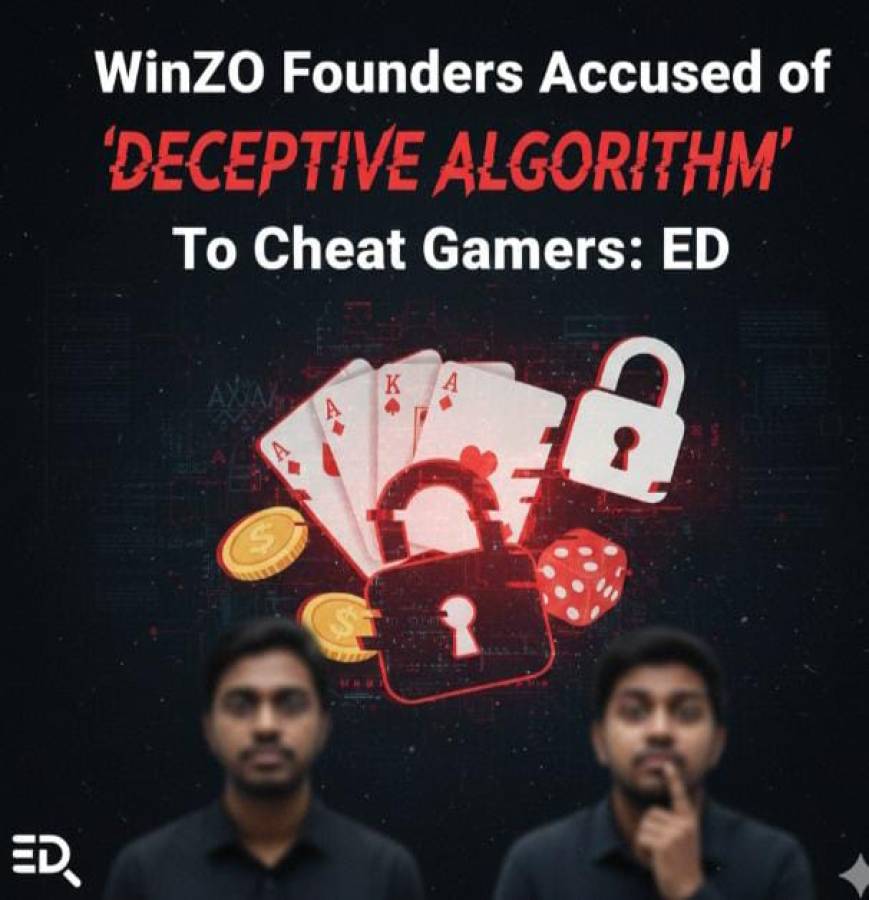
The promoters of online real-money gaming company WinZO are facing serious allegations after the Enforcement Directorate (ED) claimed they used a deceptive system to cheat genuine players and divert large sums of money. According to the agency, the promoters deployed a “concealed and deceptive” algorithm to manipulate outcomes on the gaming platform, leading to the suspected laundering of ₹377 crore in just one year.
The ED made these allegations after arresting the two co-founders of the company—Saumya Singh Rathore and Paavan Nanda—in Bengaluru under the provisions of the Prevention of Money Laundering Act (PMLA). A local court later sent them to ten days of ED custody for further investigation.
How the Alleged Deception Worked
In its submission to the court, the ED said that WinZO Games Pvt. Ltd. used a hidden algorithm named “PPP”, which allowed the platform to secretly interfere with the real-time gaming experience of users. This meant that players were not always experiencing fair play, even though they believed they were playing genuine skill-based games.
The federal agency accused the promoters of creating an unfair advantage for the company by influencing game outcomes and withholding players’ rightful winnings. According to the ED, these practices were unethical and restrictive, ultimately causing financial losses to thousands of users who trusted the platform.
Where the Money Went
According to the investigation, the suspected cheating led to the generation of about ₹377 crore in illicit profits. Officials claimed that much of this money was allegedly moved through complex methods to foreign jurisdictions. Early estimates put the value of these foreign transfers at ₹888 million, which is approximately ₹88 crore.
The agency believes the promoters used this deceptive model to strengthen their financial position while masking unlawful gains as legitimate business revenue.
What Triggered the Case
The complaint against WinZO did not originate from the ED. It first began with an FIR filed by the Gurugram Police Cyber Crime Unit. In that case, a gamer complained that he was cheated while playing on the WinZO platform. As the cyber police dug deeper, more irregularities surfaced, which eventually led to the involvement of the Enforcement Directorate.
The ED took formal cognisance on November 6, and the investigation quickly widened as evidence pointed towards possible money laundering and manipulation of digital games.
ED’s Findings So Far
The agency told the court that not only was the algorithm deceptive, but the company’s senior leadership was fully aware of how it functioned. The ED alleged that the directors intentionally designed the system to generate illegal profits.
The probe also suggested that WinZO misled users by presenting itself as a platform offering fair and transparent games. However, the ED claims the company manipulated outcomes behind the scenes, creating a false sense of trust among players.
Furthermore, investigators said the promoters used pressure tactics on internal employees to ensure the deceptive system remained operational. The company’s top-level leadership, they alleged, consistently prioritised unlawful gains over ethical business practices.
The Bigger Question: Can Online Gaming Be Trusted?
This case has once again sparked conversations about the safety and transparency of online real-money games in India. While the sector has grown rapidly in recent years, incidents like this highlight the urgent need for strong oversight.
Thousands of young players participate in real-money games daily, often believing they are engaging in fair competitions. Cases like WinZO’s raise doubts about whether some gaming companies manipulate behind the scenes to maximise profits at the cost of user trust.
Final Take
The ED is expected to question the founders in detail during their custody period, focusing on the decision-making behind the algorithm, fund transfers abroad, and the structure of financial transactions. If found guilty, the promoters could face serious legal consequences under India’s anti–money laundering laws.
For now, the case serves as a strong reminder that digital gaming platforms must operate transparently and ethically. As authorities continue their crackdown, players and regulators alike will be watching closely.
The investigation is ongoing, and more details are expected to emerge in the coming days.



















Leave a Comment