
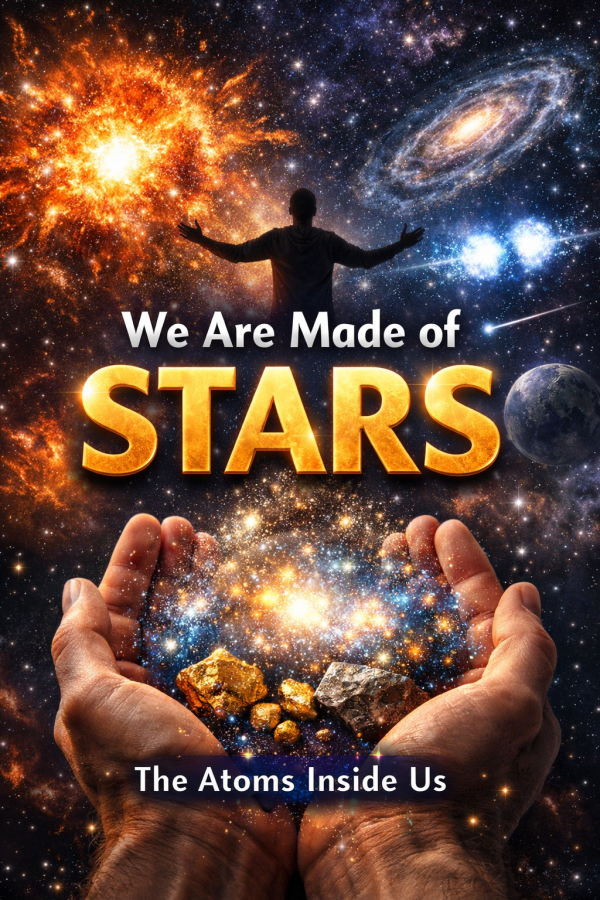
The oxygen you breathe, the iron in your blood, and the calcium in your bones were all forged in ancient stars billions of years ago. In the most literal scientific sense, every human being on Earth is made of stardust.
Take a moment to look at your hands. The oxygen filling your lungs, the calcium strengthening your bones, and the carbon forming every cell in your body share a remarkable origin. According to modern astrophysics, the atoms that make up human beings were forged billions of years ago inside ancient stars.
In the most literal scientific sense, we are made of stardust.
The story begins with the Big Bang, the event that gave birth to the universe around 13.8 billion years ago. In the first few minutes after the Big Bang, the universe produced only the simplest elements: hydrogen, helium, and a tiny amount of lithium. At that early stage, the cosmos lacked the rich chemical diversity that we see today.
There was no carbon, no oxygen, no iron—and certainly nothing that could support life.
Everything changed when the first stars began to form.
Under the pull of gravity, enormous clouds of hydrogen and helium collapsed and ignited nuclear fusion at their cores. These newborn stars became immense cosmic furnaces where lighter elements fused into heavier ones. Scientists call this process Stellar Nucleosynthesis.
Inside stars, hydrogen atoms fuse into helium. As stars age and grow hotter, helium fuses into carbon. With even greater temperatures and pressures, stars begin producing oxygen, nitrogen, silicon, and iron. These elements form the chemical backbone of planets—and life itself.
Yet the most dramatic stage of this cosmic story arrives when massive stars reach the end of their lives.
When a large star exhausts its nuclear fuel, its core collapses and triggers a titanic explosion known as a Supernova. For a brief moment, a supernova can outshine an entire galaxy. The explosion releases staggering amounts of energy and blasts newly formed elements into space.
Carbon, oxygen, iron, and countless other atoms are hurled across the cosmos as clouds of gas and dust. Over millions of years, this stellar debris drifts through interstellar space and becomes the raw material for new generations of stars and planets.
Our own cosmic neighborhood was born from such recycled stardust.
Around 4.6 billion years ago, a swirling cloud of gas and dust collapsed to form the Sun and the planets orbiting it—including Earth. The atoms that formed Earth’s oceans, mountains, atmosphere, and living organisms had already lived inside earlier stars long before the solar system existed.
In other words, the atoms in your body are far older than the planet you stand on.
Some elements require even more extreme cosmic events to form. Precious metals such as gold and platinum cannot easily be produced inside ordinary stars. Instead, scientists believe they are created during supernova explosions or in violent collisions between ultra-dense stellar remnants known as Neutron Stars.
When two neutron stars collide, they unleash unimaginable energy and create the perfect conditions for forging the heaviest elements in the periodic table. These rare cosmic events scatter gold, uranium, and platinum across space—some of which eventually become part of planets like Earth.
The cosmic connection to life may go even deeper.
Scientists studying meteorites and interstellar clouds have discovered simple organic molecules drifting through space. These molecules include chemical structures related to the building blocks of life, suggesting that some of life’s ingredients may have formed in space long before Earth itself existed.
Meteorites that landed on Earth have even been found to contain amino acid components, strengthening the idea that the chemistry necessary for life might have begun among the stars.
This discovery hints that the universe may have been quietly assembling life’s raw materials long before our planet formed.
The implications are both scientific and philosophical. Humanity is not separate from the universe; we are a direct product of its long cosmic history. Every atom inside us has traveled through space, been part of ancient stars, and survived colossal stellar explosions.
The late astronomer Carl Sagan captured this idea perfectly when he said that humans are “made of star stuff.”
Every breath you take carries oxygen forged in stellar cores. The calcium in your bones was created in ancient stars that died billions of years ago. Even the iron circulating in your blood was once formed deep within a massive star before being scattered across the galaxy.
Seen this way, the night sky is more than a distant spectacle. The stars shining above us are not just celestial objects—they are the ancient cosmic ancestors of the very atoms that make us human.
The universe did not simply create us.
It became us.
























Leave a Comment