
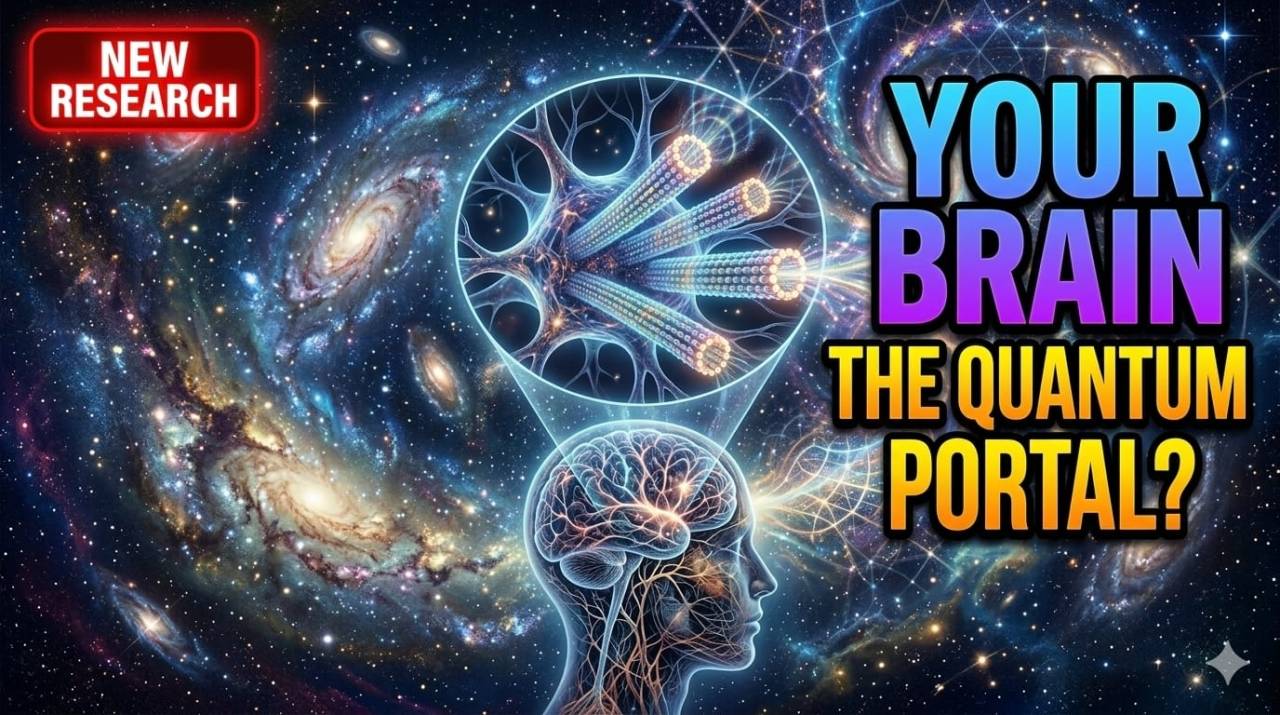
What if the human mind is not limited to the brain alone? Some scientists now believe consciousness may come from tiny quantum processes inside our brain cells—and could even be connected to the deeper structure of the universe.
The mystery of consciousness has puzzled scientists and philosophers for generations. Everyone experiences thoughts, feelings, and awareness, yet no one fully understands where they come from. Modern neuroscience usually explains consciousness in simple biological terms. The brain is seen as a very complex machine. Billions of neurons send electrical signals to one another and release chemicals that help them communicate. From this huge network of activity, our sense of awareness slowly appears. According to this view, the mind is simply the result of brain activity and exists only inside the human skull.
But not all scientists are satisfied with this explanation. Some researchers believe the story may be deeper than biology alone. They are looking again at a bold idea that connects consciousness with the strange world of quantum physics. If this idea is correct, the mind may not just be a product of neurons firing in the brain.
One of the best-known theories in this area is called Orchestrated Objective Reduction, or Orch OR. It was proposed by physicist Roger Penrose and anesthesiologist Stuart Hameroff. The theory suggests that consciousness may come from tiny processes taking place inside structures called microtubules.
Microtubules are extremely small tubes found inside brain cells. They help give cells their shape and support their structure. For a long time scientists thought that was their only job. Penrose and Hameroff argued that these tiny structures might do something more. They suggested that microtubules may allow quantum activity to happen inside brain cells.
Quantum physics deals with the behavior of matter at the smallest level. At that scale, particles can behave in ways that seem strange or even impossible in everyday life. The Orch OR theory says that these quantum processes inside microtubules could help produce conscious experience.
Many scientists were skeptical when the idea first appeared. Their main objection was simple. Quantum states are extremely delicate. In most laboratory experiments they can survive only in very controlled conditions. Scientists often cool systems close to absolute zero to keep them stable. The human brain is the opposite of such an environment. It is warm, wet, and full of chemical activity. Under such conditions, quantum effects were expected to disappear almost instantly.
Because of this problem, many researchers dismissed the theory.
In recent years, however, the debate has started to reopen. New computer simulations and experiments suggest that quantum effects in living systems might last longer than scientists once believed. Some studies indicate that biological structures could protect these fragile quantum states from outside disturbance.
If this turns out to be true for microtubules, the brain might be doing more than simply sending electrical signals between neurons. It could also support small quantum processes that help shape consciousness.
Quantum physics introduces another fascinating idea called entanglement. This is a situation in which two particles remain connected even when they are far apart. A change in one can affect the other instantly, no matter the distance between them.
If consciousness involves quantum activity, some thinkers believe the mind might interact with systems beyond the brain itself. This idea is still very speculative, but it has sparked interesting discussions about the nature of awareness.
Physicist Timothy Palmer has proposed one such possibility. He suggests that the universe may follow a kind of repeating geometric pattern, sometimes described as a “cosmic fractal.” In this view, consciousness may not be something the brain creates completely on its own. Instead, the brain might be interacting with patterns that already exist in the deeper structure of the universe.
Put simply, the brain could work less like a closed computer and more like a receiver. It might be picking up signals from a larger system rather than producing everything by itself.
These ideas may sound unusual, and many scientists remain cautious. Evidence for quantum processes in consciousness is still limited. Traditional neuroscience already explains many aspects of brain activity through neurons, networks, and chemistry.
At the same time, research in quantum biology is growing. Scientists have already found quantum effects in processes like photosynthesis and animal navigation. Discoveries like these suggest that quantum behavior may play a role in more biological systems than once thought.
For now, the nature of consciousness remains one of science’s biggest mysteries. Researchers continue to study the brain while also exploring new possibilities that connect physics and biology.
If future research confirms a quantum role in consciousness, it could change how we see ourselves. The mind would no longer appear as an isolated product of the brain alone. Instead, it might be linked in subtle ways to the deeper workings of the universe.
Such a discovery would reshape one of humanity’s oldest questions. It would suggest that our thoughts and awareness are not completely separate from the cosmos, but part of the same reality that governs the stars, matter, and space itself.

























Leave a Comment