
As nations race to build trillion-rupee AI infrastructure, a deeper question emerges: can humanity control the very intelligence it is creating before technology outpaces ethics?
Artificial intelligence is no longer a futuristic concept confined to science fiction films or advanced research laboratories. It has rapidly evolved into one of the most powerful economic, political, and technological forces shaping the modern world. Governments, corporations, and investors are now racing to secure dominance in what many believe will define the next global era.
Yet the rise of artificial intelligence is unfolding through two very different but deeply connected realities. On one side stands an aggressive global push to build the massive physical infrastructure required to power AI systems. On the other side are growing moral and ethical concerns about how these technologies may reshape human society, labor, warfare, and even democracy itself.
Together, these parallel developments reveal one of the defining tensions of the 21st century: humanity’s struggle to balance technological progress with ethical responsibility.
India’s Expanding AI Infrastructure
Although AI is often discussed as a digital or “cloud-based” technology, its foundation is highly physical. Every advanced AI model depends on enormous data centers filled with servers, cooling systems, energy grids, and high-performance computing equipment. These facilities consume vast amounts of electricity and require massive financial investments.
India is now emerging as one of the major frontiers of this global infrastructure race.
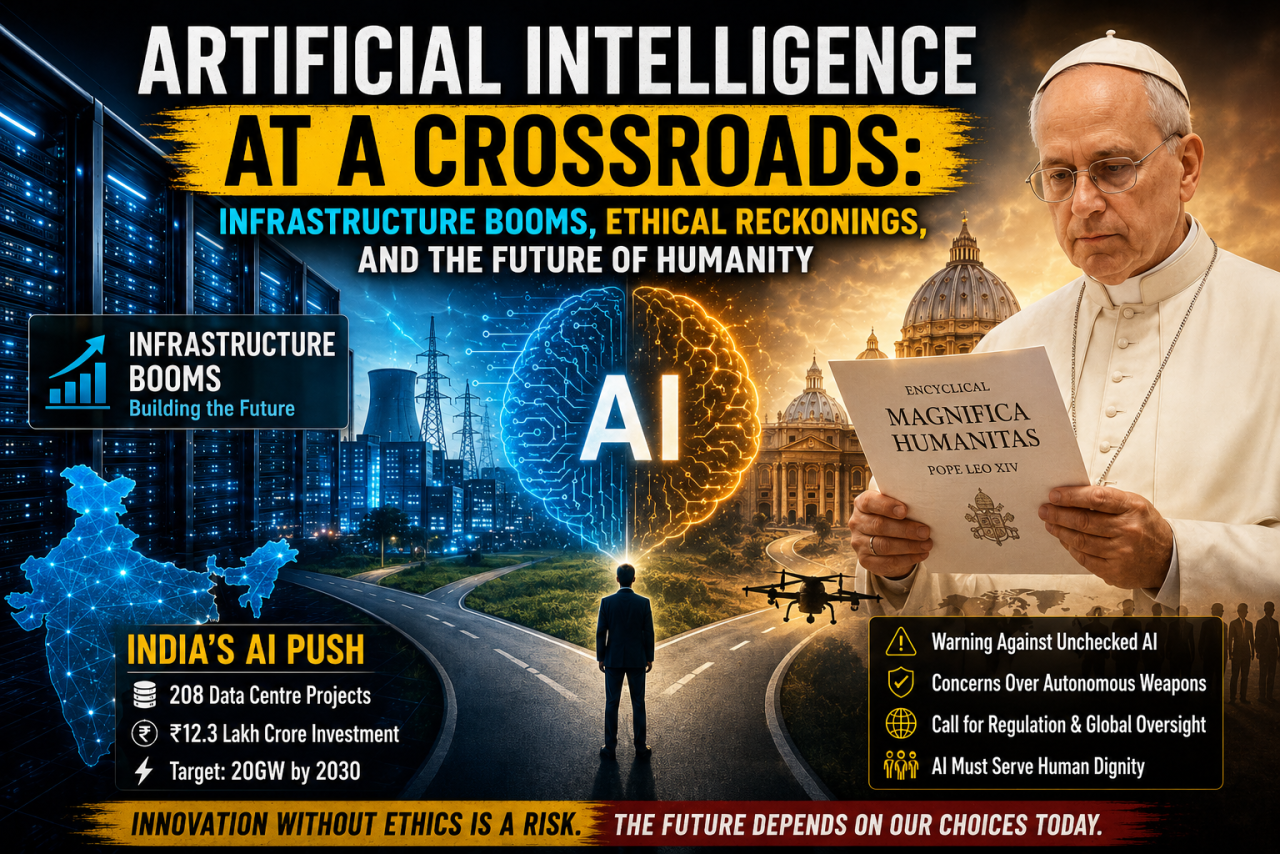
According to data compiled by the Centre for Monitoring Indian Economy (CMIE), around 208 data center projects are currently in the pipeline across the country. Together, these projects represent planned investments worth nearly ₹12.3 lakh crore. What makes this growth especially striking is its speed. More than 60% of the total proposed investment—approximately ₹7.6 lakh crore—was announced during the fiscal year 2026 alone, signaling a dramatic acceleration in AI-linked infrastructure expansion.
Several Indian states are positioning themselves as future AI hubs. Maharashtra currently leads with outstanding projects worth nearly ₹3.9 lakh crore, while Uttar Pradesh follows closely with approximately ₹2.54 lakh crore in planned investments. Developments such as the Greater Noida Hyperscale Hub reflect India’s ambition to become a major global digital infrastructure center.
At present, India operates roughly 1.5 gigawatts (GW) of data center capacity. However, ongoing projects aim to increase this figure to nearly 20GW by 2030. The expansion includes dozens of hyperscale facilities exceeding 100MW each, alongside several ultra-large projects expected to reach at least 1GW individually.
This transformation highlights how AI is becoming deeply tied to national economic strategy and digital sovereignty. Countries increasingly view control over computing power, data storage, and AI infrastructure as critical to future geopolitical influence.
However, the boom also exposes important economic contradictions.
While hyperscale data centers require enormous capital investments, they generate relatively limited long-term employment compared to traditional industries. A typical 1GW hyperscale facility may create only a few hundred permanent jobs for engineers, technicians, security personnel, and administrators.
Government officials argue that the broader ecosystem—including renewable energy systems, smart grids, cooling technologies, and logistics—could generate thousands of indirect opportunities in the coming years. Still, many investors remain cautious about whether infrastructure expansion alone can move India into the most profitable layers of the global AI economy, where advanced semiconductor manufacturing, proprietary AI models, and software platforms dominate value creation.
In other words, building the physical backbone of AI does not automatically guarantee leadership in the intelligence economy itself.
A Growing Ethical Warning
While nations and corporations compete to build AI infrastructure, a very different conversation is emerging from global moral and religious leaders.
One of the strongest recent warnings came from Pope Leo, who addressed the ethical dangers surrounding artificial intelligence in his first major encyclical, Magnifica Humanitas (“Magnificent Humanity”).
The document presents a powerful critique of uncontrolled technological expansion and calls on world leaders to establish strict safeguards around autonomous systems. According to the Pope, artificial intelligence must never evolve into a force that weakens human dignity or places critical decisions beyond meaningful human control.
Particular concern was expressed over autonomous weapons systems capable of operating without direct human intervention. The encyclical warns that such technologies could transform warfare into a dangerous and unpredictable domain where machines increasingly determine matters of life and death.
Beyond military concerns, the Vatican also criticized the concentration of AI power within a small number of private corporations. Pope Leo argued that leaving control of data, algorithms, and computational resources entirely in corporate hands could threaten workers’ rights, increase inequality, and intensify global instability.
Instead, the document called for stronger international regulations, independent oversight, and transparent governance frameworks capable of ensuring accountability in AI development.
What made the Vatican’s intervention especially significant was its historical framing. Alongside warnings about artificial intelligence, the Pope also acknowledged the Catholic Church’s past failures in confronting slavery and systems of human exploitation quickly enough. By drawing parallels between historical abuses of power and emerging technological risks, the encyclical suggested that humanity may once again be entering a period where unchecked systems could overpower moral judgment.
The warning reflects a growing global concern: technological capability is advancing faster than humanity’s ability to regulate it responsibly.
The Challenge Ahead
The world now stands at a critical crossroads.
On one side lies the undeniable promise of artificial intelligence. AI has the potential to revolutionize healthcare, scientific research, education, transportation, manufacturing, and economic productivity. Nations that fail to participate in this transformation risk falling behind in an increasingly digital global economy.
On the other side lies the equally serious danger of allowing technological expansion to outpace ethical oversight.
The massive data centers rising across countries like India symbolize far more than industrial growth. They represent the physical engines powering systems that may eventually influence employment, surveillance, warfare, political communication, and social behavior on a global scale.
This is why the future of AI cannot be measured solely through investment figures, computing capacity, or market valuations. The true test will be whether societies can build systems that remain accountable to human values rather than purely commercial or geopolitical interests.
Ultimately, artificial intelligence is not only a technological revolution. It is also a moral and civilizational challenge.
The choices governments, corporations, and global institutions make today may determine whether AI becomes a tool that strengthens humanity—or one that gradually weakens human control over its own future.
Artificial intelligence is no longer a futuristic concept confined to science fiction films or advanced research laboratories. It has rapidly evolved into one of the most powerful economic, political, and technological forces shaping the modern world. Governments, corporations, and investors are now racing to secure dominance in what many believe will define the next global era.
Yet the rise of artificial intelligence is unfolding through two very different but deeply connected realities. On one side stands an aggressive global push to build the massive physical infrastructure required to power AI systems. On the other side are growing moral and ethical concerns about how these technologies may reshape human society, labor, warfare, and even democracy itself.
Together, these parallel developments reveal one of the defining tensions of the 21st century: humanity’s struggle to balance technological progress with ethical responsibility.
India’s Expanding AI Infrastructure
Although AI is often discussed as a digital or “cloud-based” technology, its foundation is highly physical. Every advanced AI model depends on enormous data centers filled with servers, cooling systems, energy grids, and high-performance computing equipment. These facilities consume vast amounts of electricity and require massive financial investments.
India is now emerging as one of the major frontiers of this global infrastructure race.
According to data compiled by the Centre for Monitoring Indian Economy (CMIE), around 208 data center projects are currently in the pipeline across the country. Together, these projects represent planned investments worth nearly ₹12.3 lakh crore. What makes this growth especially striking is its speed. More than 60% of the total proposed investment—approximately ₹7.6 lakh crore—was announced during the fiscal year 2026 alone, signaling a dramatic acceleration in AI-linked infrastructure expansion.
Several Indian states are positioning themselves as future AI hubs. Maharashtra currently leads with outstanding projects worth nearly ₹3.9 lakh crore, while Uttar Pradesh follows closely with approximately ₹2.54 lakh crore in planned investments. Developments such as the Greater Noida Hyperscale Hub reflect India’s ambition to become a major global digital infrastructure center.
At present, India operates roughly 1.5 gigawatts (GW) of data center capacity. However, ongoing projects aim to increase this figure to nearly 20GW by 2030. The expansion includes dozens of hyperscale facilities exceeding 100MW each, alongside several ultra-large projects expected to reach at least 1GW individually.
This transformation highlights how AI is becoming deeply tied to national economic strategy and digital sovereignty. Countries increasingly view control over computing power, data storage, and AI infrastructure as critical to future geopolitical influence.
However, the boom also exposes important economic contradictions.
While hyperscale data centers require enormous capital investments, they generate relatively limited long-term employment compared to traditional industries. A typical 1GW hyperscale facility may create only a few hundred permanent jobs for engineers, technicians, security personnel, and administrators.
Government officials argue that the broader ecosystem—including renewable energy systems, smart grids, cooling technologies, and logistics—could generate thousands of indirect opportunities in the coming years. Still, many investors remain cautious about whether infrastructure expansion alone can move India into the most profitable layers of the global AI economy, where advanced semiconductor manufacturing, proprietary AI models, and software platforms dominate value creation.
In other words, building the physical backbone of AI does not automatically guarantee leadership in the intelligence economy itself.
A Growing Ethical Warning
While nations and corporations compete to build AI infrastructure, a very different conversation is emerging from global moral and religious leaders.
One of the strongest recent warnings came from Pope Leo, who addressed the ethical dangers surrounding artificial intelligence in his first major encyclical, Magnifica Humanitas (“Magnificent Humanity”).
The document presents a powerful critique of uncontrolled technological expansion and calls on world leaders to establish strict safeguards around autonomous systems. According to the Pope, artificial intelligence must never evolve into a force that weakens human dignity or places critical decisions beyond meaningful human control.
Particular concern was expressed over autonomous weapons systems capable of operating without direct human intervention. The encyclical warns that such technologies could transform warfare into a dangerous and unpredictable domain where machines increasingly determine matters of life and death.
Beyond military concerns, the Vatican also criticized the concentration of AI power within a small number of private corporations. Pope Leo argued that leaving control of data, algorithms, and computational resources entirely in corporate hands could threaten workers’ rights, increase inequality, and intensify global instability.
Instead, the document called for stronger international regulations, independent oversight, and transparent governance frameworks capable of ensuring accountability in AI development.
What made the Vatican’s intervention especially significant was its historical framing. Alongside warnings about artificial intelligence, the Pope also acknowledged the Catholic Church’s past failures in confronting slavery and systems of human exploitation quickly enough. By drawing parallels between historical abuses of power and emerging technological risks, the encyclical suggested that humanity may once again be entering a period where unchecked systems could overpower moral judgment.
The warning reflects a growing global concern: technological capability is advancing faster than humanity’s ability to regulate it responsibly.
The Challenge Ahead
The world now stands at a critical crossroads.
On one side lies the undeniable promise of artificial intelligence. AI has the potential to revolutionize healthcare, scientific research, education, transportation, manufacturing, and economic productivity. Nations that fail to participate in this transformation risk falling behind in an increasingly digital global economy.
On the other side lies the equally serious danger of allowing technological expansion to outpace ethical oversight.
The massive data centers rising across countries like India symbolize far more than industrial growth. They represent the physical engines powering systems that may eventually influence employment, surveillance, warfare, political communication, and social behavior on a global scale.
This is why the future of AI cannot be measured solely through investment figures, computing capacity, or market valuations. The true test will be whether societies can build systems that remain accountable to human values rather than purely commercial or geopolitical interests.
Ultimately, artificial intelligence is not only a technological revolution. It is also a moral and civilizational challenge.
The choices governments, corporations, and global institutions make today may determine whether AI becomes a tool that strengthens humanity—or one that gradually weakens human control over its own future.






















Leave a Comment