
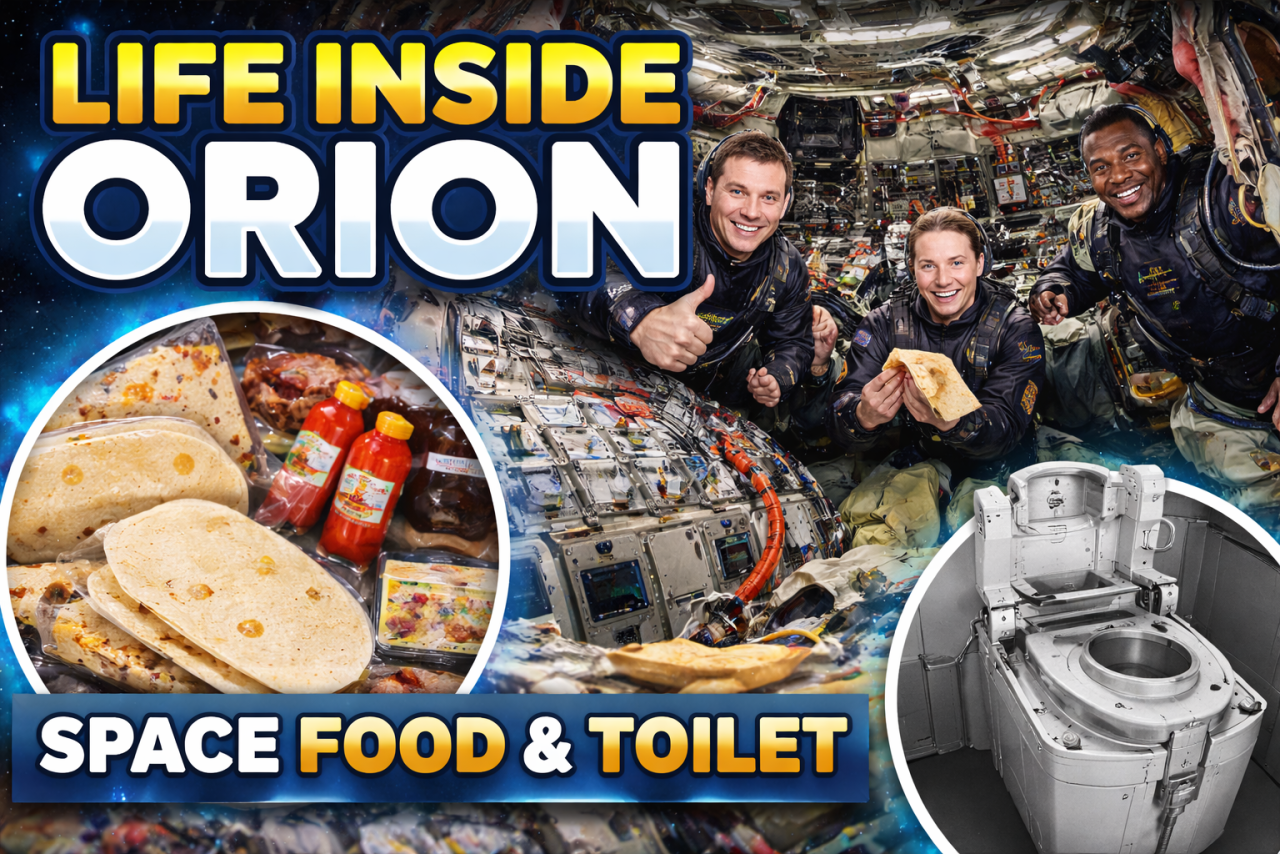
What does it really take to live beyond Earth? Inside Orion, survival is as much about tortillas and toilets as it is about technology.
As humanity prepares to return to the Moon, the spotlight often falls on rockets, propulsion systems, and billion-dollar engineering feats. Yet, a quieter story is unfolding inside the spacecraft itself—one that reveals how astronauts actually live, eat, sleep, and adapt during deep space missions. A recent glimpse into life aboard NASA’s Orion capsule offers exactly that perspective.
The details are surprisingly human.
Four astronauts aboard the Artemis II mission—the first crewed journey around the Moon in over 50 years—are carrying essentials that sound less like space-age tech and more like a carefully packed road trip kit: 58 tortillas, multiple hot sauces, coffee, and a single onboard toilet. It’s a mix that underscores a simple truth—space travel, no matter how advanced, still revolves around human needs.
Why Tortillas Beat Bread in Space
Tortillas have become a staple in space missions, and not by accident. Unlike bread, which produces crumbs that can float into sensitive equipment or be inhaled, tortillas are compact, durable, and mess-free. They’ve been a preferred choice since the days of the Space Shuttle, and their continued presence on Orion highlights how small decisions can have large operational impacts.
Food in space is not only nutrition but also psychological. Familiar tastes and small comforts can make a significant difference during long missions. That explains the inclusion of multiple hot sauces. In microgravity, bodily fluids shift upward, often dulling astronauts’ sense of taste. Strong flavors help compensate for that sensory change.
The Reality of Space Toilets
If food is about comfort, sanitation is about survival.
Orion’s single toilet has already drawn attention—not just for its limited availability but also for the technical challenges it represents. Managing human waste in microgravity is far from straightforward. Traditional plumbing doesn’t work in space, so systems rely on airflow and suction to guide waste into collection units.
Even then, things can go wrong.
Reports from the mission indicate that the toilet system initially faced issues, requiring attention from the crew and ground control. It’s a reminder that even the most advanced spacecraft can encounter basic, yet critical, challenges.
Compared to Apollo-era missions, where astronauts had to rely on rudimentary waste bags, Orion represents a significant step forward. Still, the constraints remain tight—privacy is minimal, and efficiency is essential.
Living in a Flying Capsule
The Orion spacecraft isn’t spacious. The four astronauts share a volume roughly equivalent to two minivans. Within that confined space, they eat, work, sleep, and conduct experiments.
Sleeping arrangements are equally pragmatic. Astronauts use sleeping bags tethered to the walls to prevent floating. There’s no “up” or “down” in microgravity, so orientation becomes irrelevant. What matters is stability and rest.
Daily routines are carefully structured. Beyond managing food and hygiene, the crew conducts system checks, communicates with mission control, and prepares for complex maneuvers, including a lunar flyby. Every action is scheduled, yet flexibility is crucial when unexpected issues arise—like a malfunctioning toilet or software glitches.
Technology Meets Human Endurance
The Artemis II mission is more than a technical demonstration; it’s a test of human adaptability. While Orion is equipped with advanced navigation, life-support, and communication systems, the mission’s success ultimately depends on how well astronauts can live and function in this environment.
This balance between cutting-edge technology and human resilience defines modern space exploration.
As NASA pushes toward longer missions—including potential journeys to Mars—the lessons from Orion will prove invaluable. How much food is enough? What systems are most prone to failure? How do astronauts maintain physical and mental well-being in confined spaces?
These are not abstract questions. They are being answered in real time, inside a spacecraft orbiting hundreds of thousands of kilometers from Earth.
A New Era, Grounded in Reality
The image of astronauts floating effortlessly through space often masks the complexity of their daily lives. Behind every milestone mission lies a series of practical challenges—what to eat, where to sleep, how to stay clean.
The story of Orion is not just about reaching the Moon again. It’s about understanding what it takes to live beyond Earth.
As missions grow longer and more ambitious, it’s these everyday challenges inside the spacecraft that will ultimately decide how far humans can travel in space.

























Leave a Comment