
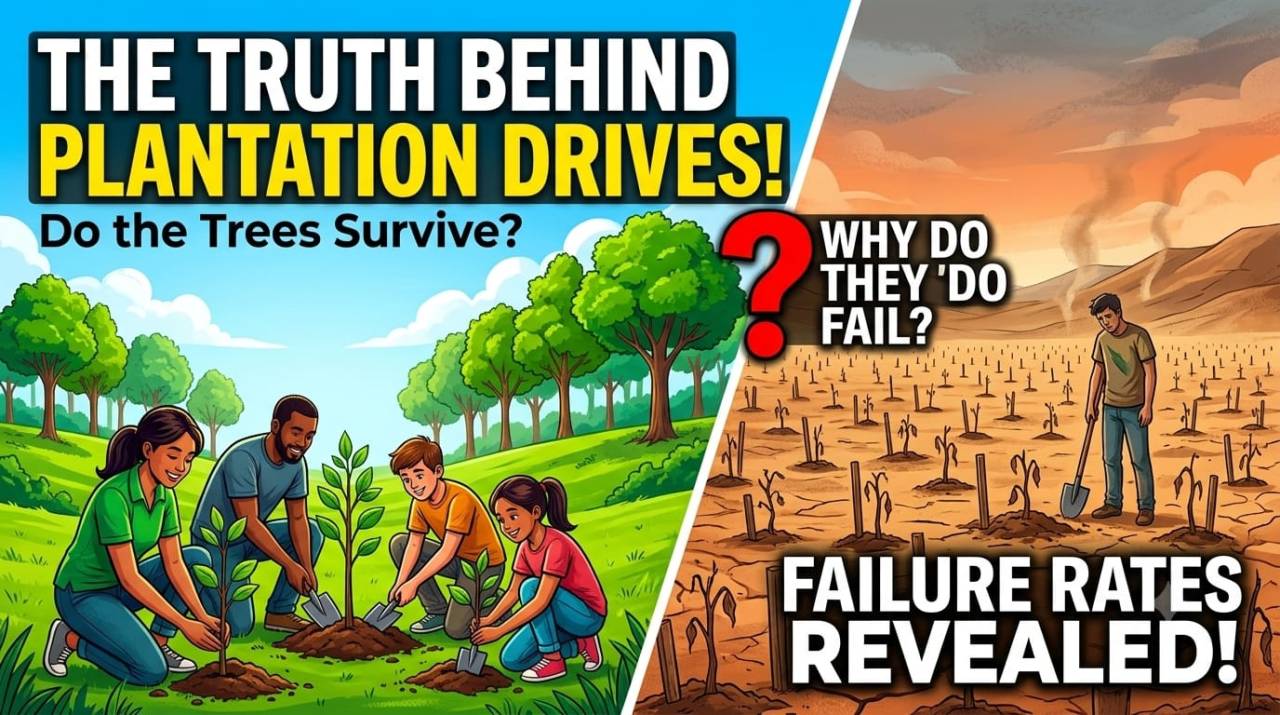
India plants crores of saplings every monsoon, yet millions never survive. If trees die within months, can record-breaking plantation drives truly help fight climate change?
Every monsoon, India witnesses a familiar spectacle. Politicians smile for the cameras, shovel in hand, holding a fragile green sapling. Headlines celebrate extraordinary achievements: thirty-five crore trees planted in a single state, one crore saplings planted in a day, or millions of seeds dispersed across vast landscapes. On paper, these campaigns appear to signal an environmental revolution. On the ground, however, they often reveal a different story. Planting a sapling is only the first step. The real measure of success is whether that sapling survives long enough to become a tree.
As climate change intensifies, India is among the countries facing some of its harshest consequences. Studies suggest that the country has warmed significantly faster than the global average in recent decades. Cities are experiencing prolonged heatwaves, urban heat islands are expanding, and seasonal weather patterns are becoming increasingly unpredictable.
To address these challenges, governments across the country have launched ambitious tree plantation campaigns. While the intent behind these initiatives is commendable, their implementation has increasingly become a race to achieve impressive numbers rather than lasting ecological outcomes.
The Illusion of Progress
Official figures present an encouraging picture. India has reported substantial gains in carbon sequestration through afforestation and tree plantation programmes, bringing the country closer to its climate commitments for 2030.
However, a closer examination raises important questions. Between 2013 and 2016, the Ministry of Statistics and Programme Implementation reported that approximately 434 crore seedlings were planted across forests and public lands. If even half of these saplings had survived, India would have witnessed an unprecedented expansion of healthy forest cover.
Independent field studies, court observations, and ecological assessments, however, suggest that survival rates are often far lower than official claims. While some states report survival rates exceeding 90 percent, ground-level assessments in many regions indicate survival rates ranging between 30 and 50 percent. In neglected plantation sites, survival can fall even further, leaving behind vast stretches where only a handful of saplings remain alive.
The result is a growing gap between plantation statistics and ecological reality.
Why So Many Saplings Fail
Growing a forest requires far more than planting a sapling. It demands scientific planning, continuous monitoring, and years of sustained care. Several structural challenges continue to undermine plantation drives.
Poor Site Selection
Saplings are frequently planted in unsuitable locations where soil quality, moisture levels, or ecological conditions cannot support their long-term growth. In many cases, species are introduced into landscapes where they are poorly adapted, significantly reducing their chances of survival.
Compromised Sapling Quality
The pressure to meet ambitious plantation targets often forces nurseries to produce enormous quantities of saplings within limited timeframes. This can affect plant quality, resulting in weak seedlings that struggle to withstand drought, pests, or extreme weather.
Neglect After Plantation
Most financial resources and public attention are concentrated on the plantation event itself. Once the ceremony concludes and media coverage ends, regular watering, weeding, fencing, and maintenance often receive inadequate funding. Without this critical support during the first few years, many young plants fail to survive.
Weak Accountability
Responsibility for plantation programmes is frequently shared among multiple government departments and local agencies. This fragmented structure dilutes accountability. Political pressure to achieve numerical targets often overrides scientific planning, while bureaucratic delays further reduce the effectiveness of plantation efforts.
Measuring Success the Right Way
India's plantation campaigns have largely been designed as seasonal events rather than long-term ecological investments. Public attention focuses on the number of saplings planted in a single day, while the far more important task of nurturing those saplings receives comparatively little attention.
If India is to strengthen its resilience against climate change and fulfil its Net Zero commitment by 2070, the country's approach to afforestation must evolve.
The true measure of success should not be the number of saplings planted, but the number of healthy trees that remain standing three, five, or even ten years later.
Achieving this shift requires long-term funding for maintenance, independent survival audits, widespread geotagging of plantation sites, transparent public reporting, and greater community participation in protecting newly planted trees.
Tree plantation drives remain an essential component of climate action. However, planting alone cannot create forests. Lasting environmental benefits will come only when equal importance is given to protecting, monitoring, and nurturing every sapling until it becomes part of a thriving ecosystem.
India's climate future will not be secured by record-breaking plantation numbers. It will be secured by living forests that continue to grow long after the cameras have left.
Every monsoon, India witnesses a familiar spectacle. Politicians smile for the cameras, shovel in hand, holding a fragile green sapling. Headlines celebrate extraordinary achievements: thirty-five crore trees planted in a single state, one crore saplings planted in a day, or millions of seeds dispersed across vast landscapes. On paper, these campaigns appear to signal an environmental revolution. On the ground, however, they often reveal a different story. Planting a sapling is only the first step. The real measure of success is whether that sapling survives long enough to become a tree.
As climate change intensifies, India is among the countries facing some of its harshest consequences. Studies suggest that the country has warmed significantly faster than the global average in recent decades. Cities are experiencing prolonged heatwaves, urban heat islands are expanding, and seasonal weather patterns are becoming increasingly unpredictable.
To address these challenges, governments across the country have launched ambitious tree plantation campaigns. While the intent behind these initiatives is commendable, their implementation has increasingly become a race to achieve impressive numbers rather than lasting ecological outcomes.
The Illusion of Progress
Official figures present an encouraging picture. India has reported substantial gains in carbon sequestration through afforestation and tree plantation programmes, bringing the country closer to its climate commitments for 2030.
However, a closer examination raises important questions. Between 2013 and 2016, the Ministry of Statistics and Programme Implementation reported that approximately 434 crore seedlings were planted across forests and public lands. If even half of these saplings had survived, India would have witnessed an unprecedented expansion of healthy forest cover.
Independent field studies, court observations, and ecological assessments, however, suggest that survival rates are often far lower than official claims. While some states report survival rates exceeding 90 percent, ground-level assessments in many regions indicate survival rates ranging between 30 and 50 percent. In neglected plantation sites, survival can fall even further, leaving behind vast stretches where only a handful of saplings remain alive.
The result is a growing gap between plantation statistics and ecological reality.
Why So Many Saplings Fail
Growing a forest requires far more than planting a sapling. It demands scientific planning, continuous monitoring, and years of sustained care. Several structural challenges continue to undermine plantation drives.
Poor Site Selection
Saplings are frequently planted in unsuitable locations where soil quality, moisture levels, or ecological conditions cannot support their long-term growth. In many cases, species are introduced into landscapes where they are poorly adapted, significantly reducing their chances of survival.
Compromised Sapling Quality
The pressure to meet ambitious plantation targets often forces nurseries to produce enormous quantities of saplings within limited timeframes. This can affect plant quality, resulting in weak seedlings that struggle to withstand drought, pests, or extreme weather.
Neglect After Plantation
Most financial resources and public attention are concentrated on the plantation event itself. Once the ceremony concludes and media coverage ends, regular watering, weeding, fencing, and maintenance often receive inadequate funding. Without this critical support during the first few years, many young plants fail to survive.
Weak Accountability
Responsibility for plantation programmes is frequently shared among multiple government departments and local agencies. This fragmented structure dilutes accountability. Political pressure to achieve numerical targets often overrides scientific planning, while bureaucratic delays further reduce the effectiveness of plantation efforts.
Measuring Success the Right Way
India's plantation campaigns have largely been designed as seasonal events rather than long-term ecological investments. Public attention focuses on the number of saplings planted in a single day, while the far more important task of nurturing those saplings receives comparatively little attention.
If India is to strengthen its resilience against climate change and fulfil its Net Zero commitment by 2070, the country's approach to afforestation must evolve.
The true measure of success should not be the number of saplings planted, but the number of healthy trees that remain standing three, five, or even ten years later.
Achieving this shift requires long-term funding for maintenance, independent survival audits, widespread geotagging of plantation sites, transparent public reporting, and greater community participation in protecting newly planted trees.
Tree plantation drives remain an essential component of climate action. However, planting alone cannot create forests. Lasting environmental benefits will come only when equal importance is given to protecting, monitoring, and nurturing every sapling until it becomes part of a thriving ecosystem.
India's climate future will not be secured by record-breaking plantation numbers. It will be secured by living forests that continue to grow long after the cameras have left.






















Leave a Comment