
Long before Earth had oceans, the universe already held vast seas. A colossal water reservoir near a distant quasar reveals that the story of life began far earlier—and farther—than we ever imagined.
The vastness of space holds secrets that challenge our comprehension, but none quite as baffling as the existence of a monumental water reserve at the dawn of the universe. Imagine an expanse of water vapor so immense it could fill Earth’s oceans 140 trillion times over. A group of astronomers, staring back 12 billion years to the edge of the known universe, made this mind-bending discovery. This is not just a tale of cosmic scales; it is a clue to the origin story of water, life’s most essential ingredient.
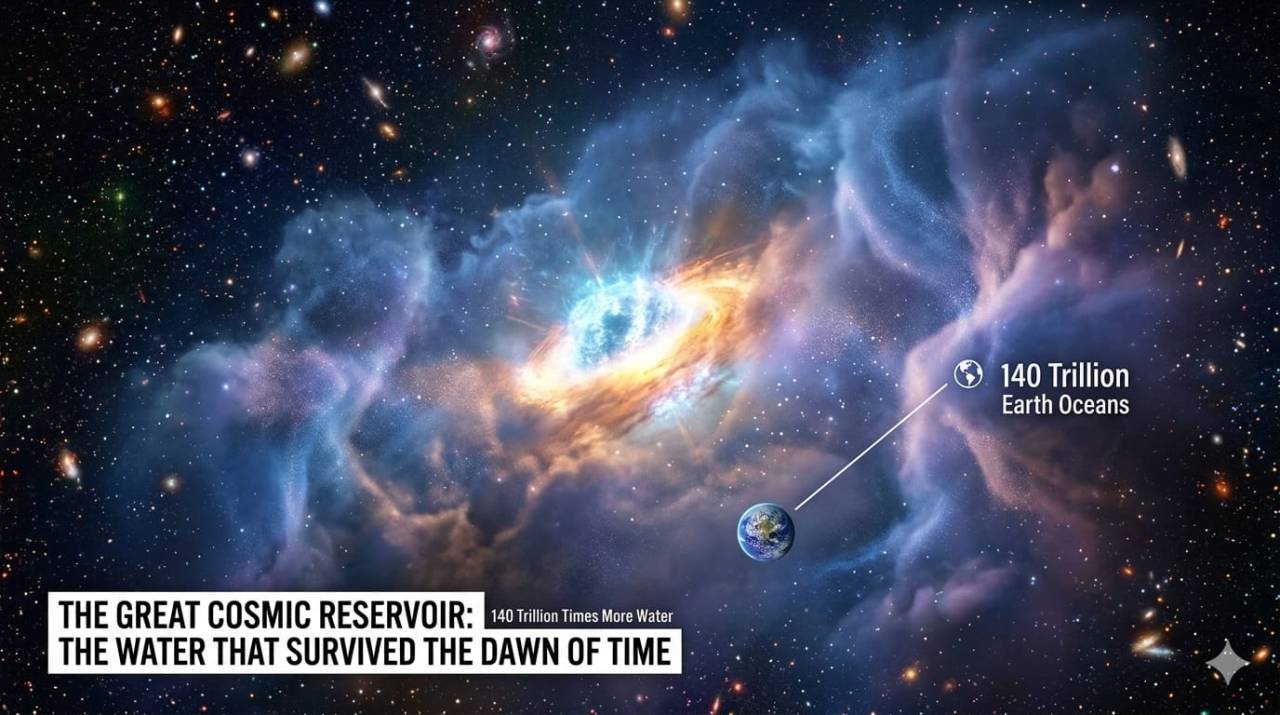
The discovery focuses on a powerful cosmic engine known as APM 08279+5255, a massive quasar—the brilliantly active, superheated core of a young galaxy. Quasar are powered by a central supermassive black hole that is slowly devouring surrounding gas and dust. This quasar, located about 12 billion light-years away, is one of the most luminous objects in the universe, radiating energy equivalent to a trillion Suns. It is around this extreme powerhouse that astronomers, using specialized telescopes sensitive to millimeter and submillimeter light, found the largest and farthest cosmic water reservoir ever detected.
The scale of this water cloud is impossible to fully grasp. The image in image_0.png presents the core facts: it's a "massive water cloud" with a volume that dwarfs Earth's entire water supply. But the environment of this water is equally extreme. The water is not a gentle sea. It exists as water vapor, or steam, in a state that is both incredibly hot and, by cosmic standards, extremely dense. It spreads out across hundreds of light-years, heated to temperatures of minus 63 degrees Fahrenheit (minus 53 degrees Celsius)—warm for space, though it sounds freezing. The cloud is bathed in the immense X-ray and infrared radiation blasting from the quasar, creating an almost unthinkably energetic and turbulent 'atmosphere.'
This water discovery offers a window into the conditions of the early universe, just 1.6 billion years after the Big Bang. It tells us that molecules of Water (H2O)—two hydrogen atoms and one oxygen atom—were forming and pooling in vast quantities relatively early on. We tend to think of water as unique to planets like Earth, but this finding proves that water is a primordial component of the cosmos. The very same H2O that we drink, that fills our seas, and that is essential to life on our planet, has existed in staggering amounts for nearly the entire history of the universe.
Furthermore, the existence of this water provides vital information about the quasar and its central supermassive black hole. The sheer volume of water vapor suggests that the galaxy is rich in "heavy" elements (like oxygen) and that the black hole is continuously fueling itself by consuming this gas. While the current quasar is immense, calculations suggest the central black hole (already 20 billion times more massive than the Sun) has enough surrounding material, including this water, to double or even triple in mass over its lifetime.
While this massive cloud could potentially consolidate and "rain" down, forming countless stars and planetary systems in the billions of years that have passed, it is key to remember the "time-machine" nature of astronomy. We are not seeing what this galaxy looks like today; we are seeing it as it was 12 billion years ago. The light we observe has traveled through billions of years of space to reach us, offering a unique opportunity to witness the formation of cosmic structures in their infancy.
This distant, primordial sea reminds us that our solar system and planet are not isolated, but are connected to the grandest and oldest processes in the cosmos. The water that sustains us has a lineage that dates back to the very dawn of time, proving that the universe is not a sterile expanse of rock and light, but a dynamic place with ancient chemical roots that made the formation of life possible.




























Leave a Comment