
As Delhi battles severe water shortages amid record heat and shrinking Yamuna flows, the crisis exposes deeper failures in urban planning, water management, and interstate cooperation.
A severe raw water deficit has plunged the national capital into an acute seasonal crisis, forcing millions of residents across central, northern, and western Delhi to contend with bone-dry taps and heavily disrupted municipal supplies. Driven by an unprecedented heatwave and a drastic drop in raw water arrivals from neighboring states, the capital’s total daily water output has plummeted to nearly 900 million gallons per day (MGD)—leaving a critical shortfall of over 100 MGD against the peak summer demand of approximately 1,002 MGD. The escalating crisis has triggered high-level emergency interventions within the Delhi government and prompted a risky, last-ditch diplomatic push to divert water from Haryana via alternative, untested canal networks.
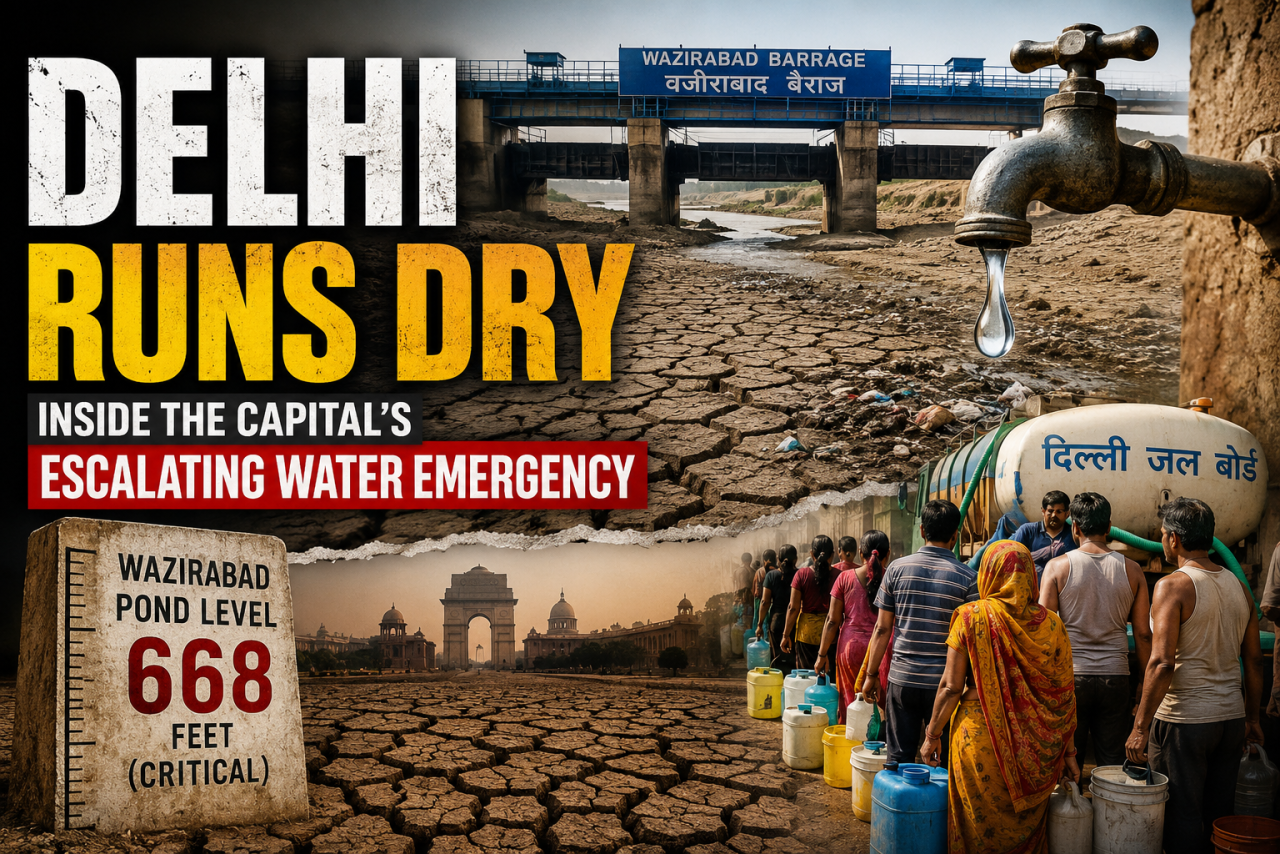
At the heart of the immediate collapse is the Wazirabad water treatment plant (WTP), one of the capital's oldest and most vital water treatment facilities. Run by the Delhi Jal Board (DJB), the plant is currently operating at barely half of its installed capacity. The pond level at the Wazirabad barrage, which normally hovers around a healthy baseline of 674.5 feet above sea level, has bottomed out to a near-historic low of approximately 668 feet. Officials state that once the water drops below the 668-foot threshold, there is virtually no usable water left for the plant’s massive intake lines to lift, rendering the machinery ineffective and leaving the riverbed exposed as dry, cracked earth.
The Anatomy of a Recurring Shortfall
The immediate trigger for the crisis is a sharp decline in the volume of raw water traveling down the Yamuna river channel from the Hathnikund barrage in Haryana. According to data obtained from the Haryana irrigation department, while a substantial volume of water is released upstream, the distribution remains highly constrained. Out of the water flowing through the system, over 2,155 cusecs are channeled into the Western Jamuna Canal (WJC), while only 352 cusecs are released directly into the mainstream Yamuna riverbed.
By the time this river water reaches Delhi, evaporation losses, local abstraction, and normal transit depletion reduce the flow significantly. Consequently, the Yamuna channel feeding Wazirabad has remained critically depleted. The DJB is currently receiving between 4,000 and 5,000 complaints daily regarding low water pressure, disrupted supply schedules, and contamination, as desperate residents run domestic booster pumps that inadvertently draw sewage or silt into empty pipeline networks.
In response, the Delhi administration has rolled out five immediate crisis-control measures:
- Emergency Riverbed Pumping: Specialized pumps have been installed directly into the Yamuna riverbed to extract pooled water, generating nearly 40 MGD to keep Wazirabad operational.
- Expanded Tanker Operations: A fleet of more than 980 DJB water tankers is now carrying out over 6,000 daily trips into affected colonies.
- Raw Water Diversion: Around 130 MGD of supply has been redirected from the Carrier Line Canal through the Twin Mains system.
- Borewell Expansion: New borewells in the Yamuna Khadar region are contributing an additional 10.5 MGD.
- Leakage Monitoring: Specialized teams have been deployed to reduce transit losses and address supply complaints.
The Somb Route: A High-Stakes Gamble
Faced with the prospect of a complete shutdown at both the Wazirabad and Chandrawal plants, Delhi has initiated an unconventional effort to secure additional water. Senior Delhi Jal Board officials have approached Haryana authorities seeking the diversion of part of the Western Jamuna Canal flow through the Somb river, a seasonal tributary of the Yamuna.
The proposal aims to bypass existing constraints and channel more water directly into the Yamuna upstream of Wazirabad. However, environmental experts have expressed concerns. Bhim Singh Rawat, coordinator of the South Asia Network on Dams, Rivers and People (SANDRP), argues that the Somb river’s porous, sandy riverbed could result in substantial transit losses. While a similar emergency release was arranged during the Chhath festival last year, sustaining a prolonged summer supply would require far greater volumes and continued cooperation between neighboring states.
CAG Report Highlights Deeper Structural Problems
While Delhi and Haryana remain locked in a familiar dispute over water allocations, a recent report by the Comptroller and Auditor General (CAG) suggests the current emergency is part of a broader pattern of systemic weakness.
The audit report, Functioning of the Delhi Jal Board, found that between 2017 and 2022, water levels at the Wazirabad barrage remained below the designated critical mark for 494 days. In effect, Delhi’s primary water source operated under deficit conditions for more than a quarter of that five-year period.
The report criticized authorities for failing to create durable solutions despite decades of recurring shortages and water-sharing disputes. It noted the absence of adequate storage infrastructure and insufficient progress toward alternative water sources capable of reducing the city’s dependence on seasonal river flows.
Emergency Measures and the Road Ahead
As public frustration grows, Delhi’s Chief Minister has convened high-level review meetings involving senior officials from the Delhi Jal Board and the state government. Emergency protocols remain in force, with tanker deployments, riverbed pumping, and diversion projects serving as temporary lifelines.
At the same time, the government has announced several longer-term initiatives. These include commissioning the Indian Institute of Technology (IIT) Roorkee to study the feasibility of a dedicated pipeline network from Haryana, expanding dredging and de-silting operations around the Wazirabad reservoir to improve storage capacity, and increasing the use of highly treated recycled wastewater for non-potable urban needs.
For millions of Delhi residents enduring long queues behind water tankers and uncertain supply schedules, however, long-term plans offer little immediate comfort. The city’s water security in the coming weeks may depend less on engineering solutions and more on whether neighboring states can set aside political differences and ensure sufficient water reaches a capital struggling to keep its taps flowing.
A severe raw water deficit has plunged the national capital into an acute seasonal crisis, forcing millions of residents across central, northern, and western Delhi to contend with bone-dry taps and heavily disrupted municipal supplies. Driven by an unprecedented heatwave and a drastic drop in raw water arrivals from neighboring states, the capital’s total daily water output has plummeted to nearly 900 million gallons per day (MGD)—leaving a critical shortfall of over 100 MGD against the peak summer demand of approximately 1,002 MGD. The escalating crisis has triggered high-level emergency interventions within the Delhi government and prompted a risky, last-ditch diplomatic push to divert water from Haryana via alternative, untested canal networks.
At the heart of the immediate collapse is the Wazirabad water treatment plant (WTP), one of the capital's oldest and most vital water treatment facilities. Run by the Delhi Jal Board (DJB), the plant is currently operating at barely half of its installed capacity. The pond level at the Wazirabad barrage, which normally hovers around a healthy baseline of 674.5 feet above sea level, has bottomed out to a near-historic low of approximately 668 feet. Officials state that once the water drops below the 668-foot threshold, there is virtually no usable water left for the plant’s massive intake lines to lift, rendering the machinery ineffective and leaving the riverbed exposed as dry, cracked earth.
The Anatomy of a Recurring Shortfall
The immediate trigger for the crisis is a sharp decline in the volume of raw water traveling down the Yamuna river channel from the Hathnikund barrage in Haryana. According to data obtained from the Haryana irrigation department, while a substantial volume of water is released upstream, the distribution remains highly constrained. Out of the water flowing through the system, over 2,155 cusecs are channeled into the Western Jamuna Canal (WJC), while only 352 cusecs are released directly into the mainstream Yamuna riverbed.
By the time this river water reaches Delhi, evaporation losses, local abstraction, and normal transit depletion reduce the flow significantly. Consequently, the Yamuna channel feeding Wazirabad has remained critically depleted. The DJB is currently receiving between 4,000 and 5,000 complaints daily regarding low water pressure, disrupted supply schedules, and contamination, as desperate residents run domestic booster pumps that inadvertently draw sewage or silt into empty pipeline networks.
In response, the Delhi administration has rolled out five immediate crisis-control measures:
- Emergency Riverbed Pumping: Specialized pumps have been installed directly into the Yamuna riverbed to extract pooled water, generating nearly 40 MGD to keep Wazirabad operational.
- Expanded Tanker Operations: A fleet of more than 980 DJB water tankers is now carrying out over 6,000 daily trips into affected colonies.
- Raw Water Diversion: Around 130 MGD of supply has been redirected from the Carrier Line Canal through the Twin Mains system.
- Borewell Expansion: New borewells in the Yamuna Khadar region are contributing an additional 10.5 MGD.
- Leakage Monitoring: Specialized teams have been deployed to reduce transit losses and address supply complaints.
The Somb Route: A High-Stakes Gamble
Faced with the prospect of a complete shutdown at both the Wazirabad and Chandrawal plants, Delhi has initiated an unconventional effort to secure additional water. Senior Delhi Jal Board officials have approached Haryana authorities seeking the diversion of part of the Western Jamuna Canal flow through the Somb river, a seasonal tributary of the Yamuna.
The proposal aims to bypass existing constraints and channel more water directly into the Yamuna upstream of Wazirabad. However, environmental experts have expressed concerns. Bhim Singh Rawat, coordinator of the South Asia Network on Dams, Rivers and People (SANDRP), argues that the Somb river’s porous, sandy riverbed could result in substantial transit losses. While a similar emergency release was arranged during the Chhath festival last year, sustaining a prolonged summer supply would require far greater volumes and continued cooperation between neighboring states.
CAG Report Highlights Deeper Structural Problems
While Delhi and Haryana remain locked in a familiar dispute over water allocations, a recent report by the Comptroller and Auditor General (CAG) suggests the current emergency is part of a broader pattern of systemic weakness.
The audit report, Functioning of the Delhi Jal Board, found that between 2017 and 2022, water levels at the Wazirabad barrage remained below the designated critical mark for 494 days. In effect, Delhi’s primary water source operated under deficit conditions for more than a quarter of that five-year period.
The report criticized authorities for failing to create durable solutions despite decades of recurring shortages and water-sharing disputes. It noted the absence of adequate storage infrastructure and insufficient progress toward alternative water sources capable of reducing the city’s dependence on seasonal river flows.
Emergency Measures and the Road Ahead
As public frustration grows, Delhi’s Chief Minister has convened high-level review meetings involving senior officials from the Delhi Jal Board and the state government. Emergency protocols remain in force, with tanker deployments, riverbed pumping, and diversion projects serving as temporary lifelines.
At the same time, the government has announced several longer-term initiatives. These include commissioning the Indian Institute of Technology (IIT) Roorkee to study the feasibility of a dedicated pipeline network from Haryana, expanding dredging and de-silting operations around the Wazirabad reservoir to improve storage capacity, and increasing the use of highly treated recycled wastewater for non-potable urban needs.
For millions of Delhi residents enduring long queues behind water tankers and uncertain supply schedules, however, long-term plans offer little immediate comfort. The city’s water security in the coming weeks may depend less on engineering solutions and more on whether neighboring states can set aside political differences and ensure sufficient water reaches a capital struggling to keep its taps flowing.




















Leave a Comment