
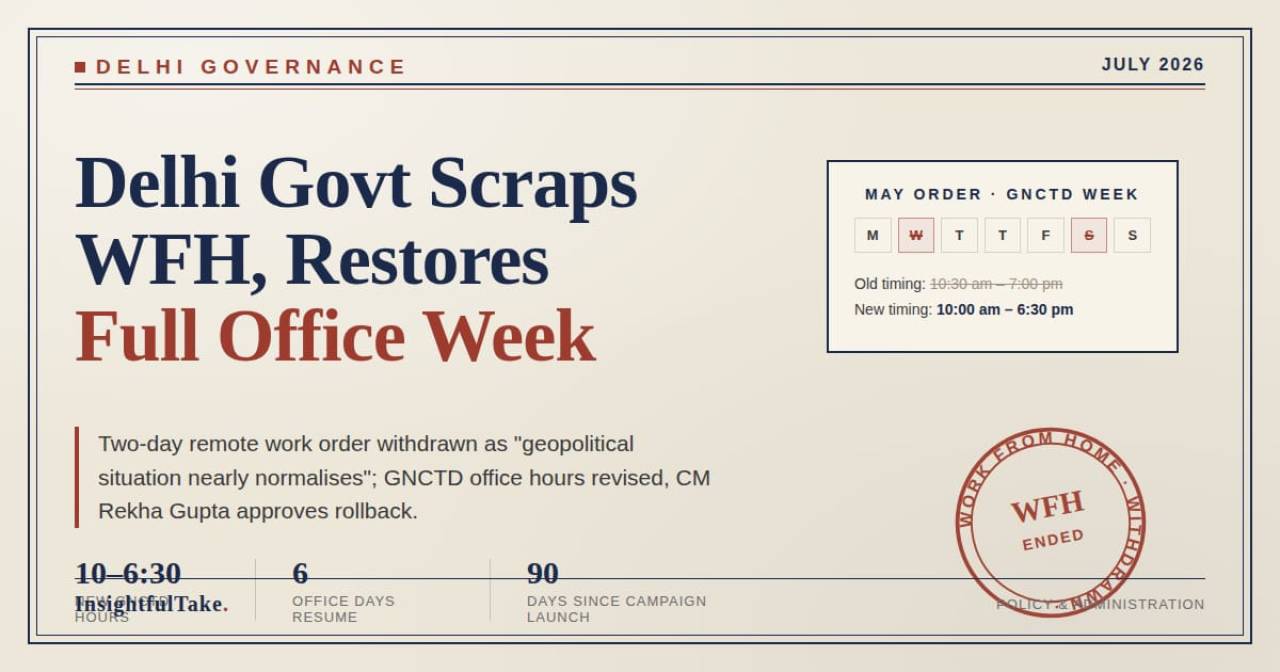
Delhi government ends its two-day work-from-home policy, restores six-day office attendance, and revises office timings as authorities say the geopolitical situation has largely returned to normal.
The Delhi government has ended the two-day work-from-home (WFH) arrangement it had introduced for its employees, bringing most departments back to full-time office attendance. Officials said the decision followed an assessment that the geopolitical situation, which had prompted the original policy, has "nearly normalised." Chief Minister Rekha Gupta has approved the rollback.
The WFH system, applicable on Wednesdays and Saturdays, was introduced in May for employees across departments under the Government of National Capital Territory of Delhi (GNCTD). With its withdrawal, office timings have also been revised. Staff will now report from 10:00 am to 6:30 pm, a marginally shorter day than the earlier 10:30 am to 7:00 pm schedule, though it restores full six-day attendance. The Municipal Corporation of Delhi (MCD), which was not part of the WFH arrangement, will continue with its existing timing of 8:30 am to 5:00 pm.
The now-discontinued policy was one part of a wider, 90-day initiative called "Mera Bharat, Mera Yogdan," launched after Prime Minister Narendra Modi called on citizens and government bodies to conserve fuel, consume more responsibly, and support domestically manufactured products. The campaign was rolled out at a time of heightened geopolitical tension, when reducing non-essential travel and fuel consumption was treated as a matter of policy priority rather than convenience.
Beyond the WFH order, the campaign carried several other measures that reflected the same conservation logic. Every Monday was designated "Metro Monday," encouraging government staff to use public transport instead of private vehicles. Official fuel allowances were cut by up to 20 percent, a direct move to reduce discretionary travel within departments. Office timings were staggered across departments, a common strategy to reduce simultaneous traffic load during peak hours. Foreign visits by officials were curtailed for a year, and departments were instructed that half of all official meetings should be conducted online rather than in person. Essential services remained outside the ambit of these restrictions throughout, as departments handling emergency response, health, or law and order could not function on a reduced-attendance model.
Read together, these measures suggest the WFH order was never intended to be a permanent shift in how the Delhi government functions, but rather a temporary conservation tool tied to a specific external situation. Its withdrawal, therefore, is less a policy reversal than a signal that the government considers the triggering conditions to have eased. Whether the other components of the campaign—Metro Monday, the fuel allowance cut, staggered timings, and reduced foreign travel—will also be wound down has not been indicated in the current order, which addresses only the two-day WFH system and office hours.
For government employees, the immediate effect is straightforward: six-day office attendance resumes, with a slightly shorter working day compensating for the loss of the two remote days. For citizens who interact with government offices, particularly those dependent on in-person services at GNCTD departments, the return to full attendance is likely to mean better availability of staff on the days that were previously affected. It also removes a point of inconsistency that had existed between GNCTD offices, which followed the WFH schedule, and MCD offices, which did not, and may have caused confusion for people requiring services from both bodies within the same week.
The larger context worth noting is that this is one of the more visible instances of a state government tying its internal administrative practices directly to a national appeal around fuel and resource conservation. How long such measures last, and how readily they are reversed once conditions change, may offer some indication of how administratively binding such appeals turn out to be in practice.
The Delhi government has ended the two-day work-from-home (WFH) arrangement it had introduced for its employees, bringing most departments back to full-time office attendance. Officials said the decision followed an assessment that the geopolitical situation, which had prompted the original policy, has "nearly normalised." Chief Minister Rekha Gupta has approved the rollback.
The WFH system, applicable on Wednesdays and Saturdays, was introduced in May for employees across departments under the Government of National Capital Territory of Delhi (GNCTD). With its withdrawal, office timings have also been revised. Staff will now report from 10:00 am to 6:30 pm, a marginally shorter day than the earlier 10:30 am to 7:00 pm schedule, though it restores full six-day attendance. The Municipal Corporation of Delhi (MCD), which was not part of the WFH arrangement, will continue with its existing timing of 8:30 am to 5:00 pm.
The now-discontinued policy was one part of a wider, 90-day initiative called "Mera Bharat, Mera Yogdan," launched after Prime Minister Narendra Modi called on citizens and government bodies to conserve fuel, consume more responsibly, and support domestically manufactured products. The campaign was rolled out at a time of heightened geopolitical tension, when reducing non-essential travel and fuel consumption was treated as a matter of policy priority rather than convenience.
Beyond the WFH order, the campaign carried several other measures that reflected the same conservation logic. Every Monday was designated "Metro Monday," encouraging government staff to use public transport instead of private vehicles. Official fuel allowances were cut by up to 20 percent, a direct move to reduce discretionary travel within departments. Office timings were staggered across departments, a common strategy to reduce simultaneous traffic load during peak hours. Foreign visits by officials were curtailed for a year, and departments were instructed that half of all official meetings should be conducted online rather than in person. Essential services remained outside the ambit of these restrictions throughout, as departments handling emergency response, health, or law and order could not function on a reduced-attendance model.
Read together, these measures suggest the WFH order was never intended to be a permanent shift in how the Delhi government functions, but rather a temporary conservation tool tied to a specific external situation. Its withdrawal, therefore, is less a policy reversal than a signal that the government considers the triggering conditions to have eased. Whether the other components of the campaign—Metro Monday, the fuel allowance cut, staggered timings, and reduced foreign travel—will also be wound down has not been indicated in the current order, which addresses only the two-day WFH system and office hours.
For government employees, the immediate effect is straightforward: six-day office attendance resumes, with a slightly shorter working day compensating for the loss of the two remote days. For citizens who interact with government offices, particularly those dependent on in-person services at GNCTD departments, the return to full attendance is likely to mean better availability of staff on the days that were previously affected. It also removes a point of inconsistency that had existed between GNCTD offices, which followed the WFH schedule, and MCD offices, which did not, and may have caused confusion for people requiring services from both bodies within the same week.
The larger context worth noting is that this is one of the more visible instances of a state government tying its internal administrative practices directly to a national appeal around fuel and resource conservation. How long such measures last, and how readily they are reversed once conditions change, may offer some indication of how administratively binding such appeals turn out to be in practice.























Leave a Comment