
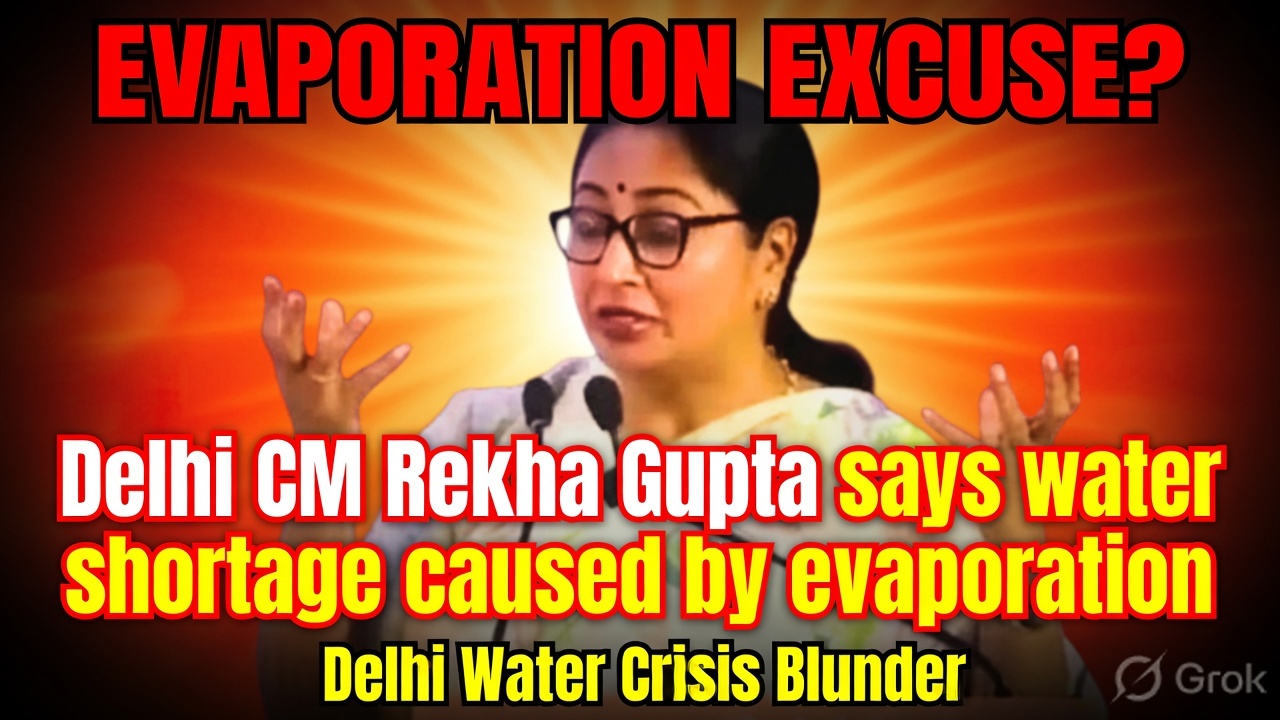
A viral remark by Delhi Chief Minister Rekha Gupta has reignited debate over the capital’s water crisis, shifting attention to the deeper challenges of aging infrastructure, supply shortages, and long-term water security.
A recent remark by Delhi Chief Minister Rekha Gupta on the capital’s water shortage has triggered widespread discussion, drawing attention not only to her comments but also to the deeper and long-standing challenges facing Delhi’s water supply system.
Speaking at a public event on June 4, Gupta said that extreme summer temperatures contribute to water losses because some water “evaporates on the way” during distribution. A video clip of the statement quickly circulated on social media, prompting criticism from opposition leaders and sparking debate among citizens already grappling with water shortages amid an intense heatwave.
While experts acknowledge that evaporation can contribute to water loss, the controversy has shifted focus toward a larger question: what are the primary causes of Delhi’s recurring water crisis, and what solutions are needed to address them?
A City Under Water Stress
Delhi, home to more than 20 million residents, has faced water-related challenges for decades. Demand consistently outpaces supply, particularly during the summer months when consumption rises sharply and water levels in key sources decline.
The city depends heavily on the Yamuna River, groundwater reserves, and water supplied through inter-state agreements. However, several factors continue to strain the system:
- Aging pipelines and distribution networks that lead to significant leakage losses.
- Rapid urbanization and population growth.
- Over-extraction of groundwater.
- Pollution in water sources, especially the Yamuna.
- Seasonal fluctuations in river flow and reservoir levels.
- Uneven distribution of water across different neighborhoods.
According to water management experts, evaporation does occur in reservoirs, canals, and exposed sections of distribution systems, particularly during periods of extreme heat. However, it is generally considered only one component of overall water loss, with infrastructure leakages and distribution inefficiencies often accounting for a much larger share.
The Politics of a Viral Soundbite
The debate surrounding Gupta’s remark demonstrates how quickly public communication can become a political issue in the age of social media. Short video clips often spread faster than detailed policy explanations, shaping public perception before broader context emerges.
Supporters of the Chief Minister argue that her comments were part of a wider discussion that also referenced low water levels, infrastructure challenges, and ongoing efforts by the government to manage supply during peak summer demand. They contend that focusing solely on a brief clip oversimplifies the broader message.
Critics, however, argue that the statement appeared to place undue emphasis on evaporation while failing to adequately address the structural causes of the crisis. For many residents facing irregular supply, long waits for tanker deliveries, or dependence on private water vendors, the controversy reflects broader frustrations with water management in the capital.
The Real Challenges Behind Delhi’s Water Crisis
The larger issue extends far beyond a single statement.
Water experts have long highlighted the need for substantial investments in infrastructure modernization. Significant volumes of treated water are believed to be lost before reaching consumers due to leakage, illegal connections, and inefficiencies in the distribution network.
Environmental concerns also play a major role. The Yamuna, one of Delhi’s principal water sources, continues to face severe pollution challenges. Contamination can affect treatment operations and place additional pressure on already stretched resources.
Climate change further complicates the situation. Rising temperatures, unpredictable rainfall patterns, and more frequent heatwaves increase demand while putting greater stress on available supplies.
At the same time, unauthorized urban expansion and shrinking natural water bodies have reduced the city's ability to recharge groundwater and store rainwater effectively.
Moving From Debate to Solutions
The controversy has renewed public attention on what many experts consider one of Delhi’s most urgent governance challenges.
Among the measures frequently recommended by urban planners and water specialists are:
- Accelerating replacement of aging pipelines to reduce leakage.
- Expanding rainwater harvesting systems across residential and commercial areas.
- Reviving lakes, ponds, and other traditional water bodies.
- Strengthening groundwater recharge initiatives.
- Improving wastewater treatment and water recycling capacity.
- Enhancing transparency through regular public reporting on supply, losses, and infrastructure projects.
- Promoting water conservation through public awareness campaigns and smart metering technologies.
Experts also emphasize the importance of cooperation between Delhi and neighboring states, given the city’s dependence on shared water resources.
A Debate Larger Than One Remark
The discussion sparked by Rekha Gupta’s comment illustrates how a single statement can become a focal point for broader public concerns. Whether viewed as a communication misstep or a remark taken out of context, the controversy has highlighted the urgent need to address the underlying issues that continue to affect millions of Delhi residents.
As another challenging summer unfolds, the central question remains unchanged: how can Delhi build a more reliable, efficient, and sustainable water system for the future?
For citizens dealing with water shortages, infrastructure failures, and rising temperatures, the answer will matter far more than any viral soundbite.
A recent remark by Delhi Chief Minister Rekha Gupta on the capital’s water shortage has triggered widespread discussion, drawing attention not only to her comments but also to the deeper and long-standing challenges facing Delhi’s water supply system.
Speaking at a public event on June 4, Gupta said that extreme summer temperatures contribute to water losses because some water “evaporates on the way” during distribution. A video clip of the statement quickly circulated on social media, prompting criticism from opposition leaders and sparking debate among citizens already grappling with water shortages amid an intense heatwave.
While experts acknowledge that evaporation can contribute to water loss, the controversy has shifted focus toward a larger question: what are the primary causes of Delhi’s recurring water crisis, and what solutions are needed to address them?
A City Under Water Stress
Delhi, home to more than 20 million residents, has faced water-related challenges for decades. Demand consistently outpaces supply, particularly during the summer months when consumption rises sharply and water levels in key sources decline.
The city depends heavily on the Yamuna River, groundwater reserves, and water supplied through inter-state agreements. However, several factors continue to strain the system:
- Aging pipelines and distribution networks that lead to significant leakage losses.
- Rapid urbanization and population growth.
- Over-extraction of groundwater.
- Pollution in water sources, especially the Yamuna.
- Seasonal fluctuations in river flow and reservoir levels.
- Uneven distribution of water across different neighborhoods.
According to water management experts, evaporation does occur in reservoirs, canals, and exposed sections of distribution systems, particularly during periods of extreme heat. However, it is generally considered only one component of overall water loss, with infrastructure leakages and distribution inefficiencies often accounting for a much larger share.
The Politics of a Viral Soundbite
The debate surrounding Gupta’s remark demonstrates how quickly public communication can become a political issue in the age of social media. Short video clips often spread faster than detailed policy explanations, shaping public perception before broader context emerges.
Supporters of the Chief Minister argue that her comments were part of a wider discussion that also referenced low water levels, infrastructure challenges, and ongoing efforts by the government to manage supply during peak summer demand. They contend that focusing solely on a brief clip oversimplifies the broader message.
Critics, however, argue that the statement appeared to place undue emphasis on evaporation while failing to adequately address the structural causes of the crisis. For many residents facing irregular supply, long waits for tanker deliveries, or dependence on private water vendors, the controversy reflects broader frustrations with water management in the capital.
The Real Challenges Behind Delhi’s Water Crisis
The larger issue extends far beyond a single statement.
Water experts have long highlighted the need for substantial investments in infrastructure modernization. Significant volumes of treated water are believed to be lost before reaching consumers due to leakage, illegal connections, and inefficiencies in the distribution network.
Environmental concerns also play a major role. The Yamuna, one of Delhi’s principal water sources, continues to face severe pollution challenges. Contamination can affect treatment operations and place additional pressure on already stretched resources.
Climate change further complicates the situation. Rising temperatures, unpredictable rainfall patterns, and more frequent heatwaves increase demand while putting greater stress on available supplies.
At the same time, unauthorized urban expansion and shrinking natural water bodies have reduced the city's ability to recharge groundwater and store rainwater effectively.
Moving From Debate to Solutions
The controversy has renewed public attention on what many experts consider one of Delhi’s most urgent governance challenges.
Among the measures frequently recommended by urban planners and water specialists are:
- Accelerating replacement of aging pipelines to reduce leakage.
- Expanding rainwater harvesting systems across residential and commercial areas.
- Reviving lakes, ponds, and other traditional water bodies.
- Strengthening groundwater recharge initiatives.
- Improving wastewater treatment and water recycling capacity.
- Enhancing transparency through regular public reporting on supply, losses, and infrastructure projects.
- Promoting water conservation through public awareness campaigns and smart metering technologies.
Experts also emphasize the importance of cooperation between Delhi and neighboring states, given the city’s dependence on shared water resources.
A Debate Larger Than One Remark
The discussion sparked by Rekha Gupta’s comment illustrates how a single statement can become a focal point for broader public concerns. Whether viewed as a communication misstep or a remark taken out of context, the controversy has highlighted the urgent need to address the underlying issues that continue to affect millions of Delhi residents.
As another challenging summer unfolds, the central question remains unchanged: how can Delhi build a more reliable, efficient, and sustainable water system for the future?
For citizens dealing with water shortages, infrastructure failures, and rising temperatures, the answer will matter far more than any viral soundbite.















Leave a Comment