
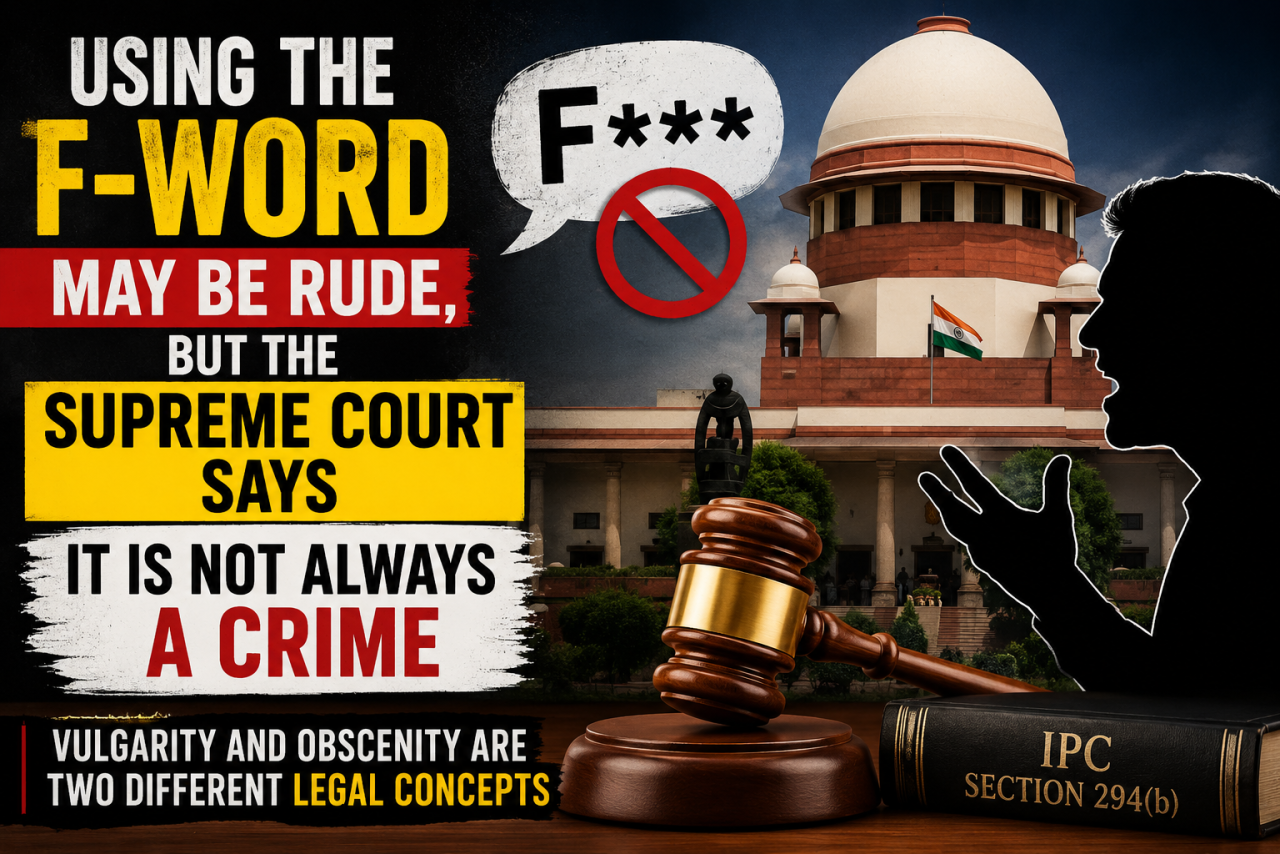
Can using the F-word land you in jail? The Supreme Court says not necessarily, drawing a crucial legal distinction between offensive language and criminal obscenity.
The Supreme Court has ruled that vulgar or offensive language is not automatically obscene under Indian law. A bench comprising Justice Sanjay Karol and Justice Vipul M. Pancholi held that vulgarity and obscenity are distinct legal concepts. Merely using coarse or abusive words during a heated exchange does not, by itself, attract criminal liability under Section 294(b) of the Indian Penal Code.
The ruling came while the court was hearing an appeal filed by Mani, who had been convicted by courts in Tamil Nadu after a violent altercation with a relative. During the dispute, Mani allegedly attacked the complainant with a billhook, a sharp agricultural tool, causing injuries that included a fractured nasal bone. He was convicted under Section 326 of the IPC for causing grievous hurt with a dangerous weapon and under Section 294(b) for using obscene language.
While upholding his conviction for causing grievous injuries, the Supreme Court set aside the conviction under Section 294(b). According to the prosecution, the altercation stemmed from a property dispute during which Mani allegedly used the English "F-word" while abusing the complainant.
The bench observed that criminal law does not punish every crude, rude, or insulting expression. For speech to qualify as an offence under Section 294(b), it must be shown that the words were lascivious or capable of depraving and corrupting the minds of those exposed to them. In other words, offensive language alone is insufficient. The expression must appeal to prurient interests or contain sexually degrading content.
Reiterating principles laid down in earlier judgments, the court clarified that obscenity laws are not intended to criminalise every offensive or uncivil remark. The bench observed:
"For an utterance to be considered obscene, it must be shown that it was lascivious or likely to deprave and corrupt people in an unpleasant manner by referring to sex or the human body in an unnecessarily insulting or offensive manner."
The judges further noted that although the F-word is undeniably offensive and abusive, profanity alone does not meet the legal threshold for obscenity. The judgment draws a clear distinction between obscene speech, which is punishable under the law, and vulgar or offensive speech, which may be socially unacceptable but is not necessarily a criminal offence.
To reinforce its reasoning, the bench referred to the 2024 judgment in the Apoorva Arora vs State (NCT of Delhi) case. In that decision, the Supreme Court held that words expressing anger, disgust, or revulsion may provoke strong reactions but do not, by themselves, amount to obscenity. Crude, uncivil, or unpleasant language does not satisfy the legal requirements of Section 294(b), the court reiterated.
The Madras High Court had earlier upheld Mani's conviction on both counts. On appeal, however, the Supreme Court partly allowed his plea, retaining the conviction for causing grievous hurt while setting aside the conviction for obscenity.
The judgment provides important clarity on the legal boundary between abusive language and criminal obscenity. Disputes involving heated exchanges and foul language frequently reach the courts, and this ruling establishes that offensive speech is not automatically punishable unless it crosses the higher legal threshold of obscenity.
For ordinary citizens, the message is clear. Losing one's temper and using foul language during an argument may be impolite and socially unacceptable, but it does not automatically constitute a criminal offence of obscenity. At the same time, the judgment does not provide immunity for sexually explicit, lascivious, or degrading expressions, which continue to remain punishable under the law.
The Supreme Court has ruled that vulgar or offensive language is not automatically obscene under Indian law. A bench comprising Justice Sanjay Karol and Justice Vipul M. Pancholi held that vulgarity and obscenity are distinct legal concepts. Merely using coarse or abusive words during a heated exchange does not, by itself, attract criminal liability under Section 294(b) of the Indian Penal Code.
The ruling came while the court was hearing an appeal filed by Mani, who had been convicted by courts in Tamil Nadu after a violent altercation with a relative. During the dispute, Mani allegedly attacked the complainant with a billhook, a sharp agricultural tool, causing injuries that included a fractured nasal bone. He was convicted under Section 326 of the IPC for causing grievous hurt with a dangerous weapon and under Section 294(b) for using obscene language.
While upholding his conviction for causing grievous injuries, the Supreme Court set aside the conviction under Section 294(b). According to the prosecution, the altercation stemmed from a property dispute during which Mani allegedly used the English "F-word" while abusing the complainant.
The bench observed that criminal law does not punish every crude, rude, or insulting expression. For speech to qualify as an offence under Section 294(b), it must be shown that the words were lascivious or capable of depraving and corrupting the minds of those exposed to them. In other words, offensive language alone is insufficient. The expression must appeal to prurient interests or contain sexually degrading content.
Reiterating principles laid down in earlier judgments, the court clarified that obscenity laws are not intended to criminalise every offensive or uncivil remark. The bench observed:
"For an utterance to be considered obscene, it must be shown that it was lascivious or likely to deprave and corrupt people in an unpleasant manner by referring to sex or the human body in an unnecessarily insulting or offensive manner."
The judges further noted that although the F-word is undeniably offensive and abusive, profanity alone does not meet the legal threshold for obscenity. The judgment draws a clear distinction between obscene speech, which is punishable under the law, and vulgar or offensive speech, which may be socially unacceptable but is not necessarily a criminal offence.
To reinforce its reasoning, the bench referred to the 2024 judgment in the Apoorva Arora vs State (NCT of Delhi) case. In that decision, the Supreme Court held that words expressing anger, disgust, or revulsion may provoke strong reactions but do not, by themselves, amount to obscenity. Crude, uncivil, or unpleasant language does not satisfy the legal requirements of Section 294(b), the court reiterated.
The Madras High Court had earlier upheld Mani's conviction on both counts. On appeal, however, the Supreme Court partly allowed his plea, retaining the conviction for causing grievous hurt while setting aside the conviction for obscenity.
The judgment provides important clarity on the legal boundary between abusive language and criminal obscenity. Disputes involving heated exchanges and foul language frequently reach the courts, and this ruling establishes that offensive speech is not automatically punishable unless it crosses the higher legal threshold of obscenity.
For ordinary citizens, the message is clear. Losing one's temper and using foul language during an argument may be impolite and socially unacceptable, but it does not automatically constitute a criminal offence of obscenity. At the same time, the judgment does not provide immunity for sexually explicit, lascivious, or degrading expressions, which continue to remain punishable under the law.


















Leave a Comment