
PM Modi wants Indians to marry, travel and spend more at home. But can keeping wedding and tourism money inside India really make a difference to the economy?
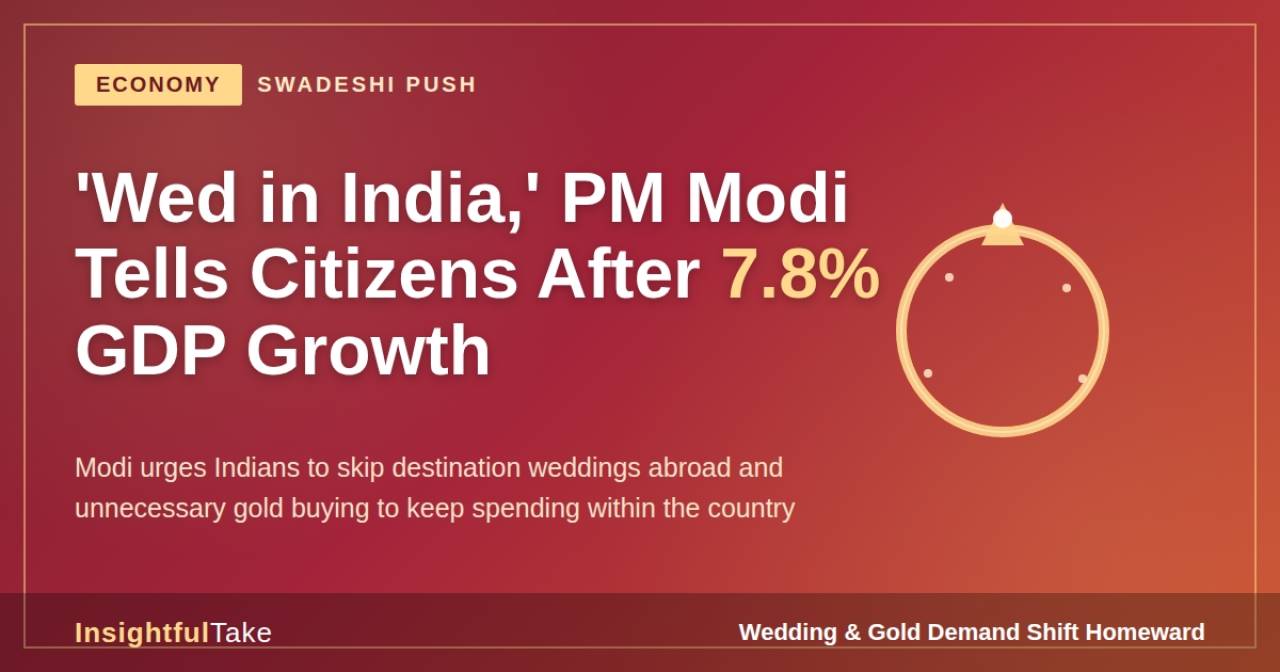
India’s economy grew by 7.8% in the April-June quarter of 2026-27, beating most expectations and underlining the strength of domestic economic activity. But Prime Minister Narendra Modi’s message after the numbers were released was not limited to GDP.
He asked Indians to rethink how and where they spend their money.
In a video message this week, Modi urged people to avoid holding weddings abroad and instead embrace the idea of “Wed in India.” He also appealed to citizens to avoid unnecessary foreign travel and to buy gold only when it is genuinely needed.
The message was part of his broader push for Swadeshi and Atmanirbhar Bharat, with the argument that more spending within India can strengthen domestic businesses, create employment and keep economic activity circulating inside the country.
But can something as personal as a wedding really make a meaningful difference to the economy?
Why Weddings Entered a GDP Conversation
India’s real GDP grew 7.8% year-on-year in the first quarter of FY2026-27, up from 6.5% in the same quarter a year earlier under the revised GDP series. Growth, however, was slower than the 8.6% recorded in the January-March quarter.
According to the government’s latest estimates, real GDP stood at ₹81.36 lakh crore in Q1 FY2026-27, compared with ₹75.46 lakh crore in the corresponding quarter of the previous financial year. Real GVA grew 8.2% during the quarter.
The strong numbers came despite geopolitical tensions, supply-chain disruptions and uncertainty in the global economy.
Modi presented the performance as evidence of India’s resilience and linked it to the need for greater self-reliance in everyday economic choices.
That is where weddings, foreign travel and gold enter the argument.
A wedding held in another country can involve spending on overseas hotels, venues, transport, catering, decoration and event management. Much of that money therefore goes to businesses outside India.
A wedding held in India, by contrast, can distribute spending among domestic hotels, caterers, decorators, photographers, transport operators, designers and other service providers.
The economic logic is simple. If the spending happens in India, a larger share of it stays within the Indian economy.
The Wedding Industry Is Already Looking Homeward
Interestingly, the shift towards domestic weddings does not appear to be driven by Modi’s latest appeal alone.
Wedding planners and industry professionals have already been reporting stronger interest in Indian destinations. Udaipur, Rajasthan and Uttarakhand are among the destinations attracting attention, while Goa and Kerala continue to appeal to couples looking for beach or resort weddings.
There are practical reasons behind the trend.
Indian wedding destinations can now offer luxury resorts, elaborate décor, large-scale catering and professional event management that were once seen as reasons to look overseas.
Cost is another factor.
A foreign destination wedding can involve international travel, visas, accommodation and logistics for dozens or even hundreds of guests. An Indian destination can offer a similar experience without many of those additional expenses.
For families watching their budgets, the attraction is obvious.
The result is that “Wed in India” may be less a new economic trend than an attempt to reinforce a trend that is already taking shape.
Gold Presents a Different Economic Problem
Gold is a more complicated part of the argument.
Unlike wedding services, gold purchased in India is not necessarily an entirely foreign expense. Indian jewellers, manufacturers and retailers all earn from the domestic gold trade.
The larger issue is that India depends heavily on imports to meet its gold demand. Higher gold imports can therefore put pressure on the country’s trade balance and foreign exchange position.
That is why Modi has urged people to avoid buying gold unless necessary.
But the gold market is responding to another powerful force as well: prices.
With gold prices at exceptionally high levels, many consumers are becoming more careful about new purchases. Instead of buying large quantities of fresh gold jewellery, some customers are opting for lighter designs, exchanging old jewellery or reusing family heirlooms.
For households preparing for weddings, this can make financial sense.
The wedding season therefore brings together two different trends: families looking for ways to reduce wedding costs and consumers becoming more cautious about buying gold.
Can ‘Wed in India’ Actually Boost GDP?
There is a difference between encouraging domestic spending and directly increasing GDP.
If a family moves its wedding from Dubai, Bali or another overseas destination to Udaipur, the expenditure does not automatically become new economic activity. The family would have spent the money anyway.
What changes is where the money is spent.
A larger share may now go to Indian hotels, restaurants, transport companies, decorators, photographers, event managers and local workers.
That can create a multiplier effect, particularly in tourism-dependent regions.
The same logic applies to foreign holidays. If an Indian family spends its vacation budget in Goa, Kerala, Kashmir or Rajasthan instead of Europe or Southeast Asia, domestic tourism businesses receive the expenditure.
The impact of gold is different. Reducing gold imports can help reduce pressure on the trade deficit, but it can also affect jewellers and other businesses involved in the domestic jewellery ecosystem.
So the economic outcome is not as straightforward as simply saying that less gold buying or fewer foreign weddings automatically means higher GDP.
The Bigger Idea Is Domestic Consumption
The significance of Modi’s message lies less in weddings themselves and more in the broader economic philosophy behind it.
India’s growth story increasingly depends on domestic consumption, investment and services. Encouraging consumers to choose Indian products, Indian tourism and Indian services is an attempt to ensure that more economic activity takes place within the country.
The Prime Minister’s “Wed in India” message therefore fits into a much larger Swadeshi campaign.
It is also a reminder that household spending decisions, when multiplied across millions of consumers, can have economic consequences.
But there is a limit to how far such appeals can go.
People ultimately choose where to marry, where to travel and what to buy based on income, prices, convenience, aspirations and personal preferences. Government appeals can influence these decisions, but they cannot replace the underlying economics.
Weddings Can Help, But They Are Not the Economy
India’s 7.8% GDP growth is being driven by much larger forces than weddings. Official data point to broad-based economic activity, while recent reporting has highlighted the role of investment, manufacturing, services and domestic demand.
Domestic weddings can certainly support hotels, tourism, hospitality and local businesses. Avoiding unnecessary gold imports can also help ease pressure on the external balance.
But neither can determine India’s economic growth on its own.
The real test of “Wed in India” is therefore not whether every Indian couple cancels a foreign wedding.
It is whether India can build domestic destinations, services and products good enough that people choose them because they are competitive, attractive and convenient, rather than simply because the government asked them to.
That would make Swadeshi more than a slogan.
It would make it a market choice.
India’s economy grew by 7.8% in the April-June quarter of 2026-27, beating most expectations and underlining the strength of domestic economic activity. But Prime Minister Narendra Modi’s message after the numbers were released was not limited to GDP.
He asked Indians to rethink how and where they spend their money.
In a video message this week, Modi urged people to avoid holding weddings abroad and instead embrace the idea of “Wed in India.” He also appealed to citizens to avoid unnecessary foreign travel and to buy gold only when it is genuinely needed.
The message was part of his broader push for Swadeshi and Atmanirbhar Bharat, with the argument that more spending within India can strengthen domestic businesses, create employment and keep economic activity circulating inside the country.
But can something as personal as a wedding really make a meaningful difference to the economy?
Why Weddings Entered a GDP Conversation
India’s real GDP grew 7.8% year-on-year in the first quarter of FY2026-27, up from 6.5% in the same quarter a year earlier under the revised GDP series. Growth, however, was slower than the 8.6% recorded in the January-March quarter.
According to the government’s latest estimates, real GDP stood at ₹81.36 lakh crore in Q1 FY2026-27, compared with ₹75.46 lakh crore in the corresponding quarter of the previous financial year. Real GVA grew 8.2% during the quarter.
The strong numbers came despite geopolitical tensions, supply-chain disruptions and uncertainty in the global economy.
Modi presented the performance as evidence of India’s resilience and linked it to the need for greater self-reliance in everyday economic choices.
That is where weddings, foreign travel and gold enter the argument.
A wedding held in another country can involve spending on overseas hotels, venues, transport, catering, decoration and event management. Much of that money therefore goes to businesses outside India.
A wedding held in India, by contrast, can distribute spending among domestic hotels, caterers, decorators, photographers, transport operators, designers and other service providers.
The economic logic is simple. If the spending happens in India, a larger share of it stays within the Indian economy.
The Wedding Industry Is Already Looking Homeward
Interestingly, the shift towards domestic weddings does not appear to be driven by Modi’s latest appeal alone.
Wedding planners and industry professionals have already been reporting stronger interest in Indian destinations. Udaipur, Rajasthan and Uttarakhand are among the destinations attracting attention, while Goa and Kerala continue to appeal to couples looking for beach or resort weddings.
There are practical reasons behind the trend.
Indian wedding destinations can now offer luxury resorts, elaborate décor, large-scale catering and professional event management that were once seen as reasons to look overseas.
Cost is another factor.
A foreign destination wedding can involve international travel, visas, accommodation and logistics for dozens or even hundreds of guests. An Indian destination can offer a similar experience without many of those additional expenses.
For families watching their budgets, the attraction is obvious.
The result is that “Wed in India” may be less a new economic trend than an attempt to reinforce a trend that is already taking shape.
Gold Presents a Different Economic Problem
Gold is a more complicated part of the argument.
Unlike wedding services, gold purchased in India is not necessarily an entirely foreign expense. Indian jewellers, manufacturers and retailers all earn from the domestic gold trade.
The larger issue is that India depends heavily on imports to meet its gold demand. Higher gold imports can therefore put pressure on the country’s trade balance and foreign exchange position.
That is why Modi has urged people to avoid buying gold unless necessary.
But the gold market is responding to another powerful force as well: prices.
With gold prices at exceptionally high levels, many consumers are becoming more careful about new purchases. Instead of buying large quantities of fresh gold jewellery, some customers are opting for lighter designs, exchanging old jewellery or reusing family heirlooms.
For households preparing for weddings, this can make financial sense.
The wedding season therefore brings together two different trends: families looking for ways to reduce wedding costs and consumers becoming more cautious about buying gold.
Can ‘Wed in India’ Actually Boost GDP?
There is a difference between encouraging domestic spending and directly increasing GDP.
If a family moves its wedding from Dubai, Bali or another overseas destination to Udaipur, the expenditure does not automatically become new economic activity. The family would have spent the money anyway.
What changes is where the money is spent.
A larger share may now go to Indian hotels, restaurants, transport companies, decorators, photographers, event managers and local workers.
That can create a multiplier effect, particularly in tourism-dependent regions.
The same logic applies to foreign holidays. If an Indian family spends its vacation budget in Goa, Kerala, Kashmir or Rajasthan instead of Europe or Southeast Asia, domestic tourism businesses receive the expenditure.
The impact of gold is different. Reducing gold imports can help reduce pressure on the trade deficit, but it can also affect jewellers and other businesses involved in the domestic jewellery ecosystem.
So the economic outcome is not as straightforward as simply saying that less gold buying or fewer foreign weddings automatically means higher GDP.
The Bigger Idea Is Domestic Consumption
The significance of Modi’s message lies less in weddings themselves and more in the broader economic philosophy behind it.
India’s growth story increasingly depends on domestic consumption, investment and services. Encouraging consumers to choose Indian products, Indian tourism and Indian services is an attempt to ensure that more economic activity takes place within the country.
The Prime Minister’s “Wed in India” message therefore fits into a much larger Swadeshi campaign.
It is also a reminder that household spending decisions, when multiplied across millions of consumers, can have economic consequences.
But there is a limit to how far such appeals can go.
People ultimately choose where to marry, where to travel and what to buy based on income, prices, convenience, aspirations and personal preferences. Government appeals can influence these decisions, but they cannot replace the underlying economics.
Weddings Can Help, But They Are Not the Economy
India’s 7.8% GDP growth is being driven by much larger forces than weddings. Official data point to broad-based economic activity, while recent reporting has highlighted the role of investment, manufacturing, services and domestic demand.
Domestic weddings can certainly support hotels, tourism, hospitality and local businesses. Avoiding unnecessary gold imports can also help ease pressure on the external balance.
But neither can determine India’s economic growth on its own.
The real test of “Wed in India” is therefore not whether every Indian couple cancels a foreign wedding.
It is whether India can build domestic destinations, services and products good enough that people choose them because they are competitive, attractive and convenient, rather than simply because the government asked them to.
That would make Swadeshi more than a slogan.
It would make it a market choice.












Leave a Comment