
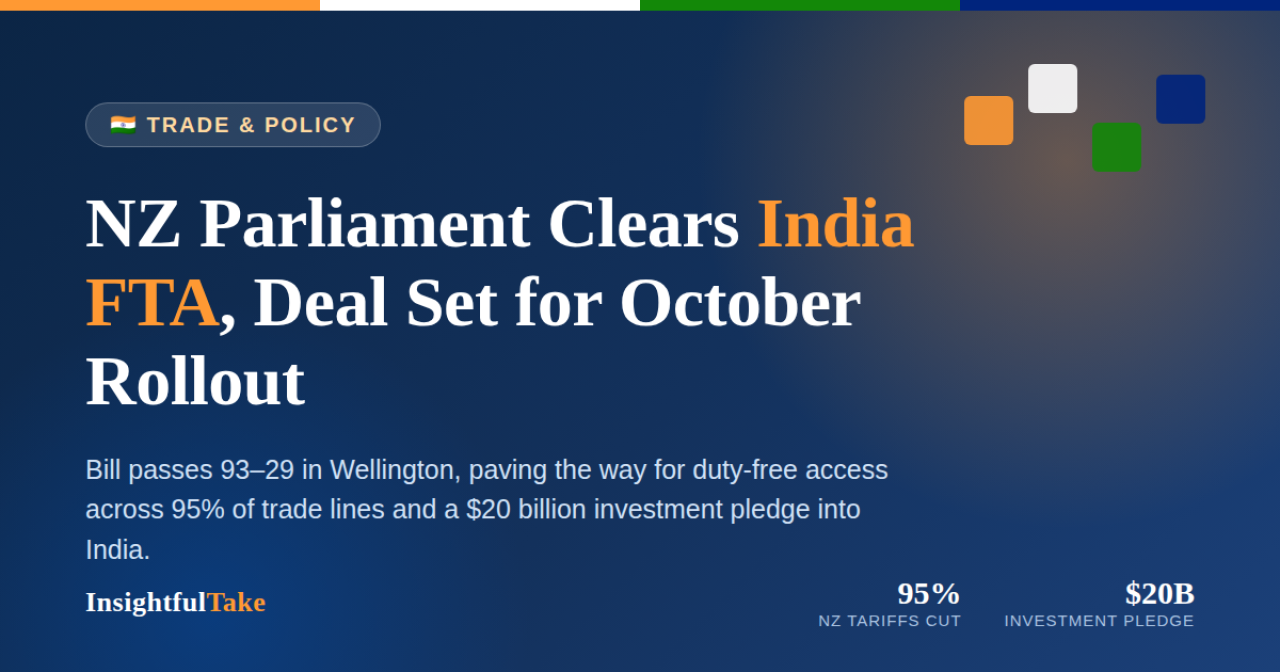
New Zealand’s Parliament has cleared the India trade deal. Tariff cuts, investment commitments and new market access could reshape a modest but growing bilateral trade relationship.
New Zealand’s Parliament has passed legislation to implement its free trade agreement with India, clearing a major step toward bringing the pact into force. The legislation passed with a 93-29 vote, with the National Party, Labour Party and ACT New Zealand voting in favour. The bill received Royal Assent on September 17, formally becoming law.
The India-New Zealand Free Trade Agreement was signed in New Delhi on April 27, 2026, after nine months of negotiations. With the implementing legislation now approved, both sides can move toward operationalising the agreement. The target is for the pact to take effect in the second half of October.
New Zealand Trade and Investment Minister Todd McClay welcomed the parliamentary vote, saying the agreement would open greater access to one of the world’s largest markets. New Zealand officials have highlighted the opportunity created by access to India’s 1.4 billion consumers.
What the Deal Covers
The agreement will significantly reduce tariffs on New Zealand exports to India. From the first day of implementation, 57 percent of New Zealand exports will become duty-free, while tariffs on 95 percent of its exports will eventually be eliminated or significantly reduced. New Zealand’s kiwifruit industry alone expects to save around NZ$125 million in tariffs over five years.
For India, New Zealand has agreed to provide zero-duty access across 100 percent of its tariff lines from the agreement’s entry into force. India, meanwhile, has offered tariff liberalisation on about 70 percent of its tariff lines, covering approximately 95 percent of bilateral trade value.
The agreement also includes a commitment by New Zealand to facilitate US$20 billion in investment in India over 15 years, with a focus on manufacturing, infrastructure, innovation and job creation.
Sensitive sectors remain protected. India has excluded dairy and several agricultural products from tariff concessions, alongside other sensitive categories. New Zealand, meanwhile, gains improved market access for products including apples, kiwifruit and Mānuka honey, subject to agreed conditions and quotas.
Why It Matters for India
India and New Zealand have relatively modest bilateral trade compared with India’s overall trade volume. The FTA therefore represents a broader effort to expand market access and diversify economic partnerships.
For Indian exporters, the agreement creates new opportunities in sectors including textiles, apparel, engineering goods, food processing, pharmaceuticals and other manufacturing and services areas. New Zealand has also made commitments covering 118 services sectors and provides Most-Favoured-Nation treatment across a further range of services sub-sectors.
The agreement also contains provisions on professional and student mobility. India’s Commerce Ministry says the pact creates a dedicated pathway for Indian students and professionals, including post-study work opportunities, a Temporary Employment Entry visa pathway for up to 5,000 Indian professionals at a time, and 1,000 Working Holiday visas annually.
A Deal That Faced Political Resistance
The parliamentary passage was not unanimous. New Zealand First, a partner in the governing coalition, voted against the legislation along with the Green Party, Te Pāti Māori and independent MPs. The parliamentary record shows New Zealand First had raised concerns during debate over aspects of the agreement, including its implications for immigration and agriculture.
Despite the opposition, the legislation secured enough cross-party support to pass comfortably.
From Agreement to Implementation
The parliamentary vote marks an important transition from negotiation to implementation. New Zealand’s implementing legislation is now in place, while the two governments work toward bringing the FTA into force.
Both countries have set an ambition of substantially increasing bilateral trade in the coming years. The real test will now be how quickly exporters, investors, students and professionals are able to use the opportunities created by the agreement once it becomes operational.
With parliamentary approval secured, the India-New Zealand trade relationship is moving from a negotiated framework to its implementation phase.
New Zealand’s Parliament has passed legislation to implement its free trade agreement with India, clearing a major step toward bringing the pact into force. The legislation passed with a 93-29 vote, with the National Party, Labour Party and ACT New Zealand voting in favour. The bill received Royal Assent on September 17, formally becoming law.
The India-New Zealand Free Trade Agreement was signed in New Delhi on April 27, 2026, after nine months of negotiations. With the implementing legislation now approved, both sides can move toward operationalising the agreement. The target is for the pact to take effect in the second half of October.
New Zealand Trade and Investment Minister Todd McClay welcomed the parliamentary vote, saying the agreement would open greater access to one of the world’s largest markets. New Zealand officials have highlighted the opportunity created by access to India’s 1.4 billion consumers.
What the Deal Covers
The agreement will significantly reduce tariffs on New Zealand exports to India. From the first day of implementation, 57 percent of New Zealand exports will become duty-free, while tariffs on 95 percent of its exports will eventually be eliminated or significantly reduced. New Zealand’s kiwifruit industry alone expects to save around NZ$125 million in tariffs over five years.
For India, New Zealand has agreed to provide zero-duty access across 100 percent of its tariff lines from the agreement’s entry into force. India, meanwhile, has offered tariff liberalisation on about 70 percent of its tariff lines, covering approximately 95 percent of bilateral trade value.
The agreement also includes a commitment by New Zealand to facilitate US$20 billion in investment in India over 15 years, with a focus on manufacturing, infrastructure, innovation and job creation.
Sensitive sectors remain protected. India has excluded dairy and several agricultural products from tariff concessions, alongside other sensitive categories. New Zealand, meanwhile, gains improved market access for products including apples, kiwifruit and Mānuka honey, subject to agreed conditions and quotas.
Why It Matters for India
India and New Zealand have relatively modest bilateral trade compared with India’s overall trade volume. The FTA therefore represents a broader effort to expand market access and diversify economic partnerships.
For Indian exporters, the agreement creates new opportunities in sectors including textiles, apparel, engineering goods, food processing, pharmaceuticals and other manufacturing and services areas. New Zealand has also made commitments covering 118 services sectors and provides Most-Favoured-Nation treatment across a further range of services sub-sectors.
The agreement also contains provisions on professional and student mobility. India’s Commerce Ministry says the pact creates a dedicated pathway for Indian students and professionals, including post-study work opportunities, a Temporary Employment Entry visa pathway for up to 5,000 Indian professionals at a time, and 1,000 Working Holiday visas annually.
A Deal That Faced Political Resistance
The parliamentary passage was not unanimous. New Zealand First, a partner in the governing coalition, voted against the legislation along with the Green Party, Te Pāti Māori and independent MPs. The parliamentary record shows New Zealand First had raised concerns during debate over aspects of the agreement, including its implications for immigration and agriculture.
Despite the opposition, the legislation secured enough cross-party support to pass comfortably.
From Agreement to Implementation
The parliamentary vote marks an important transition from negotiation to implementation. New Zealand’s implementing legislation is now in place, while the two governments work toward bringing the FTA into force.
Both countries have set an ambition of substantially increasing bilateral trade in the coming years. The real test will now be how quickly exporters, investors, students and professionals are able to use the opportunities created by the agreement once it becomes operational.
With parliamentary approval secured, the India-New Zealand trade relationship is moving from a negotiated framework to its implementation phase.

























Leave a Comment