
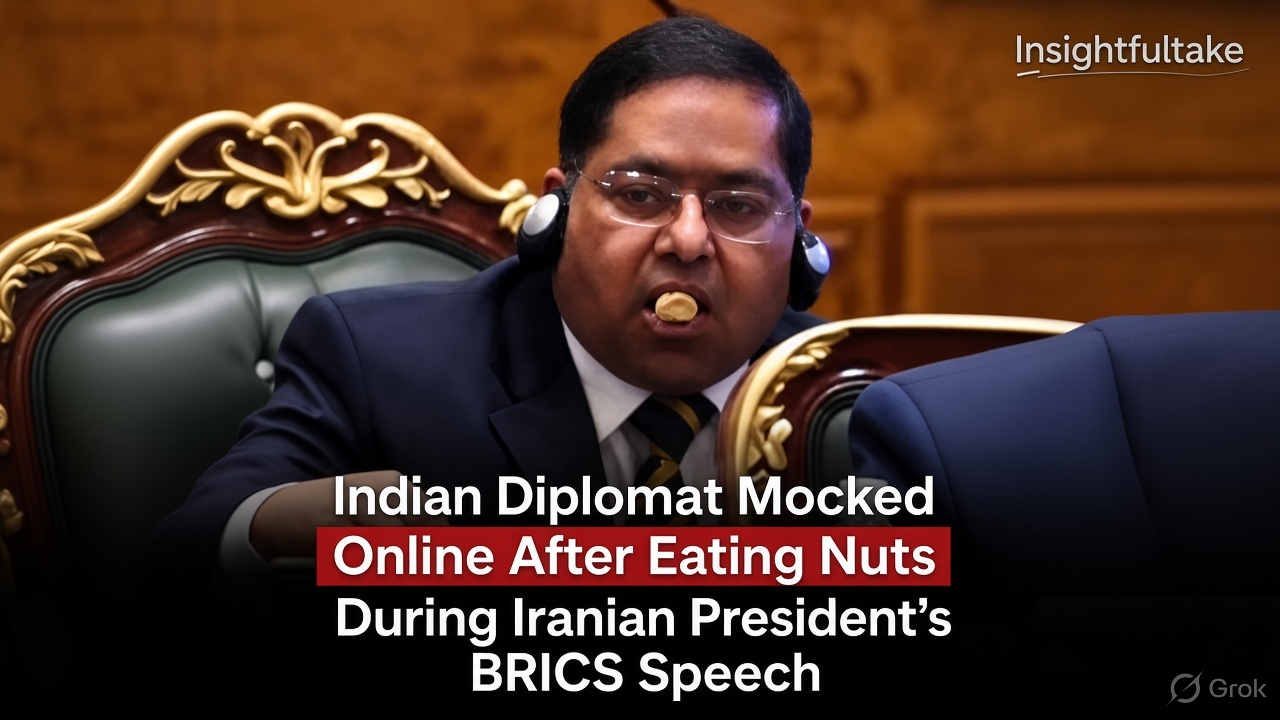
A few nuts, a viral video and a diplomatic controversy that may have never deserved to exist.
A video of Ministry of External Affairs spokesperson Randhir Jaiswal eating dry fruits during Iranian President Masoud Pezeshkian’s address at the BRICS Summit in New Delhi has been circulating for days. It has been mocked, memed, sped up for effect and picked up by outlets across the world, including in Pakistan, where it has been used to needle India’s diplomatic image.
Somewhere in this cycle of jokes and forwarded clips, a basic question has been lost: what exactly did Randhir Jaiswal do wrong?
He ate nuts that were placed on the table in front of him during a summit that ran for hours. He was sitting in a chair, not at a podium, not mid-sentence and not disrupting anyone.
That is the entire offence.
Snacks Were Served. That Is the Point.
Multiple reports on the incident have noted the same detail that got buried under the memes: refreshments, including dry fruits, were laid out for delegates and officials at their seats during the summit’s long proceedings.
This was not Jaiswal sneaking food into a solemn hall against protocol. The food had been placed there by the event’s organisers, presumably because a summit stretching across hours of speeches by multiple heads of state requires exactly that kind of provision for people seated through it.
If eating at your seat during a summit is inappropriate, the fix is simple and does not involve humiliating an individual officer: do not serve food at the seats.
Once a tray of nuts is placed in front of someone during a multi-hour event, eating from it is hardly an extraordinary act. The people who decided refreshments belonged on that table bear at least some responsibility for the controversy as well.
Ridicule That Has Nothing to Do With Diplomacy
There is a difference between criticising a public official for something that touches his actual job and mocking him for a bodily function everyone performs.
Jaiswal is a career Indian Foreign Service officer of the 1998 batch and has served as the Ministry of External Affairs’ official spokesperson since January 2024. His job that day was not to perform stillness for the cameras. He was seated, not speaking and not representing India at the podium at that particular moment.
Nothing about eating dry fruit at his own seat establishes anything about his competence, judgement or India’s standing among the BRICS nations.
What the video really captured was a man behaving much like most people would when a bowl of snacks is within arm’s reach during a long, formal event: reaching for it more than once.
That is not a scandal. On its own, it is barely a story.
It became one because it could be turned into a joke about his weight and his manners. That is where the coverage deserves scrutiny. It is not commentary on diplomacy. It is personal ridicule dressed up as news.
An Old Discomfort, Dressed as Etiquette
There is also something worth saying about how this plays out in Indian public life specifically.
Mocking a person’s body and eating habits in public is often treated as harmless humour. It is frequently dismissed as a joke, even when the joke depends entirely on humiliating someone for their appearance.
The Jaiswal clip follows that familiar pattern.
He did not need public scorn to teach him what a snack tray is for. The ridicule aimed at him has little to do with etiquette and much more to do with finding an easy target for a cheap laugh.
Video editing has also reportedly been used to speed up the footage, making the eating appear more exaggerated and comical than it was.
That matters because short clips can strip an ordinary moment of its context. Once edited, captioned and repeatedly shared, an otherwise forgettable act can acquire a meaning it never had in the first place.
When a Non-Story Becomes a Diplomatic Story
Foreign outlets picking up the clip to embarrass an Indian official, particularly at a time of geopolitical tension involving Iran and West Asia, adds another layer to what should have remained a non-story.
A moment of ordinary snacking is transformed into a supposed reflection of India’s diplomatic culture.
But diplomacy cannot reasonably be judged by whether an official eats a few nuts during a long address.
The more important questions at a summit concern what governments negotiate, what leaders say, what agreements are reached and how countries respond to shared challenges.
None of those questions is answered by a video of an official eating dry fruits.
What Should Actually Change
If summit organisers want to avoid similar distractions in the future, the answer lies primarily in how such events are organised.
They can choose not to place refreshments within reach during addresses. Or they can accept the obvious reality that people seated through hours of speeches may eat what has been provided to them.
What does not help is turning an ordinary human action into a measure of diplomatic conduct.
Randhir Jaiswal does not need his image “saved” because eating a handful of nuts is not, by itself, a diplomatic failure.
Perhaps the more useful lesson from the episode is about us.
In an age when every camera can turn a passing moment into a viral clip, we have become remarkably willing to confuse visibility with significance. A man eating a snack becomes a meme. The meme becomes a controversy. The controversy is then presented as commentary on diplomacy.
And somewhere along the way, the simplest question disappears:
Was there ever a story here at all?
A video of Ministry of External Affairs spokesperson Randhir Jaiswal eating dry fruits during Iranian President Masoud Pezeshkian’s address at the BRICS Summit in New Delhi has been circulating for days. It has been mocked, memed, sped up for effect and picked up by outlets across the world, including in Pakistan, where it has been used to needle India’s diplomatic image.
Somewhere in this cycle of jokes and forwarded clips, a basic question has been lost: what exactly did Randhir Jaiswal do wrong?
He ate nuts that were placed on the table in front of him during a summit that ran for hours. He was sitting in a chair, not at a podium, not mid-sentence and not disrupting anyone.
That is the entire offence.
Snacks Were Served. That Is the Point.
Multiple reports on the incident have noted the same detail that got buried under the memes: refreshments, including dry fruits, were laid out for delegates and officials at their seats during the summit’s long proceedings.
This was not Jaiswal sneaking food into a solemn hall against protocol. The food had been placed there by the event’s organisers, presumably because a summit stretching across hours of speeches by multiple heads of state requires exactly that kind of provision for people seated through it.
If eating at your seat during a summit is inappropriate, the fix is simple and does not involve humiliating an individual officer: do not serve food at the seats.
Once a tray of nuts is placed in front of someone during a multi-hour event, eating from it is hardly an extraordinary act. The people who decided refreshments belonged on that table bear at least some responsibility for the controversy as well.
Ridicule That Has Nothing to Do With Diplomacy
There is a difference between criticising a public official for something that touches his actual job and mocking him for a bodily function everyone performs.
Jaiswal is a career Indian Foreign Service officer of the 1998 batch and has served as the Ministry of External Affairs’ official spokesperson since January 2024. His job that day was not to perform stillness for the cameras. He was seated, not speaking and not representing India at the podium at that particular moment.
Nothing about eating dry fruit at his own seat establishes anything about his competence, judgement or India’s standing among the BRICS nations.
What the video really captured was a man behaving much like most people would when a bowl of snacks is within arm’s reach during a long, formal event: reaching for it more than once.
That is not a scandal. On its own, it is barely a story.
It became one because it could be turned into a joke about his weight and his manners. That is where the coverage deserves scrutiny. It is not commentary on diplomacy. It is personal ridicule dressed up as news.
An Old Discomfort, Dressed as Etiquette
There is also something worth saying about how this plays out in Indian public life specifically.
Mocking a person’s body and eating habits in public is often treated as harmless humour. It is frequently dismissed as a joke, even when the joke depends entirely on humiliating someone for their appearance.
The Jaiswal clip follows that familiar pattern.
He did not need public scorn to teach him what a snack tray is for. The ridicule aimed at him has little to do with etiquette and much more to do with finding an easy target for a cheap laugh.
Video editing has also reportedly been used to speed up the footage, making the eating appear more exaggerated and comical than it was.
That matters because short clips can strip an ordinary moment of its context. Once edited, captioned and repeatedly shared, an otherwise forgettable act can acquire a meaning it never had in the first place.
When a Non-Story Becomes a Diplomatic Story
Foreign outlets picking up the clip to embarrass an Indian official, particularly at a time of geopolitical tension involving Iran and West Asia, adds another layer to what should have remained a non-story.
A moment of ordinary snacking is transformed into a supposed reflection of India’s diplomatic culture.
But diplomacy cannot reasonably be judged by whether an official eats a few nuts during a long address.
The more important questions at a summit concern what governments negotiate, what leaders say, what agreements are reached and how countries respond to shared challenges.
None of those questions is answered by a video of an official eating dry fruits.
What Should Actually Change
If summit organisers want to avoid similar distractions in the future, the answer lies primarily in how such events are organised.
They can choose not to place refreshments within reach during addresses. Or they can accept the obvious reality that people seated through hours of speeches may eat what has been provided to them.
What does not help is turning an ordinary human action into a measure of diplomatic conduct.
Randhir Jaiswal does not need his image “saved” because eating a handful of nuts is not, by itself, a diplomatic failure.
Perhaps the more useful lesson from the episode is about us.
In an age when every camera can turn a passing moment into a viral clip, we have become remarkably willing to confuse visibility with significance. A man eating a snack becomes a meme. The meme becomes a controversy. The controversy is then presented as commentary on diplomacy.
And somewhere along the way, the simplest question disappears:
Was there ever a story here at all?











Leave a Comment