
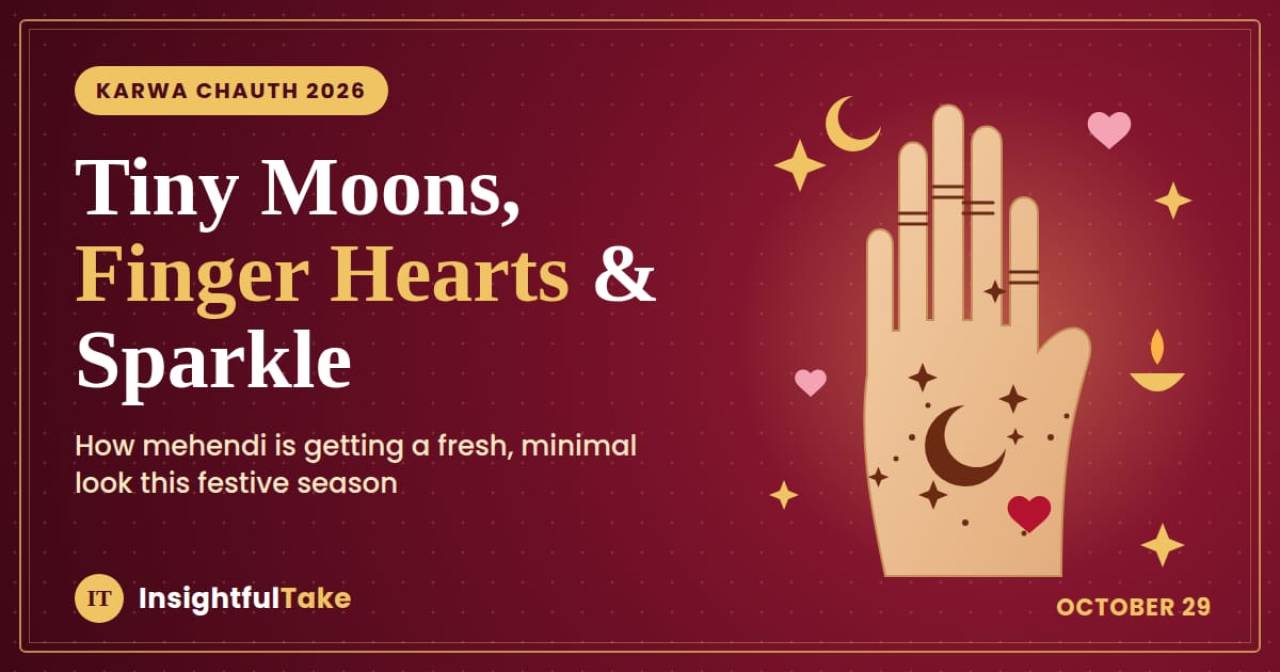
From delicate moon motifs and Korean-inspired finger hearts to crystal-studded designs, women are giving traditional mehendi a fresh, personal touch this festive season.
With Karwa Chauth falling on October 29, mehendi artists across Delhi and other Indian cities are preparing for one of their busiest days of the festive calendar. Markets are filling up with women looking for their favourite designs, while salons and neighbourhood mehendi stalls are witnessing the familiar pre-festival rush.
But there is a noticeable change in what women are asking for this year.
The elaborate floral patterns and intricate designs that once covered almost every inch of the palm are making room for something smaller and simpler. Tiny crescent moons, delicate hearts, miniature bows and even sparkling crystals are finding their way onto women's hands.
Traditional mehendi has certainly not lost its charm. However, a growing number of women, particularly younger professionals, are experimenting with designs that reflect their personalities rather than following a fixed festive pattern.
Less Mehendi, More Personal Touch
Minimal mehendi is emerging as one of the popular choices this Karwa Chauth. Instead of sitting for hours while an artist fills both hands with intricate patterns, women are opting for a small design on the palm, wrist or fingers.
The preference is partly practical. Many working women find it difficult to spare several hours for elaborate mehendi, especially when the festival falls on a weekday. Smaller designs are quicker to apply, easier to maintain and often complement both traditional and contemporary outfits.
Online interest also appears to reflect this changing preference. Reports suggest that searches for "minimal mehendi designs" in India increased sharply in the days leading up to Karwa Chauth, although independently verified search figures are not available.
Celebrity mehendi artist Sona Mistry has also highlighted the growing preference for personalised designs. The emphasis is no longer limited to how elaborate the mehendi looks. Women increasingly want something that carries a personal meaning or reflects their individual taste.
For some, that could be a tiny heart. For others, it might be their partner's initials, a favourite symbol or a delicate floral pattern.
From Korean Finger Hearts to Y2K Designs
Social media trends are influencing mehendi choices in ways that would have seemed unusual a few years ago.
One such influence comes from Korean popular culture. The finger-heart gesture, widely associated with K-pop celebrities and Korean dramas, is now inspiring small mehendi motifs. Hearts, playful doodles and personalised initials are being incorporated into designs that are simple but instantly recognisable.
Another emerging style is bedazzled mehendi, which combines traditional henna with decorative crystals and rhinestones. The stones are placed around the design to add sparkle, particularly for women who want their mehendi to stand out in festive photographs.
The revival of Y2K fashion has also reached mehendi. Hearts, stars, checkerboard patterns and bold outlines associated with late-1990s and early-2000s fashion are being recreated with henna cones.
Then there is the coquette-inspired style, featuring tiny bows, ribbons and lace-like patterns. These designs appeal to women who prefer delicate detailing over heavily filled palms.
While such styles may not replace conventional Indian mehendi, they are expanding the range of choices available to women.
Why the Moon Remains a Favourite
Among all the new designs, celestial motifs have a special connection with Karwa Chauth.
The moon occupies a central place in the festival. Women observing the traditional fast wait for moonrise before performing the evening rituals and breaking their fast.
It is therefore hardly surprising that crescent moons, stars and the traditional chand-sitaara pattern are finding favour among mehendi enthusiasts.
A tiny crescent on the wrist or a combination of stars and moons along the fingers can be both fashionable and meaningful.
Unlike some other designs borrowed from international fashion trends, celestial mehendi has a direct connection with the occasion itself.
For women who prefer understated decoration, a moon surrounded by a few stars offers a way to retain the festival's symbolism without covering the entire hand.
Celebrities Still Have a Soft Corner for Traditional Mehendi
Despite the popularity of newer styles, traditional motifs continue to enjoy considerable affection.
Veteran celebrity mehendi artist Veena Nagda, who has worked with prominent Bollywood personalities for decades, has observed that many women still prefer designs associated with marriage, prosperity and family traditions.
Actor Sonam Kapoor, for instance, has shown a fondness for the lotus motif, a flower associated with Goddess Lakshmi and traditionally regarded as a symbol of purity and prosperity.
Nagda has also recalled the late actor Sridevi's preference for incorporating her husband's name into her mehendi.
The practice of hiding a husband's name or initials within an elaborate pattern remains a familiar part of Indian wedding and festive mehendi traditions.
What is changing is the presentation. Instead of concealing initials within a dense design, some women now prefer placing them inside a small heart, moon or floral motif.
The sentiment remains familiar, even when the design looks different.
Short on Time? Ready-Made Mehendi Offers an Alternative
Not everyone has the time or patience to visit a mehendi artist. For women managing office responsibilities, household preparations and last-minute shopping, ready-made options are becoming increasingly convenient.
Henna stencils are one such alternative. A stencil is placed on the skin, and henna paste is applied over the cut-out pattern. Once the stencil is removed, it leaves behind a relatively neat design.
Temporary mehendi tattoos are another option. Available in floral, lace-inspired and geometric patterns, these can be transferred onto the skin without using traditional henna paste.
Decorative kundan stones, metallic bindis and adhesive crystals can also be used to create a festive look.
These alternatives may not reproduce the experience of applying fresh mehendi, but they offer a practical solution for women who want decorated hands without spending hours at a salon.
How Much Will Mehendi Cost This Karwa Chauth?
The cost of mehendi depends on the complexity of the design, the artist's experience and the location.
Rakesh, a mehendi artist from Delhi's New Friends Colony, estimates that minimal designs for both hands can start at around ₹600 when booked in advance.
More detailed work may cost between ₹600 and ₹1,500 per hand, with elaborate patterns and specialised designs attracting higher charges.
Prices can also increase closer to the festival, when demand is at its highest.
For women planning to get mehendi applied on October 28, booking an artist in advance could help avoid long queues and last-minute price increases.
It is also advisable to ask about the type of henna being used. Natural henna generally takes time to develop its colour, while so-called instant or black henna products may contain chemicals that can cause skin reactions.
A Few Things Worth Remembering
A good mehendi design is not necessarily the most expensive or elaborate one.
Women choosing minimal patterns should consider how the design will look with their festive clothes and jewellery. A delicate moon or floral motif may complement a simple silk saree, while crystal-studded mehendi could work well with a heavily embroidered outfit.
Those opting for traditional henna should allow sufficient time for the paste to dry and the colour to develop. The final stain generally deepens over the following day or two.
It is equally important to choose a design that feels comfortable and personal rather than copying a social media trend simply because it is popular.
Tradition Finds a New Expression
Karwa Chauth has always brought together rituals, personal emotions and festive dressing. Mehendi remains an important part of that experience for many women, whether they prefer traditional patterns or contemporary designs.
The growing popularity of minimal mehendi does not necessarily indicate a decline in tradition. Instead, it shows how familiar customs continue to adapt to changing lifestyles and individual preferences.
A woman may choose an elaborate lotus pattern because it reminds her of family traditions. Another may prefer a tiny crescent moon because it connects with the evening's rituals. Someone else may simply enjoy the sparkle of crystals or the playful appearance of a finger heart.
All these choices now find space within the same celebration.
And perhaps that is the most interesting change this Karwa Chauth. Mehendi is no longer only about how beautifully an artist can fill a palm. Increasingly, it is also about what a woman chooses to express through the design on her hands.














Leave a Comment