
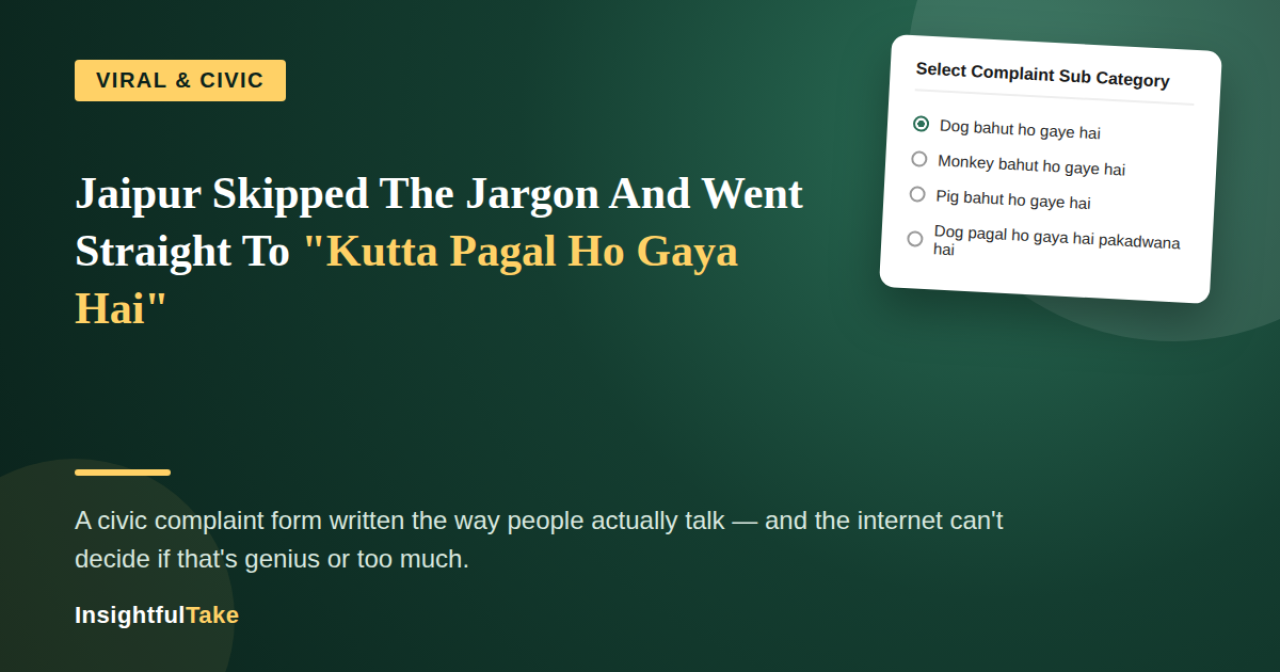
What happens when a government website stops speaking like a government file? Jaipur’s viral complaint portal offers an unexpected answer, using everyday Hinglish to make civic complaints sound more like real conversations.
Government websites are rarely designed to sound like ordinary people. They are usually filled with formal categories, administrative terminology and phrases that seem better suited to an official file than a conversation with a neighbour.
Then there is Jaipur.
The Jaipur Nagar Nigam’s online complaint portal has drawn widespread attention for using remarkably direct, everyday Hinglish to describe civic problems. Instead of relying entirely on formal expressions for animal-related complaints, the portal includes options such as “Kutta pagal ho gaya hai pakadwana hai,” “Suwar mar gaya hai,” “Billi mar gayi hai” and “Kutte bahut ho gaye hain.”
The language may sound unusual for a government website. But that unusualness is exactly what has made the portal go viral.
A Government Form That Sounds Like a Conversation
The renewed attention came after X user Ravi Handa shared a screenshot of the Jaipur Nagar Nigam website, describing it as remarkably “real”.
The post quickly attracted thousands of likes and sparked a lively discussion about how governments should communicate with citizens.
Some users welcomed the approach. They saw the informal wording as practical rather than unprofessional. One commenter called it a good initiative by the Nagar Nigam, while another argued that local problems require local solutions, including language that ordinary residents can understand.
Others simply found the contrast between the website's official status and its extremely informal wording amusing.
The reaction reveals something important. People are accustomed to government websites speaking in a language of their own. Seeing a civic authority use phrases that resemble everyday conversation immediately feels different.
Why the Wording Works
Consider a resident trying to report an aggressive stray dog.
The person is unlikely to describe the situation using administrative terminology such as “stray animal menace” or “animal-related nuisance”. They are far more likely to say that the dog has gone mad and needs to be caught.
That is essentially what the Jaipur portal allows the resident to communicate.
The significance is not that the wording is funny. It is that the wording reduces the distance between what a citizen experiences and what a government form asks the citizen to select.
That small difference can make digital civic services easier to navigate.
But Informal Does Not Always Mean Appropriate
The response has not been entirely positive.
Some social-media users questioned particular words used in the complaint categories, arguing that certain expressions could be viewed as derogatory rather than merely informal.
That criticism is important because accessibility and sensitivity have to coexist.
A government website serves people from different backgrounds and generations. Language that feels perfectly natural to one group may sound crude or insensitive to another.
The challenge, therefore, is not simply to make official language casual.
It is to make it clear without becoming careless.
Delhi Offers a Very Different Contrast
The difference becomes more apparent when similar civic complaints in Delhi are considered.
The Municipal Corporation of Delhi's complaint system uses conventional categories such as “Removal of dead animals,” “Stray monkeys” and “Stray cattle/pigs.”
The terminology is precise and familiar in government administration.
It is also unmistakably bureaucratic.
Jaipur's options, by contrast, sound closer to the way a resident might describe the problem while speaking to a friend or neighbour.
That contrast is one reason the screenshot has generated so much discussion.
The Bigger Lesson Is About Civic Technology
The Jaipur episode points to a problem that goes beyond one municipal website.
Government portals often require citizens to translate everyday problems into official vocabulary before they can seek help.
That translation is easy for people familiar with administrative systems. For everyone else, it can become an unnecessary obstacle.
Good civic technology should ideally remove such obstacles.
If a resident knows that a dead animal is lying on the road, the system should make it immediately obvious where that complaint belongs. If someone is dealing with too many stray dogs in their locality, they should not have to understand bureaucratic terminology before reporting it.
In that sense, Jaipur's informal language does something surprisingly sophisticated.
It starts with the citizen's vocabulary rather than the administration's.
The Internet Found the Joke. There Is a Serious Point Behind It.
The viral reaction may have been driven partly by humour. A government website saying “Kutta pagal ho gaya hai pakadwana hai” is certainly more memorable than a conventional administrative category.
But the popularity of the screenshot also reflects something deeper.
People want public services to be understandable.
They do not necessarily care whether a government portal sounds impressive. They care whether they can find the right option, submit a complaint and understand what happens next.
That means the Jaipur portal offers a useful lesson for digital governance.
Official does not have to mean complicated.
And accessible does not necessarily mean unprofessional.
The real test is whether the language helps citizens communicate their problems without making them learn the language of bureaucracy first.
Jaipur's viral complaint portal may have accidentally become an internet joke. But behind the laughter is a serious idea: sometimes, the most effective government communication is simply the kind that sounds like the people it is meant to serve.
Government websites are rarely designed to sound like ordinary people. They are usually filled with formal categories, administrative terminology and phrases that seem better suited to an official file than a conversation with a neighbour.
Then there is Jaipur.
The Jaipur Nagar Nigam’s online complaint portal has drawn widespread attention for using remarkably direct, everyday Hinglish to describe civic problems. Instead of relying entirely on formal expressions for animal-related complaints, the portal includes options such as “Kutta pagal ho gaya hai pakadwana hai,” “Suwar mar gaya hai,” “Billi mar gayi hai” and “Kutte bahut ho gaye hain.”
The language may sound unusual for a government website. But that unusualness is exactly what has made the portal go viral.
A Government Form That Sounds Like a Conversation
The renewed attention came after X user Ravi Handa shared a screenshot of the Jaipur Nagar Nigam website, describing it as remarkably “real”.
The post quickly attracted thousands of likes and sparked a lively discussion about how governments should communicate with citizens.
Some users welcomed the approach. They saw the informal wording as practical rather than unprofessional. One commenter called it a good initiative by the Nagar Nigam, while another argued that local problems require local solutions, including language that ordinary residents can understand.
Others simply found the contrast between the website's official status and its extremely informal wording amusing.
The reaction reveals something important. People are accustomed to government websites speaking in a language of their own. Seeing a civic authority use phrases that resemble everyday conversation immediately feels different.
Why the Wording Works
Consider a resident trying to report an aggressive stray dog.
The person is unlikely to describe the situation using administrative terminology such as “stray animal menace” or “animal-related nuisance”. They are far more likely to say that the dog has gone mad and needs to be caught.
That is essentially what the Jaipur portal allows the resident to communicate.
The significance is not that the wording is funny. It is that the wording reduces the distance between what a citizen experiences and what a government form asks the citizen to select.
That small difference can make digital civic services easier to navigate.
But Informal Does Not Always Mean Appropriate
The response has not been entirely positive.
Some social-media users questioned particular words used in the complaint categories, arguing that certain expressions could be viewed as derogatory rather than merely informal.
That criticism is important because accessibility and sensitivity have to coexist.
A government website serves people from different backgrounds and generations. Language that feels perfectly natural to one group may sound crude or insensitive to another.
The challenge, therefore, is not simply to make official language casual.
It is to make it clear without becoming careless.
Delhi Offers a Very Different Contrast
The difference becomes more apparent when similar civic complaints in Delhi are considered.
The Municipal Corporation of Delhi's complaint system uses conventional categories such as “Removal of dead animals,” “Stray monkeys” and “Stray cattle/pigs.”
The terminology is precise and familiar in government administration.
It is also unmistakably bureaucratic.
Jaipur's options, by contrast, sound closer to the way a resident might describe the problem while speaking to a friend or neighbour.
That contrast is one reason the screenshot has generated so much discussion.
The Bigger Lesson Is About Civic Technology
The Jaipur episode points to a problem that goes beyond one municipal website.
Government portals often require citizens to translate everyday problems into official vocabulary before they can seek help.
That translation is easy for people familiar with administrative systems. For everyone else, it can become an unnecessary obstacle.
Good civic technology should ideally remove such obstacles.
If a resident knows that a dead animal is lying on the road, the system should make it immediately obvious where that complaint belongs. If someone is dealing with too many stray dogs in their locality, they should not have to understand bureaucratic terminology before reporting it.
In that sense, Jaipur's informal language does something surprisingly sophisticated.
It starts with the citizen's vocabulary rather than the administration's.
The Internet Found the Joke. There Is a Serious Point Behind It.
The viral reaction may have been driven partly by humour. A government website saying “Kutta pagal ho gaya hai pakadwana hai” is certainly more memorable than a conventional administrative category.
But the popularity of the screenshot also reflects something deeper.
People want public services to be understandable.
They do not necessarily care whether a government portal sounds impressive. They care whether they can find the right option, submit a complaint and understand what happens next.
That means the Jaipur portal offers a useful lesson for digital governance.
Official does not have to mean complicated.
And accessible does not necessarily mean unprofessional.
The real test is whether the language helps citizens communicate their problems without making them learn the language of bureaucracy first.
Jaipur's viral complaint portal may have accidentally become an internet joke. But behind the laughter is a serious idea: sometimes, the most effective government communication is simply the kind that sounds like the people it is meant to serve.























Leave a Comment