
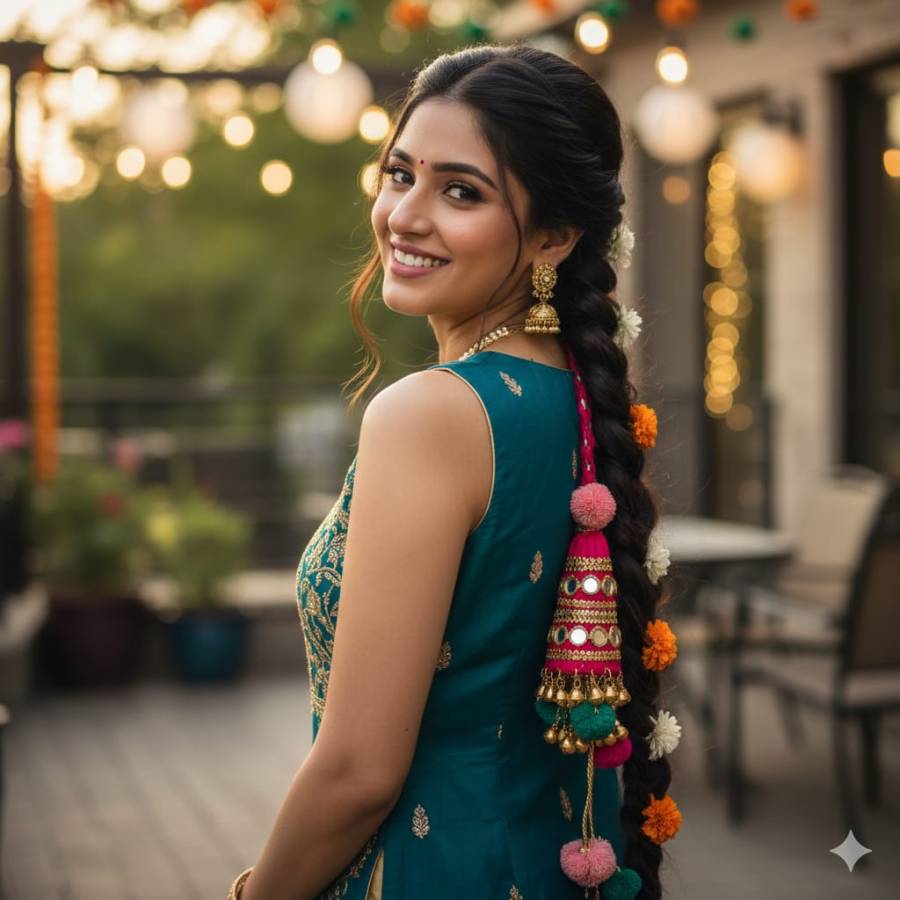
In the cultural imagination of Punjab, few objects are as instantly recognisable as the parandi. Swinging gently with every step, stitched with colour and rhythm, it is far more than a decorative hairpiece. The parandi carries memory, movement, and meaning—woven together through generations of women who wore it not just for beauty, but for belonging.
Set against the mustard-yellow fields and vibrant phulkari shawls of Punjab, the parandi has always been part of the landscape. Traditionally tied into a long braid, it adds length, weight, and ornamentation to the hair. Made from silk threads and decorated with mirrors, pom-poms, beads, or gota, the parandi transforms a simple plait into a statement—one that speaks quietly yet confidently of culture.
A Tradition Born at Home, Not in Fashion Houses
The origins of the parandi lie not in royal courts or design studios, but in the everyday lives of rural Punjab. It began as a practical solution. Long hair was considered a sign of beauty and strength, but maintaining it during long working hours or energetic folk dances was not easy. The parandi helped secure the braid while also extending its length.
Early parandis were handmade at home, often using leftover yarn, silk threads, or wool. Mothers and grandmothers braided them patiently for daughters, sometimes adding protective charms or small beads believed to ward off the evil eye. In these quiet domestic moments, the parandi became an object of care and continuity, passed from one generation to the next.
Over time, as festivals like Lohri and Vaisakhi grew in scale and celebration, the parandi became more elaborate. What was once simple turned decorative, evolving into a form of folk art that reflected joy, prosperity, and community.
When Cinema Gave the Parandi a National Stage
While the parandi was always central to Punjabi culture, it was Indian cinema that introduced it to audiences across the country. In classic Hindi films, the image of the village girl dancing with a long, swinging braid became iconic.
During the 1960s and 70s, actresses such as Vyjayanthimala and Mumtaz brought the parandi into popular imagination. Their dance sequences made the accessory synonymous with grace and expressive movement. Later, in the 1990s, the parandi returned with renewed energy. It became a symbol of confidence and spirited femininity, worn by bold, outspoken female characters.
By then, the parandi had moved beyond regional identity. It became a wedding essential across India, embraced by women far removed from Punjab but drawn to its vibrancy and charm.
Reinvented for a New Generation
Today, the parandi has found new life in contemporary fashion. Designers such as Arpita Mehta and Torani have reimagined it for modern wardrobes, pairing it with lehengas, fusion outfits, and even minimalist silhouettes. Celebrities like Nupur Sanon and Genelia Deshmukh have been seen wearing versions that range from mirror-heavy statement pieces to delicate floral interpretations.
What makes this revival significant is not just aesthetics, but intention. Younger wearers are choosing the parandi as a conscious return to tactile tradition. In an era of fast fashion and fleeting trends, the parandi offers something grounding. Its gentle weight, the sound it makes as one turns their head, and the way it demands movement connect the wearer to lived experience rather than spectacle.
Beyond Punjab: A Cultural Crossover
The parandi is no longer limited by geography. South Indian brides now blend silk tassels into floral jadas. Urban stylists pair playful, doll-inspired parandis with contemporary outfits. Across regions and styles, the accessory adapts without losing its essence.
This flexibility is what keeps the parandi relevant. It does not resist change; it absorbs it. Each reinterpretation adds another layer to its story, making it a shared cultural object rather than a fixed symbol.
A Simple DIY That Keeps the Tradition Alive
One of the parandi’s enduring strengths is its accessibility. It does not require luxury materials or expert craftsmanship.
With a handful of yarn strands, a simple braid, and a few decorative elements like bells or pom-poms, anyone can create a parandi in minutes. Tied at the base of a ponytail and braided into the hair, it instantly adds character and movement—proof that tradition does not have to be complicated to be meaningful.
More Than an Accessory
At its core, the parandi is not just about how it looks, but how it feels. It moves when you move. It announces joy without words. It reminds the wearer that fashion can be personal, cultural, and emotional all at once.
Some traditions fade quietly. Others, like the parandi, continue to sway—carrying memory, movement, and meaning into every generation that chooses to wear them.
















Leave a Comment