
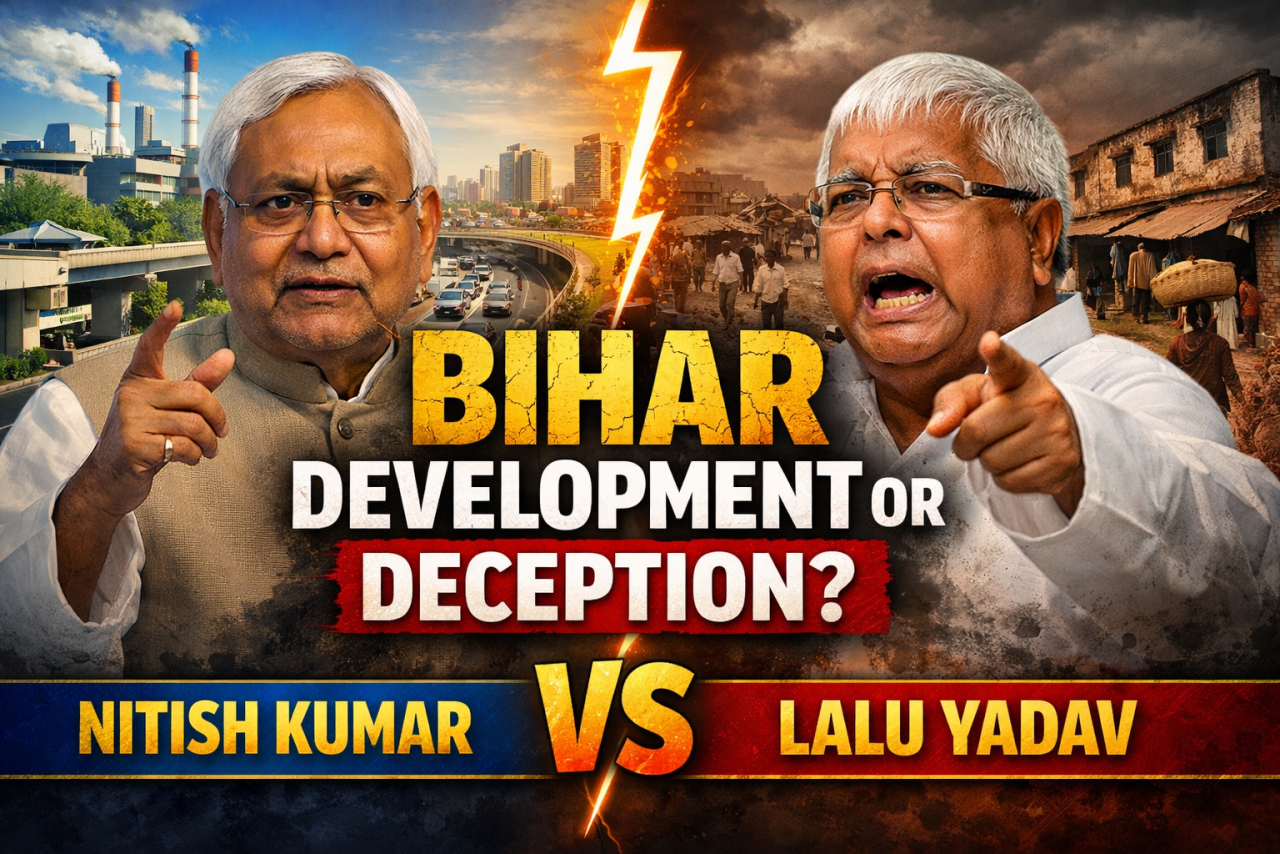
For years, Nitish Kumar was hailed as the architect of a “new Bihar.” But two decades later, the state’s economic reality raises a difficult question: was the transformation real, or largely rhetorical?
Politics often remembers villains more clearly than illusionists. Lalu Prasad Yadav was never an illusionist. He was loud, ideological, theatrical, and unapologetic about the politics he practised. Bihar under him was accused of stagnation, lawlessness, and administrative decay. But Lalu never promised technocratic transformation. His politics revolved around social justice and empowerment of the backward classes.
Nitish Kumar, by contrast, built his entire legitimacy on a very different promise: governance, efficiency and development. The contrast between the two political narratives is what makes the current moment particularly revealing. As Nitish Kumar prepares to enter the Rajya Sabha, potentially marking the closing act of his long tenure in Bihar’s executive politics, the state confronts a question that has lingered quietly for years: did the politics of promise create a deeper illusion than the politics of ideology?
The answer may lie not in rhetoric, but in the arithmetic of Bihar’s reality.
The Promise of Governance
When Nitish Kumar first became chief minister in 2005, Bihar was emerging from a period widely described as institutional decline. Roads were broken, law and order fragile, and public administration visibly weakened. Nitish Kumar’s arrival was presented as a corrective moment — the arrival of governance.
To his credit, the early years did witness visible changes. Road construction accelerated. Public infrastructure improved. Administrative procedures became more predictable. Bihar’s growth rate during several years of the late 2000s and early 2010s was among the fastest in India.
But growth numbers, like political speeches, require context. High growth rates often appear dramatic when the starting base is extremely low. The deeper test of governance is structural transformation — the creation of durable systems in education, employment and industry.
On that test, Bihar’s story becomes far more complicated.
Two Elections, One Emotional Appeal
Nitish Kumar’s later electoral campaigns relied less on bold developmental claims and more on emotional persuasion. In both the 2020 and 2025 assembly elections, a central appeal was the idea of “one more chance.”
The phrase sounded modest. But it carried an implicit admission: the transformation promised earlier had not yet arrived.
Politics allows leaders the benefit of time, but time also sharpens accountability. By the mid-2020s Nitish Kumar had effectively governed Bihar, directly or indirectly, for nearly two decades. Few Indian chief ministers have enjoyed such political longevity.
If transformation had to happen, two decades was not an unreasonable horizon.
Yet Bihar today remains the state with the lowest per capita income in India. Industrial investment continues to be limited. Large-scale private sector employment is scarce. Millions of workers still migrate each year to states such as Maharashtra, Gujarat, and Delhi in search of livelihoods.
The most telling indicator lies in the structure of the workforce. Nearly half of Bihar’s labour force remains dependent on agriculture, while manufacturing employment is minimal compared with industrial states. This is not merely an economic statistic; it reflects the absence of an industrial ecosystem capable of absorbing the aspirations of a young population.
The Education Paradox
Education illustrates the paradox of governance most clearly.
Over the years, Bihar expanded school enrolment and implemented welfare schemes designed to increase attendance, particularly among girls. These initiatives did improve access.
But access is not the same as quality.
Independent learning assessments repeatedly show that many students in Bihar struggle with basic literacy and numeracy levels appropriate for their age groups. Higher education opportunities within the state remain limited, forcing thousands of students each year to migrate to other states for university education.
A government can build classrooms, but a society ultimately judges the classrooms by the opportunities they produce. On that measure, the gap between promise and outcome remains striking.
The Politics of Constant Reinvention
Another defining feature of Nitish Kumar’s political career has been his extraordinary ability to reinvent alliances.
Over the past decade alone, Bihar witnessed multiple realignments involving the Bharatiya Janata Party and the Rashtriya Janata Dal. Each shift was justified with the language of principle or stability. But frequent realignments inevitably blur accountability.
If governance succeeds, credit is claimed collectively. If governance fails, responsibility becomes diffuse.
This fluidity has been one of Nitish Kumar’s greatest political strengths. It allowed him to remain central to Bihar’s power structure even as alliances changed.
But it also meant that the narrative of governance often moved faster than the reality of development.
The Difference Between Failure and Illusion
Lalu Prasad Yadav’s era is widely criticised, but its limitations were visible and openly debated. Bihar under Lalu was described as stagnant, and few defenders attempted to portray it as an economic miracle.
Nitish Kumar’s era operated under a different narrative. Bihar was repeatedly described as a success story of governance. The phrase “model of development” appeared frequently in political discourse.
The problem with narratives is that they eventually collide with statistics.
After two decades of governance centred on the promise of development, Bihar still ranks at the bottom of India’s economic ladder. Migration remains a defining feature of its social landscape. Industrialisation remains limited. Employment opportunities remain scarce.
This does not mean that nothing improved. Roads did improve. Administrative procedures did stabilise. Welfare delivery did expand.
But expectations were never limited to roads and paperwork.
The promise was transformation.
A Legacy Under Reconsideration
Nitish Kumar’s transition to the Rajya Sabha marks more than a personal career shift. It signals the end of an era in which one leader shaped Bihar’s political narrative for nearly a generation.
History will undoubtedly recognise his political skill and longevity. Few leaders have navigated India’s turbulent coalition politics with such persistence.
But history is rarely satisfied with survival alone.
It asks a simpler question: after so many years in power, what changed permanently?
If the answer remains uncertain, Bihar may eventually reach an uncomfortable conclusion — that the loud politics of ideology did less damage than the quiet politics of promise.
And in that reckoning, the illusion may prove deeper than the failure.






















Leave a Comment