
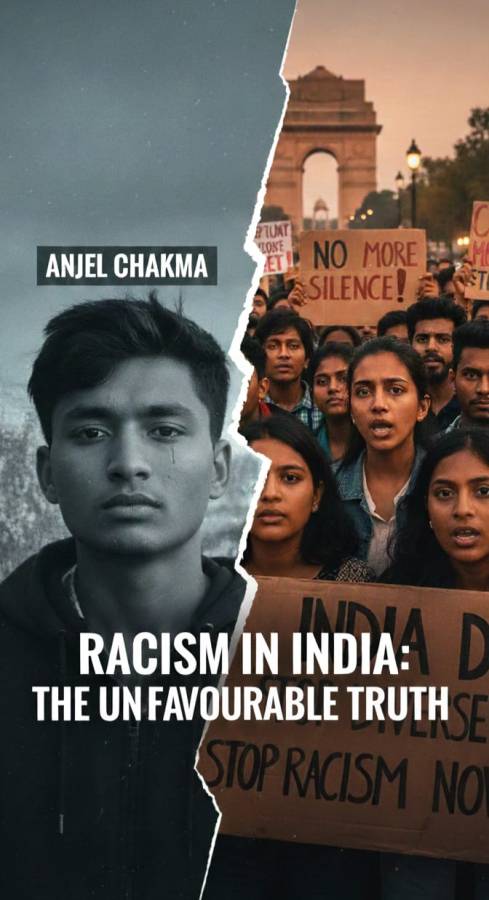
The killing of Anjel Chakma has reopened a deeply uncomfortable conversation in India—one that many prefer to avoid. On December 9, 2024, in the Selaqui area of Dehradun, Anjel and his brother Michael were simply out for groceries when they were targeted with racial slurs. When Anjel stood his ground, asserting, “We are not Chinese... We are Indians. What certificate should we show to prove that?” he was met with a brutal stabbing. After fighting for his life for 14 days, he passed away.
His story is not just a headline; it is a mirror reflecting a harsh reality. Racism in Indian society is real. It is not an imported idea or a Western accusation. It exists persistently and often violently, especially toward people from the Northeast, African communities, and those who do not fit dominant social identities.
The Illusion of Inclusion
For years, India has taken pride in its status as a diverse and pluralistic nation. While the "unity in diversity" slogan is taught in every school, it often masks a darker undercurrent. Discrimination based on physical appearance, ethnicity, and language is embedded in everyday life. The tragedy involving Anjel Chakma did not occur in isolation. It sits within a long pattern of prejudice that surfaces whenever a life is lost or a video goes viral.
In India, racism rarely announces itself with a bullhorn. Instead, it hides behind "harmless" jokes, casual slurs, and social exclusion. People from the Northeast are frequently mocked for their facial features, asked if they are "really Indian," or treated as outsiders in their own country.
A Culture of Normalization
What makes these incidents particularly troubling is the normalization of this behavior. Many grow up hearing remarks that would qualify as hate speech elsewhere but are brushed aside as "teasing." This normalization dulls national empathy. When violence occurs, the public reacts with shock, yet few address the systemic bias that led to the confrontation.
The discourse around Anjel’s death reveals a divided response. While many express genuine grief, others rush to deflect, insisting that "India is not racist" or that the incident shouldn't be "politicized." This instinct to deny is part of the problem. Refusing to name racism does not erase it; it only protects the status quo.
Statistics and the Reality of Discrimination
The numbers reflect a troubling trend. According to various surveys and studies conducted over the last decade:
- Targeted Harassment: A 2014 report by the M.P. Bezbaruah Committee found that over 86% of people from the Northeast living in Delhi had faced some form of racial discrimination.
- Housing and Employment: Studies often show that African students and Northeast migrants face higher rates of rent inflation and "background check" hurdles compared to their peers.
- Legal Lacunae: Despite these numbers, India lacks a specific, comprehensive Anti-Racism Law, a demand that has gained momentum in Tripura following Anjel’s death.
The Role of Social Media and the Law
Social media has become both a mirror and a megaphone. It exposes stories that once went unheard—like the current demand for a ₹25,000 reward for the prime suspect in Anjel’s case—but it also amplifies defensive nationalism. However, justice is not delivered through hashtags. It requires systemic change in policing, housing policies, and legal follow-through.
India’s legal framework, primarily the Scheduled Castes and the Scheduled Tribes (Prevention of Atrocities) Act, offers some protection, but enforcement remains uneven. Language barriers and institutional bias often prevent victims from reporting abuse, fearing they will be further victimized by the system meant to protect them.
From Denial to Accountability
Addressing racism does not mean rejecting national pride; it means strengthening it. A society that acknowledges its flaws is more resilient than one that hides behind denial.
- Education: Schools must move beyond slogans and teach the history and cultures of all Indian states.
- Legislation: There is a pressing need for a national anti-racism law that specifically criminalizes racial slurs and ethnically motivated violence.
- Individual Reflection: Change begins when citizens stop asking if racism exists and start asking how they may be contributing to it through silence or casual bias.
The memory of Anjel Chakma should not fade into a forgotten headline. Protecting India’s strength requires the courage to confront uncomfortable truths—even when they reflect back at us from the mirror of our own society.
By Gautam Jha
Managing Editor
















Leave a Comment