
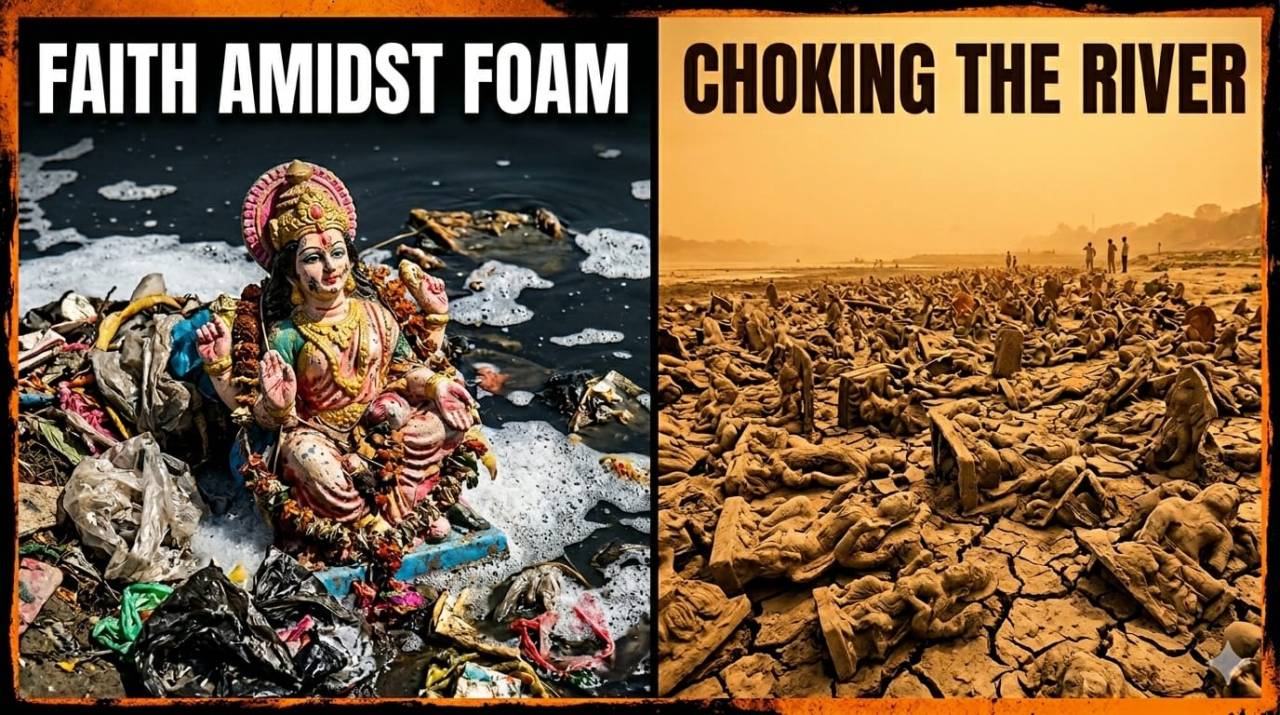
Millions worship the Yamuna as sacred, yet its shrinking banks are littered with discarded idols, ritual offerings, and plastic waste. The contradiction raises a difficult question: who will save the river from those who revere it most?
As the searing summer heat forces the waters of the Yamuna River to recede, it leaves behind a stark, apocalyptic landscape that exposes a painful contradiction at the heart of India's capital. The river, revered by millions as a sacred, life-giving goddess, has instead become a repository for the detritus of human devotion. A recent drop in water levels has uncovered an alarming environmental crisis across the city’s major riverbanks.
According to a recent ground report from a major national daily, the drying riverbeds are now heavily littered with hundreds of abandoned religious idols, framed photographs of deities, cloth offerings, remnants of ceremonial garlands, and plastic waste. This harrowing scene spans crucial stretches of the river, including Ram Ghat, Sonia Vihar, Sur Ghat, and Jagatpur Ghat. Paradoxically, these northern ghats cover the last remaining clean sections of the river—the very zones where Delhi draws its municipal drinking water and where the river's final remaining aquatic life clings to survival.
The Ecological Cost of Devotion
For years, environmentalists and civic agencies have sounded the alarm regarding the devastating ecological impact of direct ritualistic dumping. The problem lies not just in the act of devotion, but in the modern, toxic materials used to manufacture items of faith. Traditional idols made of biodegradable clay have largely been replaced by cheaper, sturdier Plaster of Paris (POP) alternatives.
Unlike clay, POP does not dissolve easily in water and can take months, or even years, to break down. Furthermore, these idols are heavily coated in toxic, chemical-laden paints containing heavy metals such as lead, cadmium, and mercury. When submerged, these chemicals leach directly into the water column. This chemical seepage severely damages river ecology, poisons fish populations, and compromises the primary source of drinking water for millions of Delhi residents.
A Systemic Breakdown of Enforcement
The persistent degradation of the Yamuna occurs despite explicit legal frameworks designed to protect it. In the landmark Manoj Mishra vs. Union of India & Ors. case (Nirmal Yamuna), the National Green Tribunal (NGT) issued a strict directive on January 13, 2015. The ruling explicitly prohibited the disposal of puja materials, idols, food grains, oil, and flowers into the river, mandating that such activities take place only at designated artificial immersion sites. Violators were to be fined ₹5,000 under the "polluter pays principle." Later that year, on September 16, the NGT reinforced these orders, restricting immersions exclusively to eco-friendly, biodegradable materials.
Yet, the conditions visible along the riverbanks suggest that these regulations exist largely on paper. Environmental experts point to a systemic failure in monitoring and enforcement. Bhim Singh Rawat, coordinator of the South Asia Network on Dams, Rivers and People (SANDRP), has noted that rampant dumping continues in blatant violation of NGT directives.
The physical infrastructure meant to deter violators has also fallen into disrepair. Wire mesh protections installed on bridges are broken, and the territorial army personnel and marshals deployed to guard the banks have achieved limited success in preventing the influx of waste. Activists further lament the absence of regular cleaning drives and organized collection points, leaving the river effectively "orphaned" by the authorities responsible for its protection.
Balancing Faith and Survival
The crisis of the Yamuna highlights an urgent need for a cultural shift in how religious practices intersect with environmental stewardship. While the freedom to practice religion is a fundamental right, the destruction of a vital natural resource threatens the collective right to clean water and a healthy environment.
Protecting the Yamuna does not require abandoning faith; it requires redefining responsibility. Civic authorities must strictly enforce NGT guidelines, repair protective barriers, expand artificial immersion facilities, and penalize repeat violators. At the same time, religious communities, temple committees, and local leaders must champion sustainable alternatives, including eco-friendly idols, designated collection centers for ritual offerings, and greater public awareness about the environmental consequences of river dumping.
Without an immediate alignment of civic enforcement and public consciousness, the very river that communities worship may continue its descent toward ecological collapse—becoming not a symbol of life and purity, but a toxic monument to human neglect.
As the searing summer heat forces the waters of the Yamuna River to recede, it leaves behind a stark, apocalyptic landscape that exposes a painful contradiction at the heart of India's capital. The river, revered by millions as a sacred, life-giving goddess, has instead become a repository for the detritus of human devotion. A recent drop in water levels has uncovered an alarming environmental crisis across the city’s major riverbanks.
According to a recent ground report from a major national daily, the drying riverbeds are now heavily littered with hundreds of abandoned religious idols, framed photographs of deities, cloth offerings, remnants of ceremonial garlands, and plastic waste. This harrowing scene spans crucial stretches of the river, including Ram Ghat, Sonia Vihar, Sur Ghat, and Jagatpur Ghat. Paradoxically, these northern ghats cover the last remaining clean sections of the river—the very zones where Delhi draws its municipal drinking water and where the river's final remaining aquatic life clings to survival.
The Ecological Cost of Devotion
For years, environmentalists and civic agencies have sounded the alarm regarding the devastating ecological impact of direct ritualistic dumping. The problem lies not just in the act of devotion, but in the modern, toxic materials used to manufacture items of faith. Traditional idols made of biodegradable clay have largely been replaced by cheaper, sturdier Plaster of Paris (POP) alternatives.
Unlike clay, POP does not dissolve easily in water and can take months, or even years, to break down. Furthermore, these idols are heavily coated in toxic, chemical-laden paints containing heavy metals such as lead, cadmium, and mercury. When submerged, these chemicals leach directly into the water column. This chemical seepage severely damages river ecology, poisons fish populations, and compromises the primary source of drinking water for millions of Delhi residents.
A Systemic Breakdown of Enforcement
The persistent degradation of the Yamuna occurs despite explicit legal frameworks designed to protect it. In the landmark Manoj Mishra vs. Union of India & Ors. case (Nirmal Yamuna), the National Green Tribunal (NGT) issued a strict directive on January 13, 2015. The ruling explicitly prohibited the disposal of puja materials, idols, food grains, oil, and flowers into the river, mandating that such activities take place only at designated artificial immersion sites. Violators were to be fined ₹5,000 under the "polluter pays principle." Later that year, on September 16, the NGT reinforced these orders, restricting immersions exclusively to eco-friendly, biodegradable materials.
Yet, the conditions visible along the riverbanks suggest that these regulations exist largely on paper. Environmental experts point to a systemic failure in monitoring and enforcement. Bhim Singh Rawat, coordinator of the South Asia Network on Dams, Rivers and People (SANDRP), has noted that rampant dumping continues in blatant violation of NGT directives.
The physical infrastructure meant to deter violators has also fallen into disrepair. Wire mesh protections installed on bridges are broken, and the territorial army personnel and marshals deployed to guard the banks have achieved limited success in preventing the influx of waste. Activists further lament the absence of regular cleaning drives and organized collection points, leaving the river effectively "orphaned" by the authorities responsible for its protection.
Balancing Faith and Survival
The crisis of the Yamuna highlights an urgent need for a cultural shift in how religious practices intersect with environmental stewardship. While the freedom to practice religion is a fundamental right, the destruction of a vital natural resource threatens the collective right to clean water and a healthy environment.
Protecting the Yamuna does not require abandoning faith; it requires redefining responsibility. Civic authorities must strictly enforce NGT guidelines, repair protective barriers, expand artificial immersion facilities, and penalize repeat violators. At the same time, religious communities, temple committees, and local leaders must champion sustainable alternatives, including eco-friendly idols, designated collection centers for ritual offerings, and greater public awareness about the environmental consequences of river dumping.
Without an immediate alignment of civic enforcement and public consciousness, the very river that communities worship may continue its descent toward ecological collapse—becoming not a symbol of life and purity, but a toxic monument to human neglect.





















Leave a Comment