
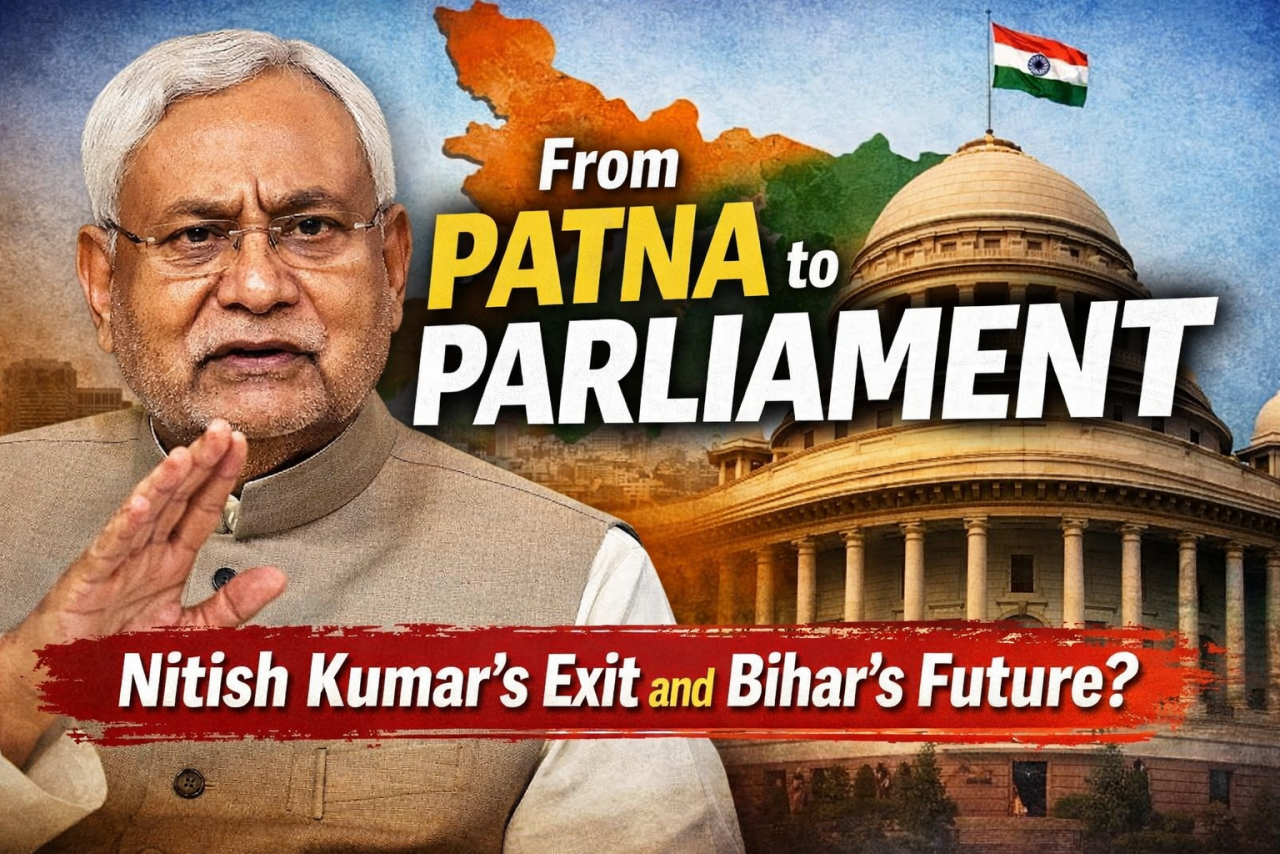
Nitish Kumar’s move to Parliament may be constitutionally valid, but it opens a larger debate on political accountability and the meaning of an electoral mandate.
The resignation of Nitish Kumar from the Bihar Legislative Council on March 30, 2026, marks a defining moment in the state’s political trajectory. After nearly two decades as Chief Minister, his transition to the Rajya Sabha signals not just a personal shift, but a broader reconfiguration of power and accountability in Bihar.
For a leader who has shaped the state’s governance narrative since 2005, the timing of this move—early into his current tenure—raises a fundamental question: does this represent a natural political transition, or does it disrupt the mandate entrusted to him by the electorate?
A Mandate Interrupted
In a parliamentary democracy, leadership transitions within a term are constitutionally valid. Yet, they often invite scrutiny when they occur without a clear electoral trigger. Nitish Kumar’s move to the Rajya Sabha has sparked debate across political and public spheres, with critics arguing that it interrupts a mandate voters expected to last a full term.
For many citizens, particularly in districts like Gaya or Madhubani, the Chief Minister remains the most visible symbol of governance and accountability. His departure at this juncture may be seen not merely as a procedural shift, but as a moment that creates uncertainty about continuity in leadership and policy direction.
The Politics Behind the Transition
Supporters of Kumar have framed the move as a continuation of his long political journey—potentially placing him among the few leaders to have served across multiple legislative institutions, including the Rajya Sabha.
However, political observers suggest that the transition may also carry strategic implications. It could open space within the ruling alliance for the Bharatiya Janata Party to assert greater leadership in the state, recalibrating the balance between allies.
Such interpretations, while speculative, reflect a broader concern in democratic politics: whether electoral mandates are sometimes subsumed within larger strategic realignments at the party or coalition level.
Timing and Political Optics
Nitish Kumar’s tenure has long been associated with the idea of “Sushasan” or good governance—a narrative built over years through welfare programs, infrastructure expansion, and administrative reforms. Yet, his decision to step aside relatively early in his current term inevitably shapes how that legacy is perceived.
Critics argue that the timing raises questions about political priorities, particularly when Bihar continues to grapple with structural challenges such as migration, employment generation, and industrial growth. Supporters, on the other hand, may view this as a transition to a different but still influential role in national politics.
In either case, the move underscores the delicate balance between political continuity and leadership mobility in India’s federal framework.
A Legacy at a Crossroads
There is little doubt that Nitish Kumar leaves behind a transformed Bihar compared to the one he inherited in 2005. Initiatives such as the Jeevika self-help group program, improvements in rural connectivity, and expanded access to electricity have significantly altered the state’s developmental landscape.
At the same time, persistent challenges remain. Issues like large-scale outmigration and limited industrialisation continue to define Bihar’s economic reality. By stepping away at this stage, Kumar leaves these unresolved questions to his successors, adding a layer of complexity to how his legacy will ultimately be judged.
His political journey now appears to straddle two distinct narratives—that of a reformer who reshaped governance, and that of a leader whose final transition came at a moment of unfinished work.
Transition or Turning Point?
Nitish Kumar’s move from Patna to Parliament is both a personal milestone and a political inflection point. While it reflects the fluid nature of leadership within India’s democratic system, it also highlights the expectations voters attach to continuity and accountability.
In the final analysis, the significance of this transition will depend less on the offices held and more on how it is remembered by the people of Bihar. Whether seen as a strategic evolution or an untimely departure, it marks the beginning of a new chapter—not just for Nitish Kumar, but for the state he has led for nearly two decades.























Leave a Comment