
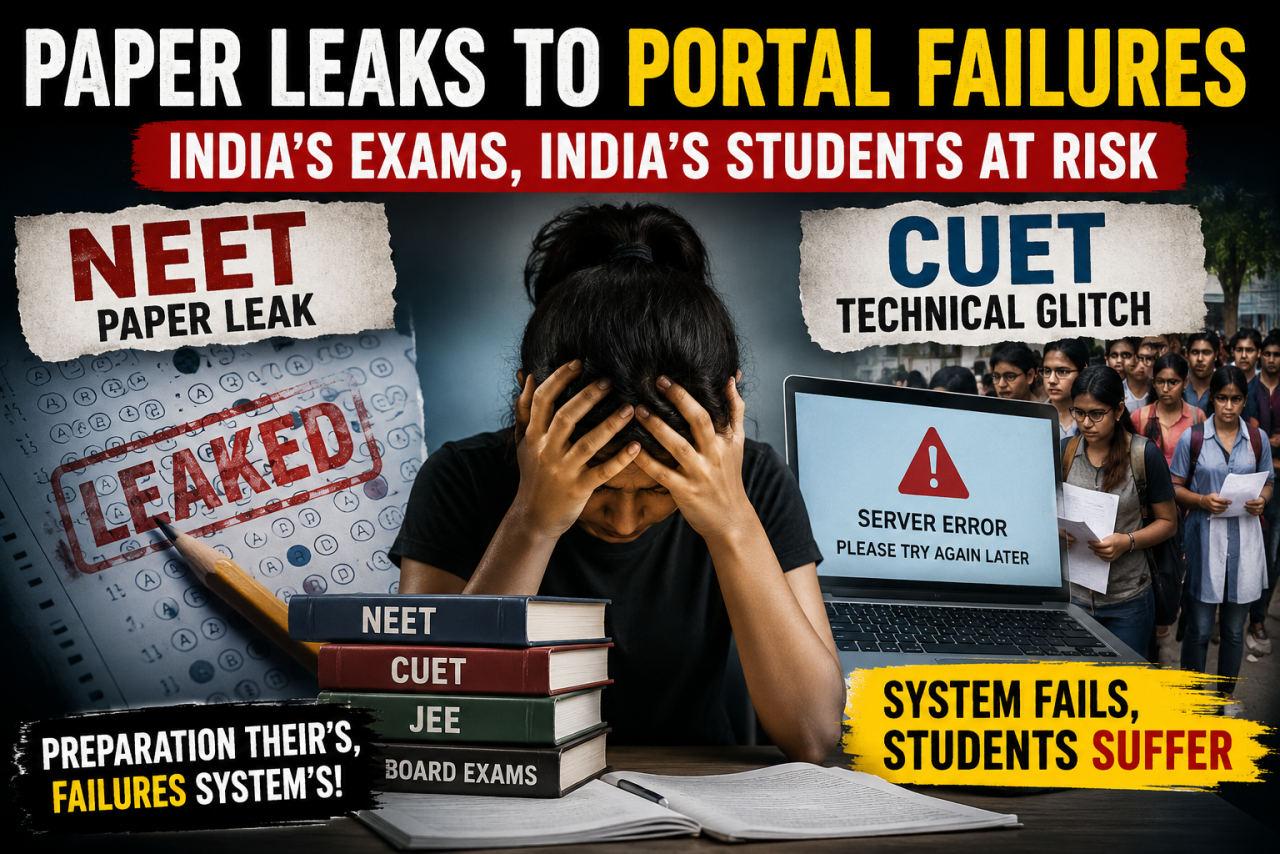
NEET's paper leak and CUET's technical glitch reveal a troubling reality: students are working harder than ever, but the systems meant to judge them are failing.
For millions of young Indians, competitive examinations are not just tests. They are gateways to higher education, professional careers, and often a family's aspirations. Students spend years preparing for exams like NEET, CUET, JEE, and board examinations, believing that hard work and merit will determine their future. However, recent events suggest that another factor increasingly influences outcomes: the reliability of the systems conducting these examinations.
The latest disruption came during the Common University Entrance Test (CUET), where technical glitches reportedly delayed examinations across multiple centres, forcing thousands of students into hours of uncertainty. According to media reports, nearly 3,700 candidates were affected, with some students waiting for hours before being informed that their examinations would be rescheduled.
The incident has reignited concerns about the growing pattern of administrative and technological failures affecting India's examination ecosystem.
A Crisis That Began With NEET
The controversy surrounding the National Eligibility cum Entrance Test (NEET-UG) earlier this year shook public confidence in India's examination system. Allegations of question paper leaks, irregularities in examination centres, and inconsistent results triggered protests across the country.
For students preparing for medical admissions, the issue was not merely administrative. Many had invested years of effort, coaching fees, and emotional energy into a single examination. When questions emerged about the integrity of the process, students felt that merit itself had been compromised.
Investigations, arrests, and court proceedings followed. Yet the damage extended beyond the immediate controversy. Trust, once broken, is difficult to restore.
The NEET episode demonstrated that even the country's most important examinations are vulnerable to systemic weaknesses. The CUET technical failure now suggests that the challenges are not limited to security issues alone but also involve infrastructure and technology management.
When Technology Becomes the Problem
Digital systems are often introduced to make examinations more efficient, transparent, and scalable. India conducts some of the world's largest examinations, making technology essential.
However, technology can only improve outcomes when backed by robust infrastructure, adequate testing, and contingency planning.
The CUET disruption reportedly stemmed from technical issues affecting examination operations. Students arrived on time, completed registration formalities, and waited inside examination centres for hours without clear communication. Some were eventually sent home.
For students, the consequences go beyond inconvenience.
Many travel long distances to examination centres. Some spend money on transportation, accommodation, and meals. Parents often take leave from work to accompany their children. A cancelled or delayed examination means not only emotional distress but also financial burden.
Most importantly, it disrupts the psychological preparation that students carefully build before a major examination.
A Pattern of Recurring Failures
What makes recent incidents particularly concerning is that they are no longer isolated events.
In the past few years, India has witnessed:
- Question paper leaks in various recruitment and entrance examinations.
- Delayed results and evaluation disputes.
- Technical glitches in online examination systems.
- Server failures during application and counselling processes.
- Controversies surrounding digital assessment mechanisms.
Each incident may have different causes, but together they reveal a common problem: the systems responsible for managing high-stakes examinations are struggling to keep pace with their scale and complexity.
India's examination machinery serves tens of millions of students every year. Even a small percentage of failure affects thousands of lives.
The Human Cost Behind the Numbers
Statistics often fail to capture the emotional reality faced by students.
A student preparing for a national-level examination typically spends months or years following a strict routine. Social activities are reduced, family expectations rise, and personal identity becomes closely linked to examination performance.
When examinations are delayed, cancelled, leaked, or disrupted by technical failures, students experience a sense of helplessness. They cannot control the system, yet they bear its consequences.
Mental health experts have repeatedly warned about the growing stress faced by Indian students. Examination uncertainty adds another layer of anxiety to an already competitive environment.
For many students, the question is no longer whether they have prepared enough. It is whether the system itself will function properly on examination day.
Why Accountability Matters
Every technical failure is often described as a "glitch." While the term sounds minor, its impact can be enormous.
When a bridge collapses, investigators examine engineering failures. When a banking system crashes, audits follow. High-stakes examinations deserve the same level of scrutiny.
Authorities must identify not only what went wrong but also why safeguards failed.
Questions that require answers include:
- Were systems adequately stress-tested?
- Were backup plans in place?
- Were vendors and service providers properly evaluated?
- Were warning signs ignored before deployment?
- How will affected students be compensated or accommodated?
Without accountability, the same mistakes are likely to recur.
Final Take
India's ambition to digitize education and examination systems is both necessary and welcome. Technology remains the only practical solution for managing examinations at such enormous scale.
However, digital transformation cannot succeed through software alone. It requires reliable infrastructure, independent audits, cybersecurity safeguards, transparent communication, and rigorous contingency planning.
Most importantly, policymakers must remember that behind every examination roll number is a young person whose future may depend on a single day.
The NEET paper leak and the CUET technical disruption may appear to be different crises, but they point to the same underlying challenge: a system that is becoming increasingly complex without becoming equally dependable.
India's students have demonstrated remarkable resilience. They continue to study, compete, and dream despite repeated disruptions. The least they should expect in return is an examination system that matches their commitment.
When students fulfil their responsibilities, institutions must fulfil theirs. The future of millions depends on it.
For millions of young Indians, competitive examinations are not just tests. They are gateways to higher education, professional careers, and often a family's aspirations. Students spend years preparing for exams like NEET, CUET, JEE, and board examinations, believing that hard work and merit will determine their future. However, recent events suggest that another factor increasingly influences outcomes: the reliability of the systems conducting these examinations.
The latest disruption came during the Common University Entrance Test (CUET), where technical glitches reportedly delayed examinations across multiple centres, forcing thousands of students into hours of uncertainty. According to media reports, nearly 3,700 candidates were affected, with some students waiting for hours before being informed that their examinations would be rescheduled.
The incident has reignited concerns about the growing pattern of administrative and technological failures affecting India's examination ecosystem.
A Crisis That Began With NEET
The controversy surrounding the National Eligibility cum Entrance Test (NEET-UG) earlier this year shook public confidence in India's examination system. Allegations of question paper leaks, irregularities in examination centres, and inconsistent results triggered protests across the country.
For students preparing for medical admissions, the issue was not merely administrative. Many had invested years of effort, coaching fees, and emotional energy into a single examination. When questions emerged about the integrity of the process, students felt that merit itself had been compromised.
Investigations, arrests, and court proceedings followed. Yet the damage extended beyond the immediate controversy. Trust, once broken, is difficult to restore.
The NEET episode demonstrated that even the country's most important examinations are vulnerable to systemic weaknesses. The CUET technical failure now suggests that the challenges are not limited to security issues alone but also involve infrastructure and technology management.
When Technology Becomes the Problem
Digital systems are often introduced to make examinations more efficient, transparent, and scalable. India conducts some of the world's largest examinations, making technology essential.
However, technology can only improve outcomes when backed by robust infrastructure, adequate testing, and contingency planning.
The CUET disruption reportedly stemmed from technical issues affecting examination operations. Students arrived on time, completed registration formalities, and waited inside examination centres for hours without clear communication. Some were eventually sent home.
For students, the consequences go beyond inconvenience.
Many travel long distances to examination centres. Some spend money on transportation, accommodation, and meals. Parents often take leave from work to accompany their children. A cancelled or delayed examination means not only emotional distress but also financial burden.
Most importantly, it disrupts the psychological preparation that students carefully build before a major examination.
A Pattern of Recurring Failures
What makes recent incidents particularly concerning is that they are no longer isolated events.
In the past few years, India has witnessed:
- Question paper leaks in various recruitment and entrance examinations.
- Delayed results and evaluation disputes.
- Technical glitches in online examination systems.
- Server failures during application and counselling processes.
- Controversies surrounding digital assessment mechanisms.
Each incident may have different causes, but together they reveal a common problem: the systems responsible for managing high-stakes examinations are struggling to keep pace with their scale and complexity.
India's examination machinery serves tens of millions of students every year. Even a small percentage of failure affects thousands of lives.
The Human Cost Behind the Numbers
Statistics often fail to capture the emotional reality faced by students.
A student preparing for a national-level examination typically spends months or years following a strict routine. Social activities are reduced, family expectations rise, and personal identity becomes closely linked to examination performance.
When examinations are delayed, cancelled, leaked, or disrupted by technical failures, students experience a sense of helplessness. They cannot control the system, yet they bear its consequences.
Mental health experts have repeatedly warned about the growing stress faced by Indian students. Examination uncertainty adds another layer of anxiety to an already competitive environment.
For many students, the question is no longer whether they have prepared enough. It is whether the system itself will function properly on examination day.
Why Accountability Matters
Every technical failure is often described as a "glitch." While the term sounds minor, its impact can be enormous.
When a bridge collapses, investigators examine engineering failures. When a banking system crashes, audits follow. High-stakes examinations deserve the same level of scrutiny.
Authorities must identify not only what went wrong but also why safeguards failed.
Questions that require answers include:
- Were systems adequately stress-tested?
- Were backup plans in place?
- Were vendors and service providers properly evaluated?
- Were warning signs ignored before deployment?
- How will affected students be compensated or accommodated?
Without accountability, the same mistakes are likely to recur.
Final Take
India's ambition to digitize education and examination systems is both necessary and welcome. Technology remains the only practical solution for managing examinations at such enormous scale.
However, digital transformation cannot succeed through software alone. It requires reliable infrastructure, independent audits, cybersecurity safeguards, transparent communication, and rigorous contingency planning.
Most importantly, policymakers must remember that behind every examination roll number is a young person whose future may depend on a single day.
The NEET paper leak and the CUET technical disruption may appear to be different crises, but they point to the same underlying challenge: a system that is becoming increasingly complex without becoming equally dependable.
India's students have demonstrated remarkable resilience. They continue to study, compete, and dream despite repeated disruptions. The least they should expect in return is an examination system that matches their commitment.
When students fulfil their responsibilities, institutions must fulfil theirs. The future of millions depends on it.























Leave a Comment