
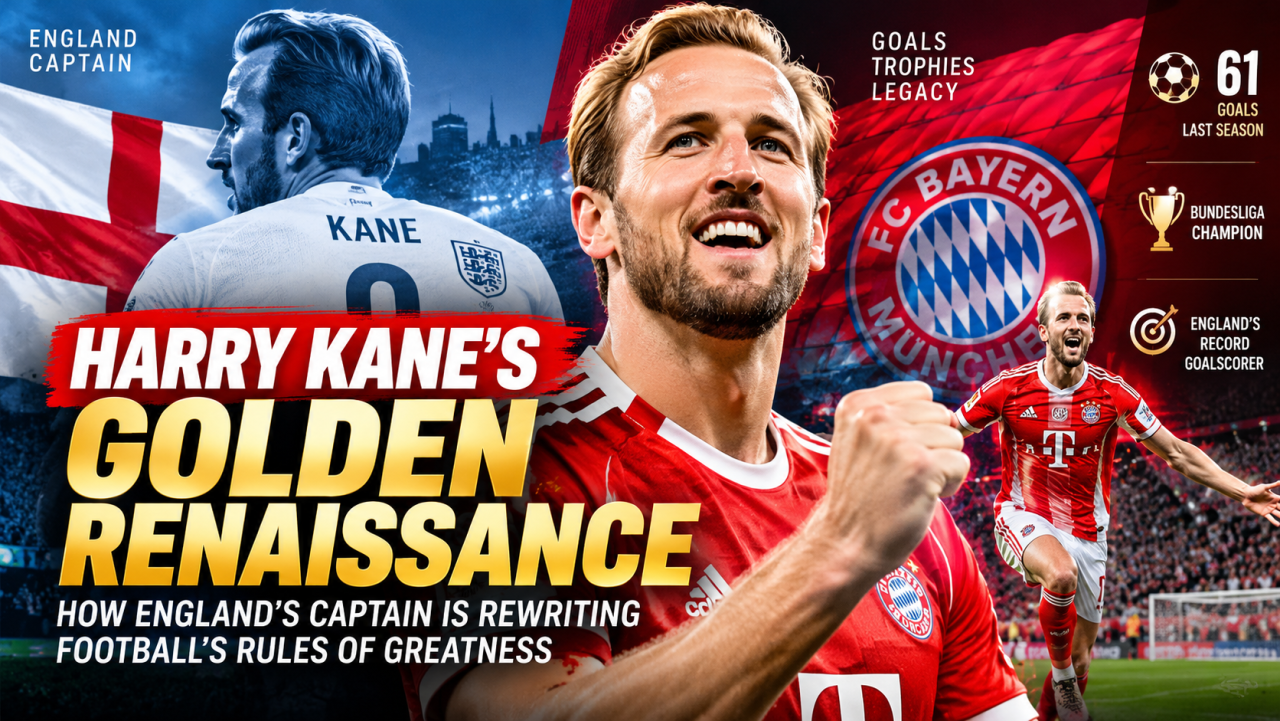
At 33, Harry Kane is defying age, breaking records and redefining greatness at Bayern Munich. But can England’s relentless goal machine finally claim football’s ultimate individual honour?
At 33, Harry Kane is challenging football’s obsession with youth. His remarkable Bayern Munich form reveals how experience, intelligence and reinvention can redefine a striker’s legacy.
Football has always been fascinated by the extraordinary. Lionel Messi made brilliance look effortless. Cristiano Ronaldo turned ambition into an art form. Kylian Mbappé brought breathtaking speed to the modern game. Yet Harry Kane has followed a different path to greatness. He neither possesses Messi’s magical footwork nor Ronaldo’s theatrical presence. His strength lies in something less glamorous but equally devastating: an exceptional understanding of football. At 33, the England captain is producing performances that challenge conventional assumptions about a striker’s prime. His goals are arriving with astonishing regularity, his influence extends beyond the penalty area, and his career appears to be entering another remarkable chapter. Kane is demonstrating that footballing intelligence can sometimes accomplish what youthful exuberance cannot.
From Tottenham’s Dependable Scorer to Bayern’s Relentless Finisher
For much of his career, Kane carried Tottenham Hotspur’s attacking ambitions. He scored consistently, created opportunities and became one of England’s most accomplished forwards. Yet his extraordinary individual achievements were frequently overshadowed by Tottenham’s inability to secure major silverware.
His move to Bayern Munich in 2023 represented more than a transfer between European clubs. It offered an opportunity to redefine his career beyond the familiar boundaries of English football.
The transformation has been striking.
Kane scored 36 Bundesliga goals during his debut season, immediately establishing himself among Germany’s most formidable attackers. More importantly, he demonstrated that his effectiveness was not dependent on the Premier League’s familiar surroundings.
Germany presented different tactical demands, defensive structures and expectations. Kane adapted without compromising his natural game.
His recent scoring exploits have reinforced that adaptability. A remarkable tally of 61 goals across a completed Bayern campaign, followed by an explosive opening to the next, has placed him among the most productive forwards in European football.
These numbers deserve attention. However, they reveal only part of his contribution.
The Intelligence Behind the Goals
Modern football increasingly rewards versatility. A traditional centre-forward once operated primarily inside the penalty area, waiting for opportunities. Kane approaches the position differently.
He frequently drops into midfield, draws defenders away from their positions and creates space for advancing teammates. His passing range allows Bayern to build attacks through him rather than merely towards him.
This distinction matters.
Kane can function simultaneously as a goalscorer, playmaker and tactical organiser. His movements create problems that defenders cannot easily resolve. Following him leaves space behind. Ignoring him gives him time to distribute the ball.
His finishing, meanwhile, remains remarkably economical.
Unlike attackers who depend heavily on pace or elaborate dribbling, Kane relies on positioning, anticipation and precision. He understands where the ball is likely to arrive before defenders recognise the danger.
Such qualities generally improve through experience.
That explains why his advancing age has not diminished his effectiveness. His game was never built exclusively around physical superiority. It was constructed around decisions.
Why Bayern Munich Has Become His Perfect Platform
Bayern provides something Kane rarely enjoyed consistently at Tottenham: a team accustomed to dominating possession and creating sustained attacking pressure.
The German champions possess the resources, tactical organisation and attacking talent necessary to support an elite striker.
For Kane, this environment has proved particularly rewarding.
He no longer needs to shoulder every attacking responsibility. His teammates can exploit the spaces he creates, while their movement offers him additional scoring opportunities.
The relationship is mutually beneficial.
Bayern gains a forward capable of transforming possession into goals. Kane gains a structure that maximises his technical strengths.
His contribution has also extended beyond individual statistics. Bayern’s Bundesliga triumph in 2024–25 finally ended the long-running discussion surrounding his absence of major team trophies.
For years, critics questioned whether individual brilliance could constitute greatness without collective success. That argument now carries considerably less force.
The Ballon d’Or Question
Kane’s remarkable productivity inevitably raises questions about football’s most prestigious individual recognition.
The Ballon d’Or has historically celebrated exceptional goalscorers, influential playmakers and players whose performances define successful seasons.
Kane possesses several of those credentials.
His consistency is extraordinary. His technical contribution extends beyond scoring. His leadership for club and country provides another dimension to his reputation.
Yet individual awards are rarely determined by statistics alone.
Champions League performances, international tournaments, team achievements and the narratives surrounding rival players all influence the outcome.
Kane therefore faces competition not merely from other strikers but from footballers occupying different tactical roles.
Nevertheless, his sustained excellence makes him difficult to overlook.
The larger question is whether football's appreciation of spectacular individual moments sometimes undervalues the quieter sophistication of players like Kane.
England’s Captain and the Unfinished International Ambition
Kane’s significance extends well beyond Munich.
As England’s record goalscorer, he has become a central figure in the national team’s modern history. His international record reflects consistency across changing managers, tactical systems and generations of teammates.
England has reached major tournament finals during his captaincy, but the ultimate prize has remained elusive.
That absence continues to shape assessments of his legacy.
Winning an international trophy would elevate Kane’s standing considerably. Yet reducing his achievements to whether England eventually wins a tournament would overlook the remarkable contribution he has already made.
Football is a collective sport, even when its greatest individuals dominate the conversation.
Greatness Does Not Always Need Reinvention
Perhaps the most fascinating aspect of Kane’s career is its apparent simplicity.
He has not dramatically reinvented himself through extravagant technical experimentation. Instead, he has refined the qualities that made him exceptional.
His movement has become more calculated. His passing remains influential. His finishing reflects years of accumulated experience.
While younger attackers frequently dominate football’s marketing machinery, Kane offers a compelling alternative narrative.
He represents professional longevity built on discipline, adaptability and an almost obsessive commitment to improvement.
His career also challenges the assumption that a footballer’s most productive years must necessarily arrive before 30.
For certain players, experience becomes an advantage rather than a limitation.
Kane belongs firmly in that category.
The England captain may never command the same cultural fascination as Messi or Ronaldo. He may never become football’s most flamboyant personality. But his performances increasingly demand recognition on their own terms.
Ultimately, greatness is not measured by spectacle alone. It is measured by influence, consistency and the ability to deliver when expectations become overwhelming.
Harry Kane has spent his career answering those expectations with goals. Now, at an age when many forwards begin contemplating decline, he is offering football another possibility.
Perhaps the finest chapter of a great striker’s career does not always arrive first. Sometimes, it comes when experience finally catches up with ambition.
























Leave a Comment