
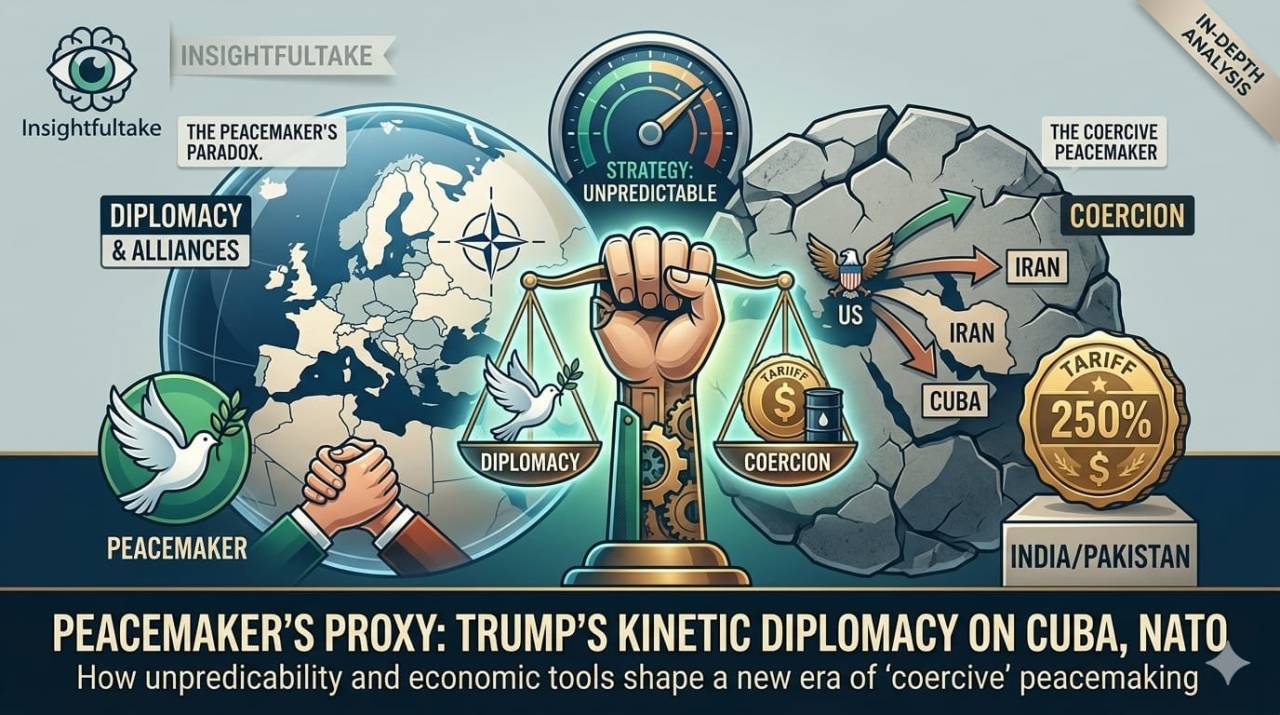
He calls himself a peacemaker—but his latest words on Cuba and NATO suggest a very different playbook.
Remarks by Donald Trump at a Miami investment forum have drawn attention for their direct tone and policy signals that could have wider global impact. Speaking before business leaders and investors, Trump outlined his views on ongoing conflicts, U.S. alliances, and the use of economic and military pressure in foreign policy. While he described himself as a “peacemaker,” his comments included references to potential military action, tariff threats, and conditional support for allies. The combination of these positions has raised questions among analysts and diplomats about whether the United States is moving toward a more force-driven and transactional approach in its international engagements.
Focus on Cuba
A key line from the speech was: “Cuba is next.” Trump made the comment while referring to U.S. actions in Venezuela and Iran. The remark points to a tougher approach toward Cuba, which is currently facing an economic crisis and fuel shortages.
Trump said Cuba is close to collapse and suggested it could be pressured further. At the same time, there are reports of limited back-channel contacts with parts of the Cuban leadership. This creates a mixed picture—talks on one side, warnings on the other.
He also spoke about the role of the military, saying force may not be needed but cannot be ruled out. The statement reflects a shift from clear deterrence to a more open-ended position where both pressure and engagement are used together.
Questions Over NATO
Trump also raised doubts about the role of the NATO alliance. He said the United States should not automatically support allies who do not contribute enough.
This suggests a move away from the idea of shared responsibility that has defined NATO for decades. Instead, Trump indicated that support could depend on what allies offer in return.
The comments come at a time of differences between the U.S. and some European countries over Iran. Several allies have opposed military escalation, while Trump has taken a more aggressive stance. His remarks may increase pressure on those countries to align more closely with Washington.
Claim of ‘Peacemaker’
Despite the strong language, Trump repeated that he wants to be seen as a peacemaker. He said he had helped prevent conflicts in several cases, including tensions between India and Pakistan.
According to Trump, economic pressure played a key role. He referred to the use of tariffs as a way to push countries to step back from conflict. This reflects a broader approach where trade and economic tools are used alongside military strength.
His statements suggest a model of diplomacy based less on long negotiations and more on immediate pressure—either economic or strategic—to influence outcomes.
Shift in Approach
For many years, U.S. foreign policy has relied on stable alliances and clear commitments. Trump’s remarks indicate a different approach. By questioning NATO while still expecting support, and by warning Cuba while keeping communication channels open, the policy appears less predictable.
Supporters argue that this flexibility gives the U.S. more leverage. Critics say it creates uncertainty and could weaken trust among allies.
Final Take
Trump’s comments highlight a wider debate about how the U.S. should use its power. His approach combines economic measures, military signals, and direct messaging. The goal, he says, is to avoid long conflicts and reach quick outcomes.
However, it is not yet clear how this strategy will affect global stability. Allies may seek clearer assurances, while rivals may test the limits of U.S. policy.
The gap between Trump’s “peacemaker” claim and his willingness to use pressure remains a key point of discussion. As the situation develops, it will shape how other countries respond to the U.S. and how future conflicts are managed.



















Leave a Comment