
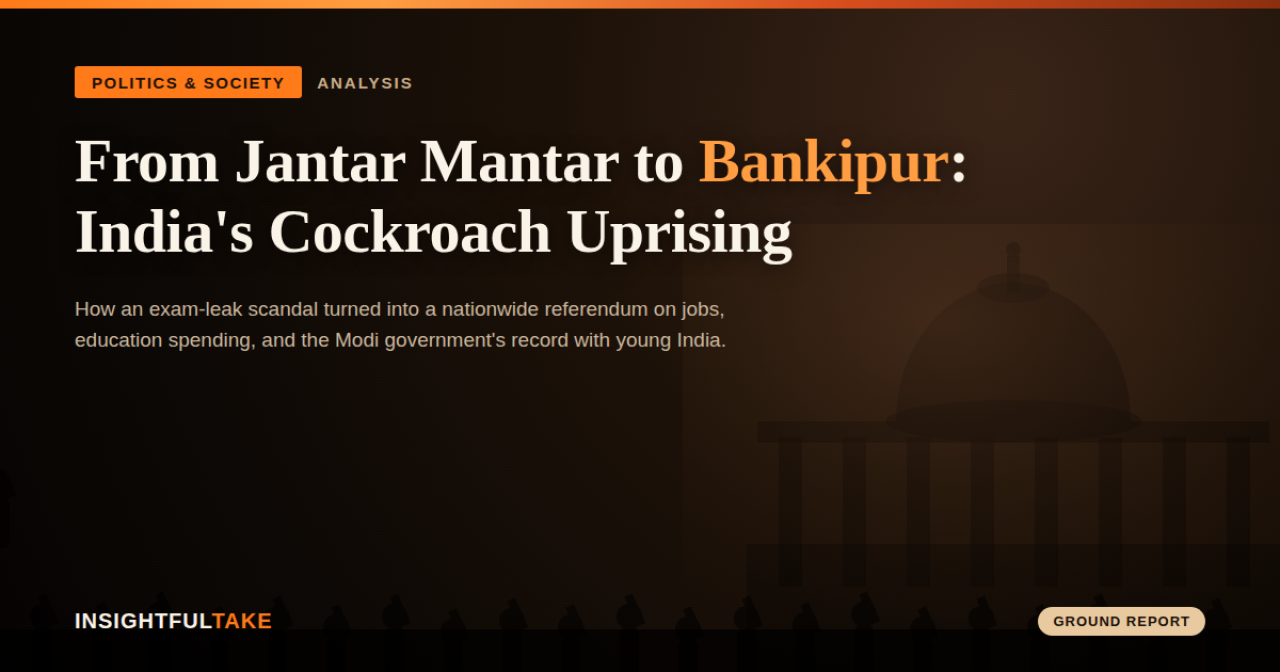
When an exam scandal became a symbol of India’s wider youth anger, the “cockroach” insult stopped being an insult and became a political warning.
Every generation finds its own word of insult. India’s Gen Z has taken “cockroach”, a word meant to demean young protesters, and turned it into a slogan, a political identity and a symbol of anger at the state.
What began with an examination scandal soon became a wider protest over jobs, recruitment, education and the sense among young Indians that the system demands more from them than it offers in return. From Jantar Mantar to Ranchi and from hunger strikes to the ballot box in Patna, the anger has travelled well beyond the original trigger.
The question now is no longer simply whether an examination was compromised. It is whether India’s young voters still believe that the political system understands what they are asking for.
Where It Began
The immediate trigger was an examination crisis. The NEET-UG medical entrance test, scheduled for May 3, was called off after allegations of a paper leak, unsettling the futures of more than 2.28 million students who had spent a year, and often much longer, preparing for a single examination.
The controversy acquired a sharper political edge after Chief Justice Surya Kant’s reported remarks describing unemployed youth as “cockroaches” and “parasites” attacking institutions. Students quickly turned the language against its intended meaning.
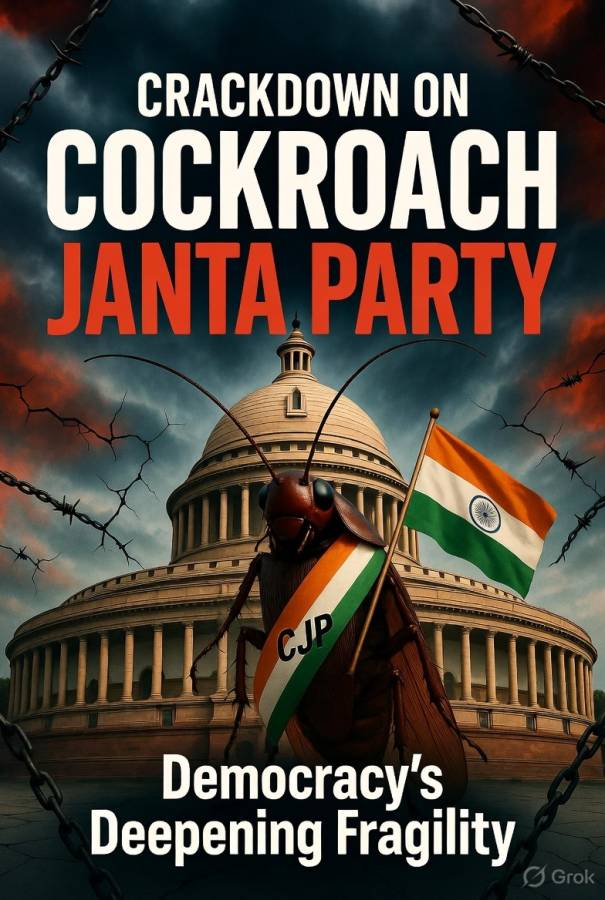
Abhijeet Dipke, a student in Boston, embraced the “cockroach” label, and what began as an act of defiance developed into the Cockroach Janta Party, or CJP. The group moved from social media into street politics, eventually appearing at Jantar Mantar as a protest movement rather than an internet joke.
The protests gained national attention after Sonam Wangchuk’s 23-day hunger strike and his forcible removal from the protest site. The July 20 march towards Parliament brought lathi charges, tear gas and an internet shutdown in parts of central Delhi. The CJP claimed around 150 protesters were injured, while 118 police personnel were reportedly injured.
Five days later, Education Minister Dharmendra Pradhan resigned, citing moral responsibility while continuing to defend the ministry’s record.
The symbolism was difficult to miss. A controversy that began with an examination had become a confrontation between young Indians and the institutions responsible for their education and employment.
The Charge Sheet
Strip away the satire and the underlying grievances are serious.
India has one of the world’s largest young populations, yet secure employment remains out of reach for millions. Graduate unemployment is particularly high, while competitive government examinations have become gateways to a limited number of coveted jobs.
Education spending exposes another part of the problem. Combined spending by the Centre and states has remained around 4 percent of GDP for years, well below the 6 percent target recommended by the Kothari Commission and repeatedly echoed in national education policy.
There is also a growing private economy built around the failure of public systems to meet demand. Coaching centres, test-preparation platforms and private tutors have become an unofficial extension of India’s education system. Families spend heavily because the cost of losing a year is often greater than the cost of preparation itself.
For millions of students, therefore, an examination is not merely an examination. It can determine whether they study medicine, obtain a government job, move abroad, return home unemployed or spend another year preparing for the next attempt.
That pressure explains why a paper leak can become a political flashpoint.
Beyond Delhi
What makes the CJP movement significant is its attempt to connect grievances that have traditionally remained separate.
Student protests over recruitment, examinations and education have appeared across India for years. What is different this time is the attempt to create a common political vocabulary around them.
In August, a CJP delegation travelled to Ranchi to support students protesting the Jharkhand Public Service Commission’s recruitment process. The movement also claimed solidarity demonstrations in cities including Patna, Goa, Mumbai, Bengaluru, Kolkata, Dehradun and Guwahati.
The grievances are not identical.
In Jharkhand, recruitment and government jobs dominate the conversation. In Bihar, migration and the scarcity of employment remain central concerns. In Goa, economic pressures and employment have their own political dimensions.
But the underlying question is similar: what does the Indian state offer young people after years of education and examination?
The movement has therefore grown beyond a single paper leak. It has become a platform for grievances that were already present.
The Government’s Answer
The BJP’s response has combined confrontation, defence of its record and attempts to appeal directly to younger voters.
Party leaders have accused protesters of trying to weaken the country, while the government has pointed to increased higher-education allocations, tougher action against examination fraud and initiatives aimed at career counselling.
The government’s broader argument is that investment in education and employment has increased and that institutional reforms are underway.
But statistics do not automatically settle political anger.
A student who has spent years preparing for a competitive examination is unlikely to judge the state by an allocation figure alone. The practical questions are simpler. Was the examination fair? Was the recruitment process transparent? Will there be enough jobs? And if something goes wrong, will anyone be held accountable?
The government’s social-media outreach has also revealed the difficulty of speaking to Gen Z in a language designed by political strategists. Slang and short-form videos can create visibility, but they cannot substitute for credibility.
Then Came Bankipur
The bypoll in Bankipur, in Patna, offered the movement its first major electoral test.
The constituency carried symbolic importance for the BJP. It was the home seat of the party’s national president and had remained with the BJP since 1995.
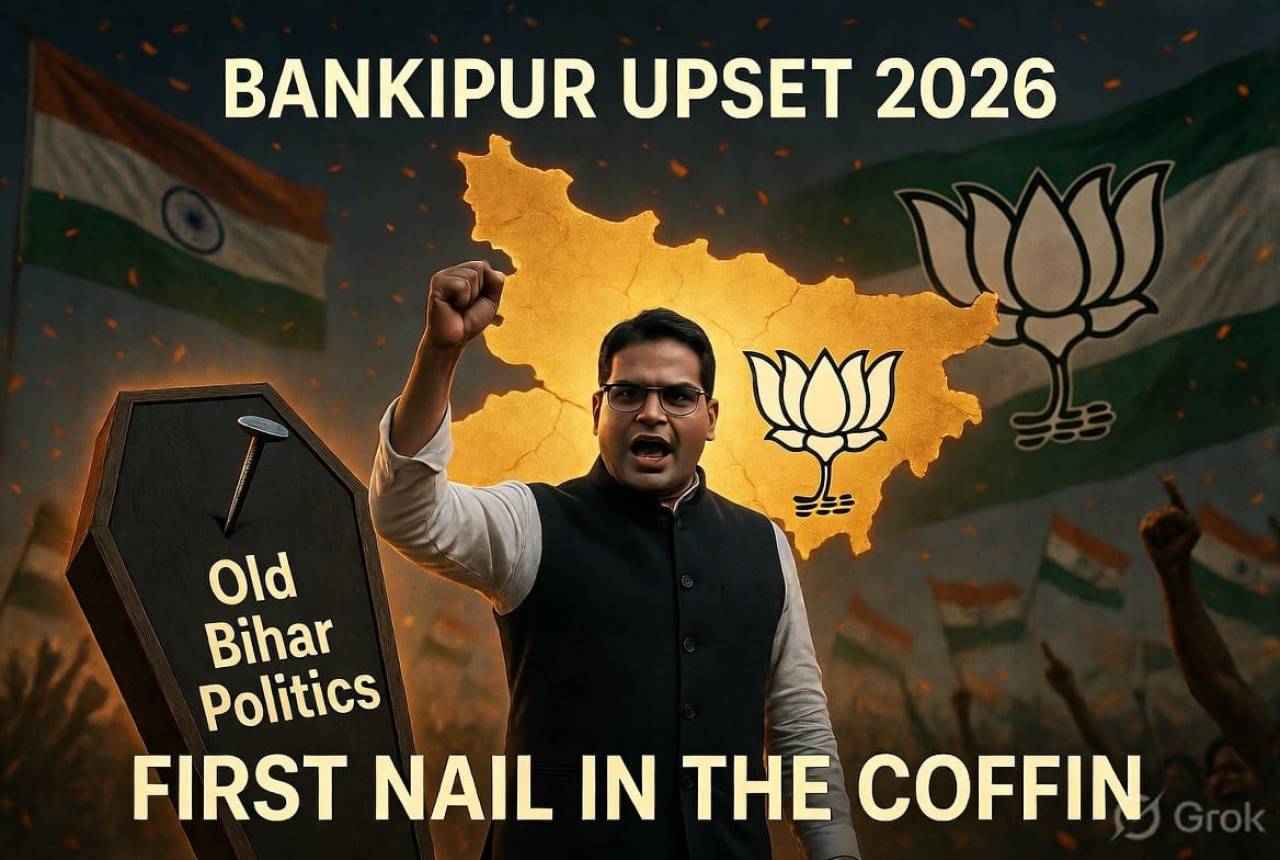
Prashant Kishor’s Jan Suraaj Party won the seat by nearly 19,000 votes, while turnout fell by more than seven percentage points compared with the general election.
The result cannot automatically be described as a youth revolt against the BJP. Elections rarely provide such clean conclusions. But it did offer an uncomfortable signal for a party that has built much of its political strength around its appeal to younger voters.
The important question is not simply who won Bankipur. It is why some young voters are becoming increasingly willing to look beyond the established political choices.
What Remains Unsettled
The protests may eventually fade from the headlines. The deeper problem will not disappear so easily.
The argument is no longer only about how much governments spend on education. It is about whether that spending produces fair examinations, credible recruitment, affordable education and meaningful employment.
It is also about political language.
Calling young protesters names may generate outrage for a day. Turning that insult into a political identity can give the anger a life of its own.
That is what makes the “cockroach” episode more than a curious piece of protest theatre. A generation facing fierce competition for education and employment has found a label it can reclaim. Whether that identity becomes a lasting political force remains uncertain.
But Bankipur offers an early warning.
Young Indians may not always know which party deserves their vote. They increasingly know what they want from whoever gets it: a fair examination, a credible recruitment system, affordable education and a job worth staying in India for.
The tents at Jantar Mantar may thin out. The slogans may change. The political alliances may shift.
The question of employment will remain.
And unlike an insult, it cannot be answered with a slogan.
Every generation finds its own word of insult. India’s Gen Z has taken “cockroach”, a word meant to demean young protesters, and turned it into a slogan, a political identity and a symbol of anger at the state.
What began with an examination scandal soon became a wider protest over jobs, recruitment, education and the sense among young Indians that the system demands more from them than it offers in return. From Jantar Mantar to Ranchi and from hunger strikes to the ballot box in Patna, the anger has travelled well beyond the original trigger.
The question now is no longer simply whether an examination was compromised. It is whether India’s young voters still believe that the political system understands what they are asking for.
Where It Began
The immediate trigger was an examination crisis. The NEET-UG medical entrance test, scheduled for May 3, was called off after allegations of a paper leak, unsettling the futures of more than 2.28 million students who had spent a year, and often much longer, preparing for a single examination.
The controversy acquired a sharper political edge after Chief Justice Surya Kant’s reported remarks describing unemployed youth as “cockroaches” and “parasites” attacking institutions. Students quickly turned the language against its intended meaning.
Abhijeet Dipke, a student in Boston, embraced the “cockroach” label, and what began as an act of defiance developed into the Cockroach Janta Party, or CJP. The group moved from social media into street politics, eventually appearing at Jantar Mantar as a protest movement rather than an internet joke.
The protests gained national attention after Sonam Wangchuk’s 23-day hunger strike and his forcible removal from the protest site. The July 20 march towards Parliament brought lathi charges, tear gas and an internet shutdown in parts of central Delhi. The CJP claimed around 150 protesters were injured, while 118 police personnel were reportedly injured.
Five days later, Education Minister Dharmendra Pradhan resigned, citing moral responsibility while continuing to defend the ministry’s record.
The symbolism was difficult to miss. A controversy that began with an examination had become a confrontation between young Indians and the institutions responsible for their education and employment.
The Charge Sheet
Strip away the satire and the underlying grievances are serious.
India has one of the world’s largest young populations, yet secure employment remains out of reach for millions. Graduate unemployment is particularly high, while competitive government examinations have become gateways to a limited number of coveted jobs.
Education spending exposes another part of the problem. Combined spending by the Centre and states has remained around 4 percent of GDP for years, well below the 6 percent target recommended by the Kothari Commission and repeatedly echoed in national education policy.
There is also a growing private economy built around the failure of public systems to meet demand. Coaching centres, test-preparation platforms and private tutors have become an unofficial extension of India’s education system. Families spend heavily because the cost of losing a year is often greater than the cost of preparation itself.
For millions of students, therefore, an examination is not merely an examination. It can determine whether they study medicine, obtain a government job, move abroad, return home unemployed or spend another year preparing for the next attempt.
That pressure explains why a paper leak can become a political flashpoint.
Beyond Delhi
What makes the CJP movement significant is its attempt to connect grievances that have traditionally remained separate.
Student protests over recruitment, examinations and education have appeared across India for years. What is different this time is the attempt to create a common political vocabulary around them.
In August, a CJP delegation travelled to Ranchi to support students protesting the Jharkhand Public Service Commission’s recruitment process. The movement also claimed solidarity demonstrations in cities including Patna, Goa, Mumbai, Bengaluru, Kolkata, Dehradun and Guwahati.
The grievances are not identical.
In Jharkhand, recruitment and government jobs dominate the conversation. In Bihar, migration and the scarcity of employment remain central concerns. In Goa, economic pressures and employment have their own political dimensions.
But the underlying question is similar: what does the Indian state offer young people after years of education and examination?
The movement has therefore grown beyond a single paper leak. It has become a platform for grievances that were already present.
The Government’s Answer
The BJP’s response has combined confrontation, defence of its record and attempts to appeal directly to younger voters.
Party leaders have accused protesters of trying to weaken the country, while the government has pointed to increased higher-education allocations, tougher action against examination fraud and initiatives aimed at career counselling.
The government’s broader argument is that investment in education and employment has increased and that institutional reforms are underway.
But statistics do not automatically settle political anger.
A student who has spent years preparing for a competitive examination is unlikely to judge the state by an allocation figure alone. The practical questions are simpler. Was the examination fair? Was the recruitment process transparent? Will there be enough jobs? And if something goes wrong, will anyone be held accountable?
The government’s social-media outreach has also revealed the difficulty of speaking to Gen Z in a language designed by political strategists. Slang and short-form videos can create visibility, but they cannot substitute for credibility.
Then Came Bankipur
The bypoll in Bankipur, in Patna, offered the movement its first major electoral test.
The constituency carried symbolic importance for the BJP. It was the home seat of the party’s national president and had remained with the BJP since 1995.
Prashant Kishor’s Jan Suraaj Party won the seat by nearly 19,000 votes, while turnout fell by more than seven percentage points compared with the general election.
The result cannot automatically be described as a youth revolt against the BJP. Elections rarely provide such clean conclusions. But it did offer an uncomfortable signal for a party that has built much of its political strength around its appeal to younger voters.
The important question is not simply who won Bankipur. It is why some young voters are becoming increasingly willing to look beyond the established political choices.
What Remains Unsettled
The protests may eventually fade from the headlines. The deeper problem will not disappear so easily.
The argument is no longer only about how much governments spend on education. It is about whether that spending produces fair examinations, credible recruitment, affordable education and meaningful employment.
It is also about political language.
Calling young protesters names may generate outrage for a day. Turning that insult into a political identity can give the anger a life of its own.
That is what makes the “cockroach” episode more than a curious piece of protest theatre. A generation facing fierce competition for education and employment has found a label it can reclaim. Whether that identity becomes a lasting political force remains uncertain.
But Bankipur offers an early warning.
Young Indians may not always know which party deserves their vote. They increasingly know what they want from whoever gets it: a fair examination, a credible recruitment system, affordable education and a job worth staying in India for.
The tents at Jantar Mantar may thin out. The slogans may change. The political alliances may shift.
The question of employment will remain.
And unlike an insult, it cannot be answered with a slogan.





















Leave a Comment