
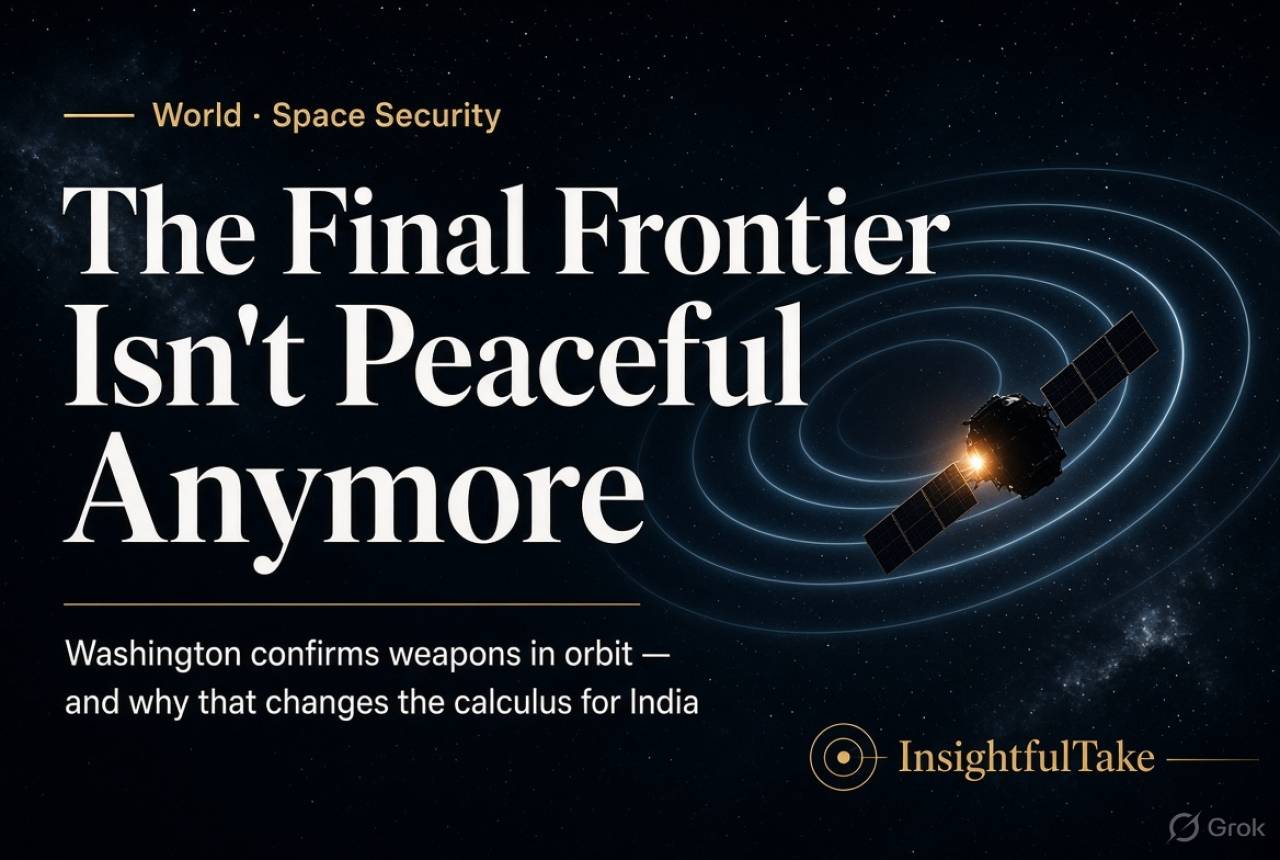
Space is no longer just a domain of exploration and communication. With weapons now acknowledged in orbit, India faces a new strategic reality.
For decades, outer space carried an unusual distinction among the domains of human conflict. Treaties and international norms sought to keep it from becoming another battlefield. That assumption is now under pressure.
The United States has confirmed that it has deployed weapons in orbit. Air Force Secretary Troy Meink said at the Air and Space Cyber Conference in Maryland that Washington has fielded “on-orbit space control weapons” capable of defending US forces against hostile action.
The statement is significant because it confirms that such capabilities are not simply being discussed as a future possibility. They are already part of the military equation.
For every major spacefaring country, including India, that changes the strategic environment.
A quiet shift now being acknowledged openly
The most striking part of the US announcement is not necessarily the existence of the capability. Major military powers have spent years developing technologies designed to protect their satellites, disrupt an adversary's space systems or hold satellites at risk.
What has changed is the willingness to acknowledge such systems publicly.
Meink did not explain what the weapons are, how they operate or whether they are designed to target objects in orbit, systems on the ground or both. That lack of detail leaves considerable room for interpretation.
It also creates strategic uncertainty. If countries do not know exactly what another power can do in space, they have an incentive to prepare for the most serious possible scenario.
Russia and China have criticised the growing weaponisation of outer space. Moscow has called for space to remain free of weapons, while Beijing has also opposed what it describes as the weaponisation of outer space.
At the same time, both countries have demonstrated anti-satellite capabilities. Their destructive tests have also generated orbital debris, highlighting the risks that military competition in space can create for everyone operating there.
The emerging reality is therefore larger than one country's decision. Space is increasingly being treated as another domain of military competition.
Why this matters for India
India has long viewed space primarily through the lens of science, communication, navigation and economic development. That picture has changed steadily.
The 2019 Mission Shakti anti-satellite test demonstrated that India had the ability to destroy a satellite in low Earth orbit. New Delhi described the test as a demonstration of India's defensive and deterrent capability.
India has also established the Defence Space Agency as part of a broader effort to strengthen its military use of space.
The reason is straightforward. Modern armed forces depend heavily on satellites.
Communications, navigation, surveillance, intelligence gathering and precision targeting increasingly depend on space-based systems. Satellites also support civilian functions ranging from weather forecasting and disaster management to telecommunications and navigation.
A conflict that disrupts these systems could therefore affect both military operations and everyday civilian infrastructure.
For India, the question is no longer whether space has strategic importance. It is how much protection its growing space infrastructure requires.
The ammunition lesson India should not overlook
The US disclosure also comes alongside another important Pentagon assessment concerning ammunition stocks.
Washington has acknowledged pressure on its munitions inventories following its air campaign against Iran. Operation Epic Fury has been estimated to have cost around $33.4 billion, including about $22.3 billion in munitions expenditure.
The figures offer a broader military lesson.
Even a country with enormous defence spending can consume weapons faster than its industrial base can replace them during sustained high-intensity operations.
India has faced its own questions about ammunition reserves and production capacity during periods of military tension, including conflicts and stand-offs involving Pakistan and China.
The issue is therefore not simply about how many weapons a country possesses on paper. It is also about how quickly those weapons can be replenished when a conflict continues.
Space warfare could create a similar problem. Satellites and space-based systems can take years to design, manufacture and launch. Losing critical systems in a conflict cannot necessarily be solved by simply ordering replacements.
Is the Outer Space Treaty ready for this new reality
The 1967 Outer Space Treaty remains the central legal framework governing activities in space. India is a party to the treaty.
It prohibits placing nuclear weapons and other weapons of mass destruction in orbit, but it does not prohibit every form of conventional military capability in space.
That distinction has become increasingly important.
The treaty was negotiated at a time when space technology was far less advanced and the military dependence on satellites was nowhere near today's level.
The challenge now is to establish clearer rules for technologies capable of disrupting, disabling or destroying space assets without creating another uncontrolled arms race.
India has supported international efforts to prevent an arms race in outer space, including discussions at the United Nations on the Prevention of an Arms Race in Outer Space, or PAROS.
But diplomacy is becoming more difficult as major powers expand their military capabilities in space.
India has little choice but to prepare
India's space ambitions are expanding rapidly. ISRO's growing satellite capabilities, commercial space activity and the Gaganyaan human spaceflight programme are increasing the country's dependence on a secure and stable space environment.
That makes the growing militarisation of orbit more than a distant geopolitical issue.
India needs resilient satellites, stronger space-domain awareness, secure communications and the ability to protect critical space infrastructure. At the same time, it has an interest in supporting international rules that prevent military competition from turning orbit into an increasingly dangerous battlefield.
America's admission that weapons are already in orbit therefore carries a message far beyond Washington.
The era when space could be treated mainly as a domain of exploration and communication is fading. For India, the challenge is to strengthen its ability to operate in this new environment without allowing the space race to become an unchecked arms race.
For decades, outer space carried an unusual distinction among the domains of human conflict. Treaties and international norms sought to keep it from becoming another battlefield. That assumption is now under pressure.
The United States has confirmed that it has deployed weapons in orbit. Air Force Secretary Troy Meink said at the Air and Space Cyber Conference in Maryland that Washington has fielded “on-orbit space control weapons” capable of defending US forces against hostile action.
The statement is significant because it confirms that such capabilities are not simply being discussed as a future possibility. They are already part of the military equation.
For every major spacefaring country, including India, that changes the strategic environment.
A quiet shift now being acknowledged openly
The most striking part of the US announcement is not necessarily the existence of the capability. Major military powers have spent years developing technologies designed to protect their satellites, disrupt an adversary's space systems or hold satellites at risk.
What has changed is the willingness to acknowledge such systems publicly.
Meink did not explain what the weapons are, how they operate or whether they are designed to target objects in orbit, systems on the ground or both. That lack of detail leaves considerable room for interpretation.
It also creates strategic uncertainty. If countries do not know exactly what another power can do in space, they have an incentive to prepare for the most serious possible scenario.
Russia and China have criticised the growing weaponisation of outer space. Moscow has called for space to remain free of weapons, while Beijing has also opposed what it describes as the weaponisation of outer space.
At the same time, both countries have demonstrated anti-satellite capabilities. Their destructive tests have also generated orbital debris, highlighting the risks that military competition in space can create for everyone operating there.
The emerging reality is therefore larger than one country's decision. Space is increasingly being treated as another domain of military competition.
Why this matters for India
India has long viewed space primarily through the lens of science, communication, navigation and economic development. That picture has changed steadily.
The 2019 Mission Shakti anti-satellite test demonstrated that India had the ability to destroy a satellite in low Earth orbit. New Delhi described the test as a demonstration of India's defensive and deterrent capability.
India has also established the Defence Space Agency as part of a broader effort to strengthen its military use of space.
The reason is straightforward. Modern armed forces depend heavily on satellites.
Communications, navigation, surveillance, intelligence gathering and precision targeting increasingly depend on space-based systems. Satellites also support civilian functions ranging from weather forecasting and disaster management to telecommunications and navigation.
A conflict that disrupts these systems could therefore affect both military operations and everyday civilian infrastructure.
For India, the question is no longer whether space has strategic importance. It is how much protection its growing space infrastructure requires.
The ammunition lesson India should not overlook
The US disclosure also comes alongside another important Pentagon assessment concerning ammunition stocks.
Washington has acknowledged pressure on its munitions inventories following its air campaign against Iran. Operation Epic Fury has been estimated to have cost around $33.4 billion, including about $22.3 billion in munitions expenditure.
The figures offer a broader military lesson.
Even a country with enormous defence spending can consume weapons faster than its industrial base can replace them during sustained high-intensity operations.
India has faced its own questions about ammunition reserves and production capacity during periods of military tension, including conflicts and stand-offs involving Pakistan and China.
The issue is therefore not simply about how many weapons a country possesses on paper. It is also about how quickly those weapons can be replenished when a conflict continues.
Space warfare could create a similar problem. Satellites and space-based systems can take years to design, manufacture and launch. Losing critical systems in a conflict cannot necessarily be solved by simply ordering replacements.
Is the Outer Space Treaty ready for this new reality
The 1967 Outer Space Treaty remains the central legal framework governing activities in space. India is a party to the treaty.
It prohibits placing nuclear weapons and other weapons of mass destruction in orbit, but it does not prohibit every form of conventional military capability in space.
That distinction has become increasingly important.
The treaty was negotiated at a time when space technology was far less advanced and the military dependence on satellites was nowhere near today's level.
The challenge now is to establish clearer rules for technologies capable of disrupting, disabling or destroying space assets without creating another uncontrolled arms race.
India has supported international efforts to prevent an arms race in outer space, including discussions at the United Nations on the Prevention of an Arms Race in Outer Space, or PAROS.
But diplomacy is becoming more difficult as major powers expand their military capabilities in space.
India has little choice but to prepare
India's space ambitions are expanding rapidly. ISRO's growing satellite capabilities, commercial space activity and the Gaganyaan human spaceflight programme are increasing the country's dependence on a secure and stable space environment.
That makes the growing militarisation of orbit more than a distant geopolitical issue.
India needs resilient satellites, stronger space-domain awareness, secure communications and the ability to protect critical space infrastructure. At the same time, it has an interest in supporting international rules that prevent military competition from turning orbit into an increasingly dangerous battlefield.
America's admission that weapons are already in orbit therefore carries a message far beyond Washington.
The era when space could be treated mainly as a domain of exploration and communication is fading. For India, the challenge is to strengthen its ability to operate in this new environment without allowing the space race to become an unchecked arms race.
























Leave a Comment