
India’s richest billionaires have grown richer, BJP’s income has surged and government debt has expanded. The numbers reveal a changing economic and political landscape.
India's economic story over the past decade can be told through three very different sets of numbers: the rapidly expanding fortunes of its richest billionaires, the growing financial strength of its ruling political party, and the sharp rise in government debt.
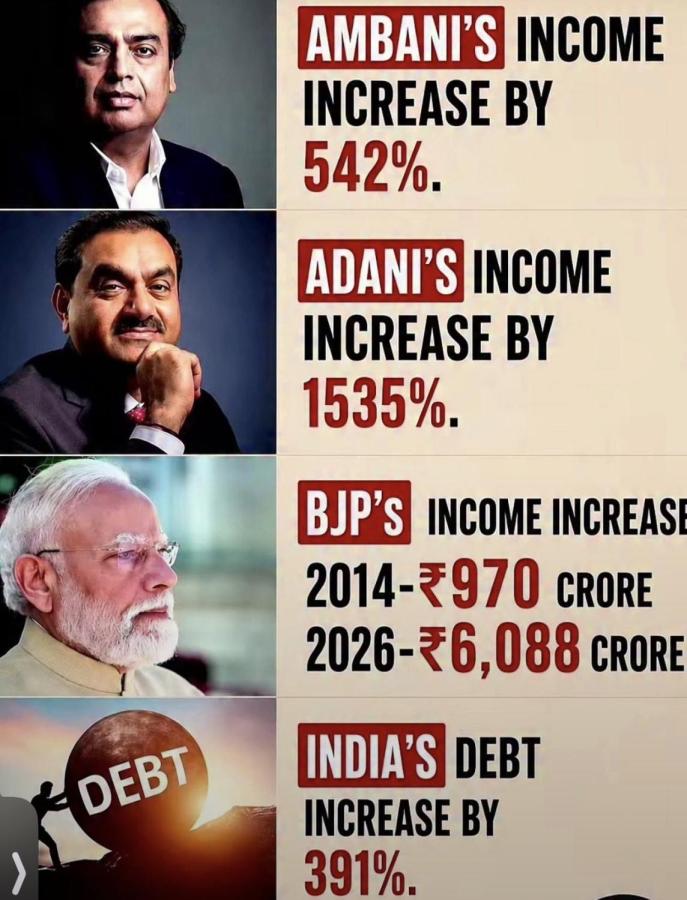
Figures often used to illustrate these changes include a 542% rise in Mukesh Ambani's wealth, a 1,535% increase for Gautam Adani, a rise in BJP income from ₹970 crore to ₹6,088 crore, and a 391% increase in India's debt.
The broader trends behind these numbers are real. But the exact percentages require closer examination because each figure depends on what is being measured, the starting year and the source used.
Billionaire wealth: a dramatic rise, but not the same as income
The first distinction is between income and wealth.
For billionaires such as Mukesh Ambani and Gautam Adani, most of their wealth is tied to shares, businesses and other assets rather than annual salaries. Their fortunes therefore rise or fall largely with the market value of their holdings.
That makes net worth a more useful measure than income when comparing their financial position over time.
By that measure, both fortunes have increased enormously.
Mukesh Ambani's wealth has grown several times over since the mid-2010s. Gautam Adani's rise has been even more dramatic, taking him from a relatively small billionaire fortune to one of the world's richest individuals within a few years.
The exact percentage, however, depends heavily on the dates selected.
Adani's wealth is a particularly difficult case because the value of his listed companies has experienced extreme volatility. His fortune surged as Adani Group stocks climbed, fell sharply following the 2023 Hindenburg Research report and subsequently recovered to varying degrees.
A comparison between two carefully selected dates can therefore produce a dramatically different percentage from one based on another set of dates.
The same applies to Ambani. Changes in the market value of Reliance Industries and the treatment of family-held assets can affect the estimated size of his fortune.
The underlying conclusion remains strong: India's richest business families have accumulated wealth at a pace far beyond the growth experienced by most households.
The precise percentages, however, should not be treated as fixed economic facts without identifying the valuation source and the exact dates being compared.
BJP's income: the rise is substantial and documented
Political party finances offer a more straightforward basis for comparison because national parties are required to submit audited financial statements to the Election Commission of India.
The BJP's income has increased dramatically over the past decade.
According to the Association for Democratic Reforms (ADR), the party reported total income of ₹4,340.47 crore in 2023-24, the highest among India's national political parties. The figure represented nearly three-quarters of the combined income of the six national parties analysed by ADR.
The BJP's income had stood at ₹2,360.84 crore in 2022-23, meaning it increased by 83.85% in a single year.
The contrast with other national parties is significant. The Congress reported income of ₹1,225.12 crore in 2023-24, placing the BJP's declared income more than three times higher.
Electoral bonds played an important role in this political funding landscape. ADR reported that the BJP received ₹1,685.63 crore through electoral bonds in 2023-24.
The Supreme Court struck down the Electoral Bond Scheme in February 2024, holding that the non-disclosure of political funding information violated citizens' right to information.
This makes the BJP's financial growth an important part of India's changing political economy.
However, the specific claim that BJP income rose from ₹970 crore in 2014 to ₹6,088 crore in 2026 cannot be accepted without a source establishing both figures and the financial years they represent.
The available audited data supports a substantial and sustained rise in BJP income. It does not, by itself, establish those particular numbers.
India's debt: the rupee figure has ballooned, but the percentage depends on the definition
India's government debt presents another case where the headline number needs context.
The Central Government's total liabilities were about ₹58.66 lakh crore in 2014-15, according to government data.
By the end of March 2026, the Union Budget placed the Centre's total debt and other liabilities at approximately ₹197.18 lakh crore.
That represents a dramatic increase in the government's nominal liabilities over the period.
But it does not amount to a 391% increase.
The calculation changes depending on what is included in the definition of India's debt. Central government debt, total central liabilities and combined Centre-and-state government debt are different measures.
Using the broader general-government measure can produce a substantially larger figure than using central government liabilities alone.
That distinction matters because debt cannot be assessed solely by looking at the number of rupees owed.
Economists also examine debt relative to GDP, which provides a measure of the economy's capacity to carry that debt.
India's nominal GDP has expanded considerably over the same period. As a result, the economic significance of a larger debt stock cannot be understood simply by comparing the rupee amounts from two different years.
The absolute increase is therefore genuine. The 391% figure requires a clearly defined debt measure and base year before it can be treated as an accurate calculation.
Three different measures tell three different stories
The figures involving billionaires, political parties and government debt may appear comparable because they are all expressed as percentages or large rupee amounts.
Economically, however, they measure very different things.
Billionaire wealth is largely an estimate of the market value of privately controlled assets and listed shareholdings.
Political party income refers to funds received by an organisation during a financial year.
Government debt represents accumulated financial liabilities and must be assessed against the size and capacity of the economy.
Putting them together can highlight a broader transformation in India's political economy, but it cannot establish a single measure of economic progress or inequality.
What the data does establish is significant.
India's richest individuals have seen extraordinary increases in wealth. The BJP has emerged as the country's financially dominant national political party. And the government's nominal liabilities have expanded sharply.
At the same time, the precise percentages attached to these developments are much more dependent on methodology than a simple graphic suggests.
The numbers behind India's changing economic landscape
The decade since 2014 has brought a significant concentration of economic and political resources.
The fortunes of India's richest entrepreneurs have multiplied, driven largely by the expansion in the market value of their businesses and investments. Political funding has become increasingly concentrated, with the BJP's declared income far exceeding that of its national rivals. Government liabilities have also increased substantially as the economy, public spending and borrowing have expanded.
None of these developments can be reduced to a single percentage.
A billionaire's wealth can change by billions of dollars without the person receiving that amount as annual income. A political party can report a sharp increase in income because of donations and election-related funding. Government debt can rise while the economy itself grows, changing the significance of the debt burden.
The numbers therefore tell a more useful story when their definitions are kept intact.
India's economic story over the past decade can be told through three very different sets of numbers: the rapidly expanding fortunes of its richest billionaires, the growing financial strength of its ruling political party, and the sharp rise in government debt.
Figures often used to illustrate these changes include a 542% rise in Mukesh Ambani's wealth, a 1,535% increase for Gautam Adani, a rise in BJP income from ₹970 crore to ₹6,088 crore, and a 391% increase in India's debt.
The broader trends behind these numbers are real. But the exact percentages require closer examination because each figure depends on what is being measured, the starting year and the source used.
Billionaire wealth: a dramatic rise, but not the same as income
The first distinction is between income and wealth.
For billionaires such as Mukesh Ambani and Gautam Adani, most of their wealth is tied to shares, businesses and other assets rather than annual salaries. Their fortunes therefore rise or fall largely with the market value of their holdings.
That makes net worth a more useful measure than income when comparing their financial position over time.
By that measure, both fortunes have increased enormously.
Mukesh Ambani's wealth has grown several times over since the mid-2010s. Gautam Adani's rise has been even more dramatic, taking him from a relatively small billionaire fortune to one of the world's richest individuals within a few years.
The exact percentage, however, depends heavily on the dates selected.
Adani's wealth is a particularly difficult case because the value of his listed companies has experienced extreme volatility. His fortune surged as Adani Group stocks climbed, fell sharply following the 2023 Hindenburg Research report and subsequently recovered to varying degrees.
A comparison between two carefully selected dates can therefore produce a dramatically different percentage from one based on another set of dates.
The same applies to Ambani. Changes in the market value of Reliance Industries and the treatment of family-held assets can affect the estimated size of his fortune.
The underlying conclusion remains strong: India's richest business families have accumulated wealth at a pace far beyond the growth experienced by most households.
The precise percentages, however, should not be treated as fixed economic facts without identifying the valuation source and the exact dates being compared.
BJP's income: the rise is substantial and documented
Political party finances offer a more straightforward basis for comparison because national parties are required to submit audited financial statements to the Election Commission of India.
The BJP's income has increased dramatically over the past decade.
According to the Association for Democratic Reforms (ADR), the party reported total income of ₹4,340.47 crore in 2023-24, the highest among India's national political parties. The figure represented nearly three-quarters of the combined income of the six national parties analysed by ADR.
The BJP's income had stood at ₹2,360.84 crore in 2022-23, meaning it increased by 83.85% in a single year.
The contrast with other national parties is significant. The Congress reported income of ₹1,225.12 crore in 2023-24, placing the BJP's declared income more than three times higher.
Electoral bonds played an important role in this political funding landscape. ADR reported that the BJP received ₹1,685.63 crore through electoral bonds in 2023-24.
The Supreme Court struck down the Electoral Bond Scheme in February 2024, holding that the non-disclosure of political funding information violated citizens' right to information.
This makes the BJP's financial growth an important part of India's changing political economy.
However, the specific claim that BJP income rose from ₹970 crore in 2014 to ₹6,088 crore in 2026 cannot be accepted without a source establishing both figures and the financial years they represent.
The available audited data supports a substantial and sustained rise in BJP income. It does not, by itself, establish those particular numbers.
India's debt: the rupee figure has ballooned, but the percentage depends on the definition
India's government debt presents another case where the headline number needs context.
The Central Government's total liabilities were about ₹58.66 lakh crore in 2014-15, according to government data.
By the end of March 2026, the Union Budget placed the Centre's total debt and other liabilities at approximately ₹197.18 lakh crore.
That represents a dramatic increase in the government's nominal liabilities over the period.
But it does not amount to a 391% increase.
The calculation changes depending on what is included in the definition of India's debt. Central government debt, total central liabilities and combined Centre-and-state government debt are different measures.
Using the broader general-government measure can produce a substantially larger figure than using central government liabilities alone.
That distinction matters because debt cannot be assessed solely by looking at the number of rupees owed.
Economists also examine debt relative to GDP, which provides a measure of the economy's capacity to carry that debt.
India's nominal GDP has expanded considerably over the same period. As a result, the economic significance of a larger debt stock cannot be understood simply by comparing the rupee amounts from two different years.
The absolute increase is therefore genuine. The 391% figure requires a clearly defined debt measure and base year before it can be treated as an accurate calculation.
Three different measures tell three different stories
The figures involving billionaires, political parties and government debt may appear comparable because they are all expressed as percentages or large rupee amounts.
Economically, however, they measure very different things.
Billionaire wealth is largely an estimate of the market value of privately controlled assets and listed shareholdings.
Political party income refers to funds received by an organisation during a financial year.
Government debt represents accumulated financial liabilities and must be assessed against the size and capacity of the economy.
Putting them together can highlight a broader transformation in India's political economy, but it cannot establish a single measure of economic progress or inequality.
What the data does establish is significant.
India's richest individuals have seen extraordinary increases in wealth. The BJP has emerged as the country's financially dominant national political party. And the government's nominal liabilities have expanded sharply.
At the same time, the precise percentages attached to these developments are much more dependent on methodology than a simple graphic suggests.
The numbers behind India's changing economic landscape
The decade since 2014 has brought a significant concentration of economic and political resources.
The fortunes of India's richest entrepreneurs have multiplied, driven largely by the expansion in the market value of their businesses and investments. Political funding has become increasingly concentrated, with the BJP's declared income far exceeding that of its national rivals. Government liabilities have also increased substantially as the economy, public spending and borrowing have expanded.
None of these developments can be reduced to a single percentage.
A billionaire's wealth can change by billions of dollars without the person receiving that amount as annual income. A political party can report a sharp increase in income because of donations and election-related funding. Government debt can rise while the economy itself grows, changing the significance of the debt burden.
The numbers therefore tell a more useful story when their definitions are kept intact.





















Leave a Comment