
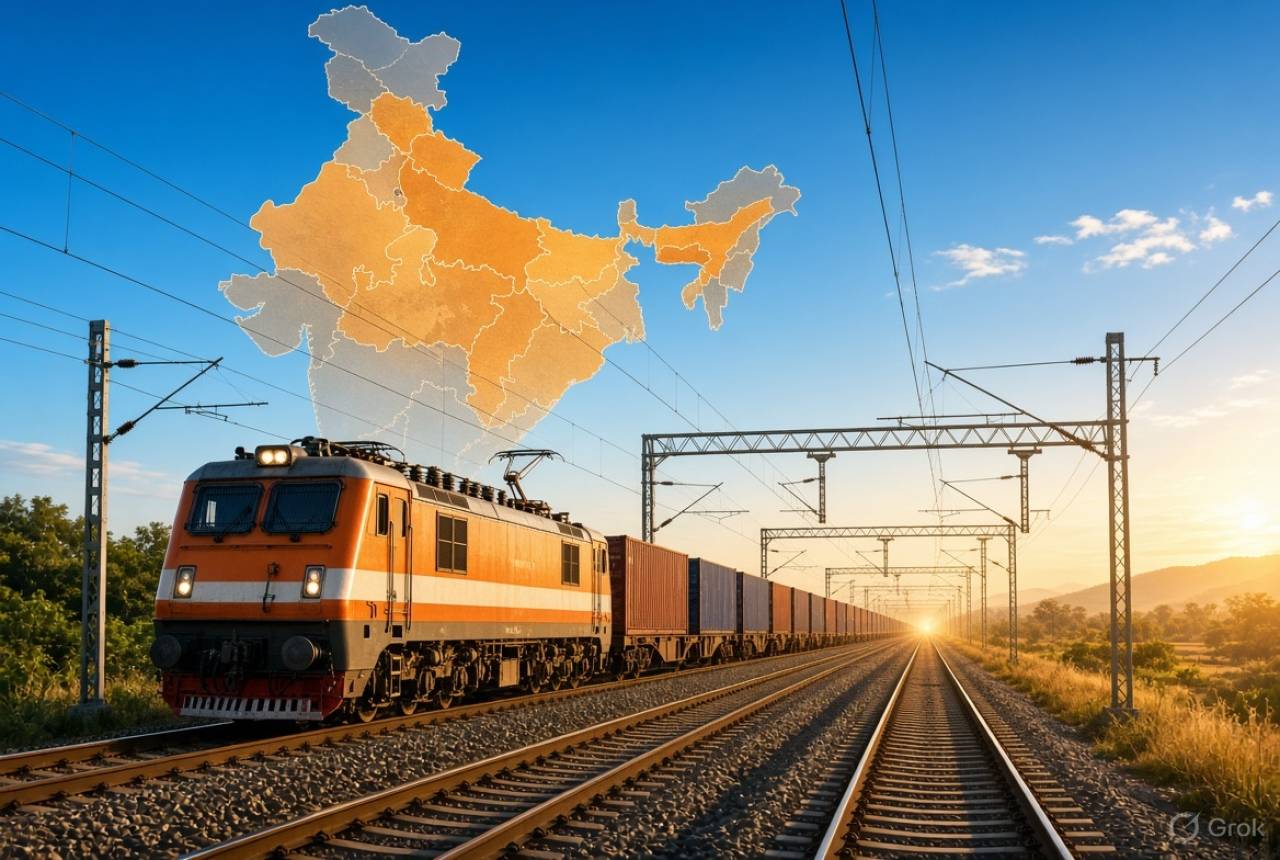
A ₹20,804 crore railway expansion is set to transform key corridors across nine states. Bihar is not among them.
The Union Cabinet’s recent approval of eight multi-tracking railway projects worth ₹20,804 crore across nine states has been hailed as a major step towards easing congestion and boosting freight capacity on some of India’s busiest corridors. The projects will add nearly 1,200 kilometres of track capacity, improve connectivity for almost 6,900 villages, and create additional freight-handling capacity of around 74 million tonnes per annum.
Yet one state remains conspicuously absent from the list is Bihar.
The chosen states, West Bengal, Jharkhand, Odisha, Madhya Pradesh, Chhattisgarh, Tamil Nadu, Andhra Pradesh, Karnataka and Telangana, largely align with high-volume mineral and industrial routes. Corridors such as Kharagpur–Jharsuguda, Katni–Pendra Road and Bilaspur–Pendra Road are critical for coal, cement, iron and steel movement. Southern projects support automobiles, containers and agricultural goods.
These choices make economic sense under the PM Gati Shakti framework, which prioritises integrated planning and high-traffic lines. But the exclusion of Bihar raises legitimate questions about balanced regional development.
Bihar’s Railway Need Goes Beyond Passenger Movement
Bihar’s need for enhanced rail infrastructure is acute. With a large population, dense rural settlements and significant out-migration, the state relies heavily on railways for both passenger movement and the transport of agricultural produce, foodgrains and other commodities.
Many of its existing routes face chronic congestion, limited line capacity and operational bottlenecks that delay both passenger and freight trains.
Improved multi-tracking could reduce logistics costs, support emerging industrial clusters and strengthen links between eastern and northern India. Bihar also sits at a strategic junction for traffic flowing between the mineral-rich eastern states and the consuming markets of the north and west.
Leaving it outside a major capacity-enhancement package risks perpetuating connectivity gaps that hinder economic mobility.
The Question of Regional Balance
Critics argue that the selection criteria appear weighted towards existing high-density freight corridors rather than areas of potential or acute social need.
While the eastern projects rightly target coal and steel belts in Jharkhand, Odisha and Chhattisgarh, Bihar’s agricultural economy and growing industrial aspirations receive less attention in this round.
The state has seen progress in electrification, new lines and station upgrades under various schemes. Yet large-scale multi-tracking of the kind sanctioned elsewhere remains limited.
The additional capacity created by the approved projects is projected to lower dependence on road transport and improve the reliability of train services. These are benefits that Bihar’s passengers and freight users would equally value.
Why the Government’s Priorities Still Make Sense
Supporters of the Cabinet decision point out that project selection follows traffic density, congestion levels and alignment with national freight corridors rather than a simple state-wise distribution.
The first set of projects, covering 656 km, and the second set, covering around 540 km, target specific bottlenecks on routes already carrying heavy volumes of coal, cement, steel, containers and industrial goods.
Extending similar works to Bihar would require separate identification of high-priority sections, detailed surveys and alignment with the National Master Plan.
Still, the scale of the current investment, nearly ₹21,000 crore, makes Bihar’s omission more noticeable.
A state that contributes substantially to national passenger traffic and serves as a vital link in the broader railway network could reasonably expect inclusion in such an expansion drive.
Bihar Cannot Afford to Wait for the Next Phase
The projects are scheduled for completion by 2029-30 and are expected to deliver greater operational flexibility, reduced bottlenecks and stronger multi-modal connectivity.
These outcomes are desirable everywhere, but they are especially relevant for Bihar, where reliable rail services can ease pressure on roads, support agricultural markets and encourage industrial investment.
Future phases of railway modernisation under Gati Shakti and related programmes should therefore examine Bihar’s corridors with the same urgency applied to the nine states now benefiting.
Infrastructure decisions inevitably involve prioritisation. High-traffic mineral and industrial routes deserve attention. Yet equitable development also demands that states with large populations, significant connectivity deficits and untapped economic potential are not left behind.
The ₹20,804 crore package marks progress for many regions. For Bihar, it serves as a reminder that the next round of capacity expansion must address its pressing needs if the goal of a truly national and balanced railway network is to be realised.
The Union Cabinet’s recent approval of eight multi-tracking railway projects worth ₹20,804 crore across nine states has been hailed as a major step towards easing congestion and boosting freight capacity on some of India’s busiest corridors. The projects will add nearly 1,200 kilometres of track capacity, improve connectivity for almost 6,900 villages, and create additional freight-handling capacity of around 74 million tonnes per annum.
Yet one state remains conspicuously absent from the list is Bihar.
The chosen states, West Bengal, Jharkhand, Odisha, Madhya Pradesh, Chhattisgarh, Tamil Nadu, Andhra Pradesh, Karnataka and Telangana, largely align with high-volume mineral and industrial routes. Corridors such as Kharagpur–Jharsuguda, Katni–Pendra Road and Bilaspur–Pendra Road are critical for coal, cement, iron and steel movement. Southern projects support automobiles, containers and agricultural goods.
These choices make economic sense under the PM Gati Shakti framework, which prioritises integrated planning and high-traffic lines. But the exclusion of Bihar raises legitimate questions about balanced regional development.
Bihar’s Railway Need Goes Beyond Passenger Movement
Bihar’s need for enhanced rail infrastructure is acute. With a large population, dense rural settlements and significant out-migration, the state relies heavily on railways for both passenger movement and the transport of agricultural produce, foodgrains and other commodities.
Many of its existing routes face chronic congestion, limited line capacity and operational bottlenecks that delay both passenger and freight trains.
Improved multi-tracking could reduce logistics costs, support emerging industrial clusters and strengthen links between eastern and northern India. Bihar also sits at a strategic junction for traffic flowing between the mineral-rich eastern states and the consuming markets of the north and west.
Leaving it outside a major capacity-enhancement package risks perpetuating connectivity gaps that hinder economic mobility.
The Question of Regional Balance
Critics argue that the selection criteria appear weighted towards existing high-density freight corridors rather than areas of potential or acute social need.
While the eastern projects rightly target coal and steel belts in Jharkhand, Odisha and Chhattisgarh, Bihar’s agricultural economy and growing industrial aspirations receive less attention in this round.
The state has seen progress in electrification, new lines and station upgrades under various schemes. Yet large-scale multi-tracking of the kind sanctioned elsewhere remains limited.
The additional capacity created by the approved projects is projected to lower dependence on road transport and improve the reliability of train services. These are benefits that Bihar’s passengers and freight users would equally value.
Why the Government’s Priorities Still Make Sense
Supporters of the Cabinet decision point out that project selection follows traffic density, congestion levels and alignment with national freight corridors rather than a simple state-wise distribution.
The first set of projects, covering 656 km, and the second set, covering around 540 km, target specific bottlenecks on routes already carrying heavy volumes of coal, cement, steel, containers and industrial goods.
Extending similar works to Bihar would require separate identification of high-priority sections, detailed surveys and alignment with the National Master Plan.
Still, the scale of the current investment, nearly ₹21,000 crore, makes Bihar’s omission more noticeable.
A state that contributes substantially to national passenger traffic and serves as a vital link in the broader railway network could reasonably expect inclusion in such an expansion drive.
Bihar Cannot Afford to Wait for the Next Phase
The projects are scheduled for completion by 2029-30 and are expected to deliver greater operational flexibility, reduced bottlenecks and stronger multi-modal connectivity.
These outcomes are desirable everywhere, but they are especially relevant for Bihar, where reliable rail services can ease pressure on roads, support agricultural markets and encourage industrial investment.
Future phases of railway modernisation under Gati Shakti and related programmes should therefore examine Bihar’s corridors with the same urgency applied to the nine states now benefiting.
Infrastructure decisions inevitably involve prioritisation. High-traffic mineral and industrial routes deserve attention. Yet equitable development also demands that states with large populations, significant connectivity deficits and untapped economic potential are not left behind.
The ₹20,804 crore package marks progress for many regions. For Bihar, it serves as a reminder that the next round of capacity expansion must address its pressing needs if the goal of a truly national and balanced railway network is to be realised.


























Leave a Comment