
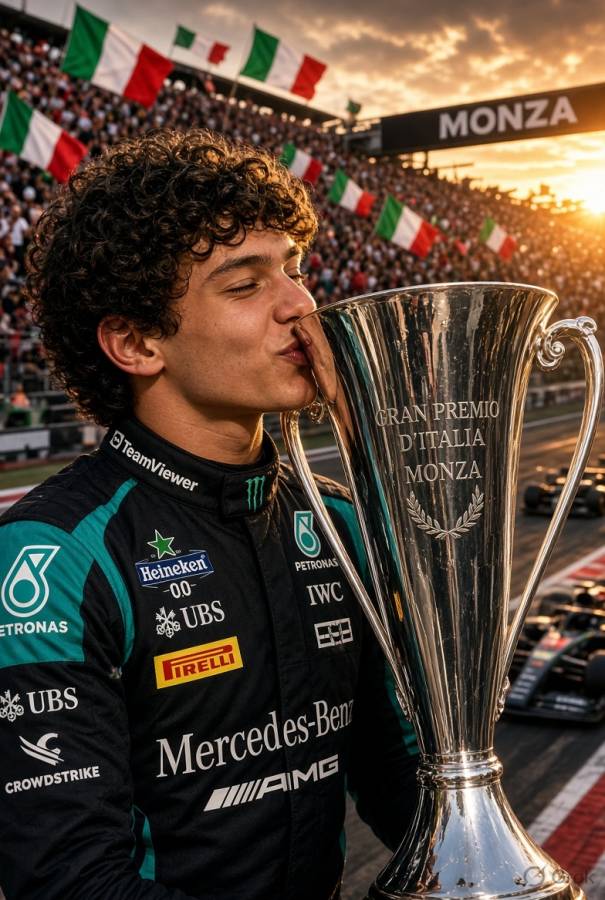
Starting 19th and facing impossible odds, Kimi Antonelli produced a stunning Monza comeback to end Italy’s 60-year wait for a home F1 winner.
Monza has always carried the weight of ghosts.
The Temple of Speed does not simply host races. It tests the soul of Italian motorsport. For sixty long years, those ghosts had the last word. No Italian driver had stood on the top step of the podium at his home Grand Prix since Ludovico Scarfiotti in 1966.
On a humid Sunday afternoon in September 2026, a curly-haired 20-year-old from Bologna finally silenced them.
Kimi Antonelli started 19th after an engine change forced him to the back of the grid. In Formula 1, 19th is where dreams usually go to die. Yet what unfolded over 53 breathless laps was pure theatre, part recovery drive, part masterclass, and part national catharsis.
A Race That Refused to Follow the Script
When the lights went out, the rear of the field descended into chaos. Cars scrambled for grip, positions and survival.
Antonelli did none of that.
He was methodical, almost cold. He picked off rivals through Turn 1 and the sweeping Curva Grande with the calm precision of a driver twice his age. While others fought their cars, he seemed to be reading the race in a different language.
But the afternoon refused to stay simple.
An early yellow flag bunched the field together. A prolonged Virtual Safety Car period threatened tyre temperatures. Then a full red flag completely reset the race and threatened to erase every hard-won position Antonelli had clawed back.
Lesser drivers might have unravelled.
The Italian stayed ice-cool.
Every restart became another opportunity. Instead of allowing the chaos to dictate his race, Antonelli used it to his advantage.
The Russell Battle
The decisive moment arrived after the final restart.
George Russell, his Mercedes teammate and a season-long rival, sat squarely in his sights. What followed was high-speed chess at nearly 300 km/h.
Russell defended with every trick in the book. He changed lines, deployed battery power and braked late.
Antonelli answered with spatial awareness and late-braking bravery that seemed to belong to another plane.
On Lap 50, before the iconic Ascari chicane, he completed the move.
Russell was dispatched.
The Italian was free.
A Charge Worthy of the Greats
From there, Antonelli’s charge felt almost inevitable.
His performance evoked some of the great recovery drives in Formula 1 history. There were echoes of Max Verstappen’s remarkable surge from 14th to first at Spa in 2022, Lewis Hamilton’s penalty-defying charge at Interlagos in 2021, Kimi Räikkönen’s ice-cold heroics at Suzuka in 2005, and Michael Schumacher’s strategic brilliance in changing conditions at Spa in 1995.
But Antonelli did not simply repeat history.
He created his own version of it.
He coaxed life out of fading tyres while maintaining a blistering pace that nobody could match. Every lap seemed to confirm that the race was becoming something more than a comeback.
It was becoming a statement.
When he finally took the chequered flag, the roar from the grandstands was deafening. Red, white and green smoke billowed into the Lombardy sky.
At just 20 years old, Antonelli had delivered a phenomenal performance in his home race with the composure of a veteran.
The Numbers Behind the Miracle
The numbers tell their own story.
Antonelli now holds the modern record for the most wins by an Italian driver after the legendary Alberto Ascari.
More significantly, he becomes only the second driver in Formula 1 history to win a race from 19th on the grid, joining John Watson, whose famous 1983 victory came from 22nd at the United States Grand Prix West.
The list of Formula 1’s deepest comebacks now has a new Italian name at its heart.
But statistics alone cannot explain what happened at Monza.
More Than a Victory
What made the afternoon truly special was not simply the result, but the manner of it.
Antonelli did not merely survive the interruptions. He thrived in them.
He did not simply overtake. He dismantled the opposition with ruthless intelligence.
He did not simply win. He reminded an entire nation why this sport still matters.
For sixty years, Italian fans had waited. They had watched foreign champions lift the trophy on their sacred soil. They had endured a drought that sometimes felt like a national curse.
On this day, the curse ended.
The boy from Bologna arrived at Monza and gave the tifosi something far more precious than a home victory.
He gave them a moment they could believe in.
The Antonelli Era Begins
As celebrations rolled deep into the Monza night, one truth hung in the air thicker than the tyre smoke.
Formula 1 has a new star.
And the Temple of Speed has its Italian hero once more.
The 60-year wait is over.
The Antonelli era has begun.
Monza has always carried the weight of ghosts.
The Temple of Speed does not simply host races. It tests the soul of Italian motorsport. For sixty long years, those ghosts had the last word. No Italian driver had stood on the top step of the podium at his home Grand Prix since Ludovico Scarfiotti in 1966.
On a humid Sunday afternoon in September 2026, a curly-haired 20-year-old from Bologna finally silenced them.
Kimi Antonelli started 19th after an engine change forced him to the back of the grid. In Formula 1, 19th is where dreams usually go to die. Yet what unfolded over 53 breathless laps was pure theatre, part recovery drive, part masterclass, and part national catharsis.
A Race That Refused to Follow the Script
When the lights went out, the rear of the field descended into chaos. Cars scrambled for grip, positions and survival.
Antonelli did none of that.
He was methodical, almost cold. He picked off rivals through Turn 1 and the sweeping Curva Grande with the calm precision of a driver twice his age. While others fought their cars, he seemed to be reading the race in a different language.
But the afternoon refused to stay simple.
An early yellow flag bunched the field together. A prolonged Virtual Safety Car period threatened tyre temperatures. Then a full red flag completely reset the race and threatened to erase every hard-won position Antonelli had clawed back.
Lesser drivers might have unravelled.
The Italian stayed ice-cool.
Every restart became another opportunity. Instead of allowing the chaos to dictate his race, Antonelli used it to his advantage.
The Russell Battle
The decisive moment arrived after the final restart.
George Russell, his Mercedes teammate and a season-long rival, sat squarely in his sights. What followed was high-speed chess at nearly 300 km/h.
Russell defended with every trick in the book. He changed lines, deployed battery power and braked late.
Antonelli answered with spatial awareness and late-braking bravery that seemed to belong to another plane.
On Lap 50, before the iconic Ascari chicane, he completed the move.
Russell was dispatched.
The Italian was free.
A Charge Worthy of the Greats
From there, Antonelli’s charge felt almost inevitable.
His performance evoked some of the great recovery drives in Formula 1 history. There were echoes of Max Verstappen’s remarkable surge from 14th to first at Spa in 2022, Lewis Hamilton’s penalty-defying charge at Interlagos in 2021, Kimi Räikkönen’s ice-cold heroics at Suzuka in 2005, and Michael Schumacher’s strategic brilliance in changing conditions at Spa in 1995.
But Antonelli did not simply repeat history.
He created his own version of it.
He coaxed life out of fading tyres while maintaining a blistering pace that nobody could match. Every lap seemed to confirm that the race was becoming something more than a comeback.
It was becoming a statement.
When he finally took the chequered flag, the roar from the grandstands was deafening. Red, white and green smoke billowed into the Lombardy sky.
At just 20 years old, Antonelli had delivered a phenomenal performance in his home race with the composure of a veteran.
The Numbers Behind the Miracle
The numbers tell their own story.
Antonelli now holds the modern record for the most wins by an Italian driver after the legendary Alberto Ascari.
More significantly, he becomes only the second driver in Formula 1 history to win a race from 19th on the grid, joining John Watson, whose famous 1983 victory came from 22nd at the United States Grand Prix West.
The list of Formula 1’s deepest comebacks now has a new Italian name at its heart.
But statistics alone cannot explain what happened at Monza.
More Than a Victory
What made the afternoon truly special was not simply the result, but the manner of it.
Antonelli did not merely survive the interruptions. He thrived in them.
He did not simply overtake. He dismantled the opposition with ruthless intelligence.
He did not simply win. He reminded an entire nation why this sport still matters.
For sixty years, Italian fans had waited. They had watched foreign champions lift the trophy on their sacred soil. They had endured a drought that sometimes felt like a national curse.
On this day, the curse ended.
The boy from Bologna arrived at Monza and gave the tifosi something far more precious than a home victory.
He gave them a moment they could believe in.
The Antonelli Era Begins
As celebrations rolled deep into the Monza night, one truth hung in the air thicker than the tyre smoke.
Formula 1 has a new star.
And the Temple of Speed has its Italian hero once more.
The 60-year wait is over.
The Antonelli era has begun.
























Leave a Comment