
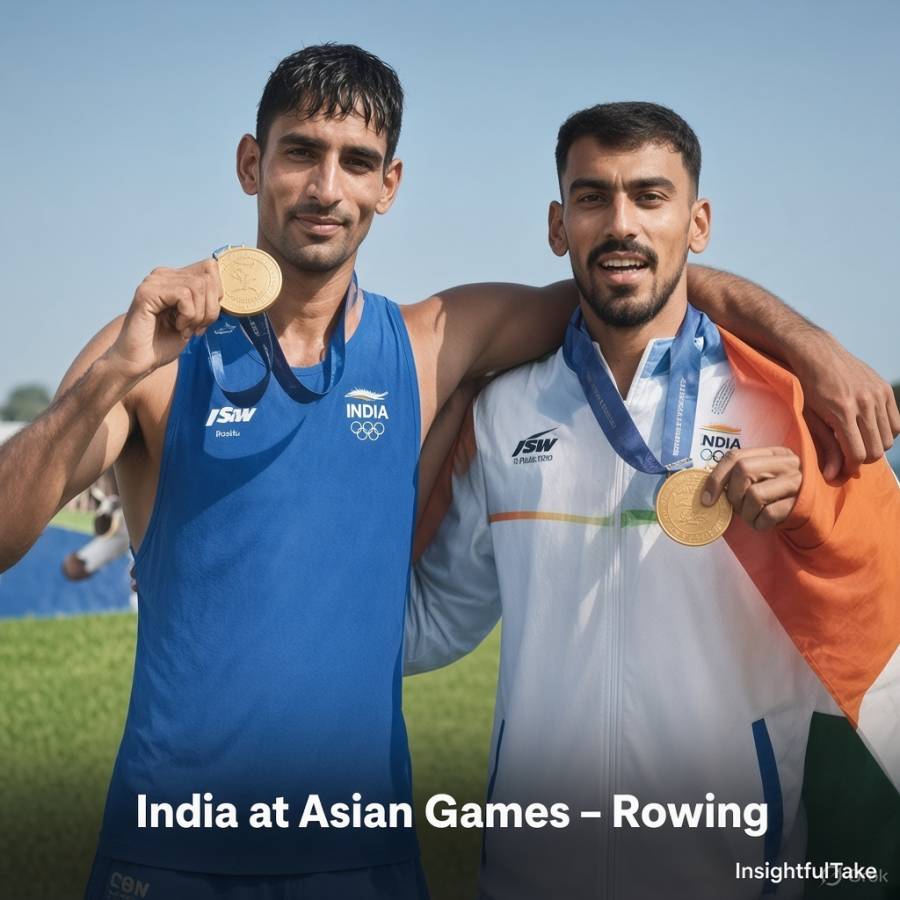
A last-minute team reshuffle changed their event, but Satnam Singh and Salman Khan turned the setback into a historic Asian Games bronze for India.
Satnam Singh and Salman Khan gave India its first-ever medal in the men's double sculls rowing event at the Asian Games. The duo finished third at the Nagaragawa International Regatta Course, clocking 6:13.25 minutes, and brought home a bronze medal on Thursday. It was a historic first for India in this particular event, and the manner in which the medal came about makes the story even more compelling for sports fans back home.
The backstory behind the medal is what makes it stand out. Satnam and Salman weren't even supposed to row together in this event. They were originally picked for the quadruple sculls team along with Jakar Khan and Balraj Panwar. But following a controversial, last-minute reshuffle in team combinations, the two were moved into the double sculls event instead, replacing Navdeep Singh and Kuldeep Singh. For most athletes, being shifted out of a team they had prepared for would be unsettling. But Satnam and Salman refused to let it affect their performance.
Salman told Hindustan Times that the change did affect them mentally, but they made a conscious decision to give their best regardless. He credited their strong understanding on the water to the seven months they had already spent training together for the quadruple sculls event. That shared training history meant the duo didn't need much time to adjust to rowing as a pair instead of as part of a four-man crew, and it showed in how competitive they remained through most of the race.
The race itself was a nail-biter from start to almost finish. China's pair of Yi Xiudi and Nie Yide won gold with a time of 6:09.77, followed closely by Uzbekistan's Mamatkulov Mekhrajbek and Sardor Pavel at 6:10.49. Satnam and Salman were actually holding second place all the way up to the 1,500-metre mark of the race, putting them in medal contention for silver. However, they slipped to third place in the final 500 metres as the Uzbek pair pushed harder in the closing stretch.
Salman was candid about the conditions that worked in their favour. A helpful tailwind and calm waters on the day suited lighter finalists, and since he and Satnam weighed around 85 kg each while most of the other rowers in the field were in the 90-95 kg range, their lighter build gave them a genuine speed advantage over the bulkier competition. It was a reminder that in rowing, strategy and body composition can matter just as much as raw strength.
Satnam's personal journey to this medal carries its own weight. He hails from Fatta Mohala village in Punjab's Mansa district and currently serves with the Indian Navy as a Chief Petty Officer. Before turning to rowing, he was a state and national-level handball player, and it was seeing London Olympian Swarn Singh that first pushed him towards competitive rowing. He later trained at the Sports Institute of Punjab in Ropar, where his early development in the sport took shape before he moved on to represent the country at the international level.
For Salman too, this medal is the product of years of grinding through the ranks of Indian rowing, often away from the spotlight that cricket and other mainstream sports enjoy in the country. Rowing rarely gets the attention it deserves in India, despite the discipline, endurance and technical skill it demands from athletes who train for hours on end, often in less-than-ideal conditions compared to their international competitors.
This bronze also adds to India's growing medal tally in rowing at the Asian Games overall. Since the country's tally over the years reflects a mix of two gold, seven silver and twenty bronze medals in the sport, Satnam and Salman's achievement adds another chapter to a slowly but steadily improving Asian Games rowing legacy for India. For a sport that doesn't always make front-page news, this bronze deserves its moment of recognition.
For Satnam and Salman, the takeaway from Nagaragawa is simple: a forced change in plans, an unfamiliar event, and a shorter preparation window still led them to the podium. It's the kind of grit-driven story that Indian sports fans love, proof that resilience on the field can turn a setback into a milestone.
Satnam Singh and Salman Khan gave India its first-ever medal in the men's double sculls rowing event at the Asian Games. The duo finished third at the Nagaragawa International Regatta Course, clocking 6:13.25 minutes, and brought home a bronze medal on Thursday. It was a historic first for India in this particular event, and the manner in which the medal came about makes the story even more compelling for sports fans back home.
The backstory behind the medal is what makes it stand out. Satnam and Salman weren't even supposed to row together in this event. They were originally picked for the quadruple sculls team along with Jakar Khan and Balraj Panwar. But following a controversial, last-minute reshuffle in team combinations, the two were moved into the double sculls event instead, replacing Navdeep Singh and Kuldeep Singh. For most athletes, being shifted out of a team they had prepared for would be unsettling. But Satnam and Salman refused to let it affect their performance.
Salman told Hindustan Times that the change did affect them mentally, but they made a conscious decision to give their best regardless. He credited their strong understanding on the water to the seven months they had already spent training together for the quadruple sculls event. That shared training history meant the duo didn't need much time to adjust to rowing as a pair instead of as part of a four-man crew, and it showed in how competitive they remained through most of the race.
The race itself was a nail-biter from start to almost finish. China's pair of Yi Xiudi and Nie Yide won gold with a time of 6:09.77, followed closely by Uzbekistan's Mamatkulov Mekhrajbek and Sardor Pavel at 6:10.49. Satnam and Salman were actually holding second place all the way up to the 1,500-metre mark of the race, putting them in medal contention for silver. However, they slipped to third place in the final 500 metres as the Uzbek pair pushed harder in the closing stretch.
Salman was candid about the conditions that worked in their favour. A helpful tailwind and calm waters on the day suited lighter finalists, and since he and Satnam weighed around 85 kg each while most of the other rowers in the field were in the 90-95 kg range, their lighter build gave them a genuine speed advantage over the bulkier competition. It was a reminder that in rowing, strategy and body composition can matter just as much as raw strength.
Satnam's personal journey to this medal carries its own weight. He hails from Fatta Mohala village in Punjab's Mansa district and currently serves with the Indian Navy as a Chief Petty Officer. Before turning to rowing, he was a state and national-level handball player, and it was seeing London Olympian Swarn Singh that first pushed him towards competitive rowing. He later trained at the Sports Institute of Punjab in Ropar, where his early development in the sport took shape before he moved on to represent the country at the international level.
For Salman too, this medal is the product of years of grinding through the ranks of Indian rowing, often away from the spotlight that cricket and other mainstream sports enjoy in the country. Rowing rarely gets the attention it deserves in India, despite the discipline, endurance and technical skill it demands from athletes who train for hours on end, often in less-than-ideal conditions compared to their international competitors.
This bronze also adds to India's growing medal tally in rowing at the Asian Games overall. Since the country's tally over the years reflects a mix of two gold, seven silver and twenty bronze medals in the sport, Satnam and Salman's achievement adds another chapter to a slowly but steadily improving Asian Games rowing legacy for India. For a sport that doesn't always make front-page news, this bronze deserves its moment of recognition.
For Satnam and Salman, the takeaway from Nagaragawa is simple: a forced change in plans, an unfamiliar event, and a shorter preparation window still led them to the podium. It's the kind of grit-driven story that Indian sports fans love, proof that resilience on the field can turn a setback into a milestone.
























Leave a Comment