
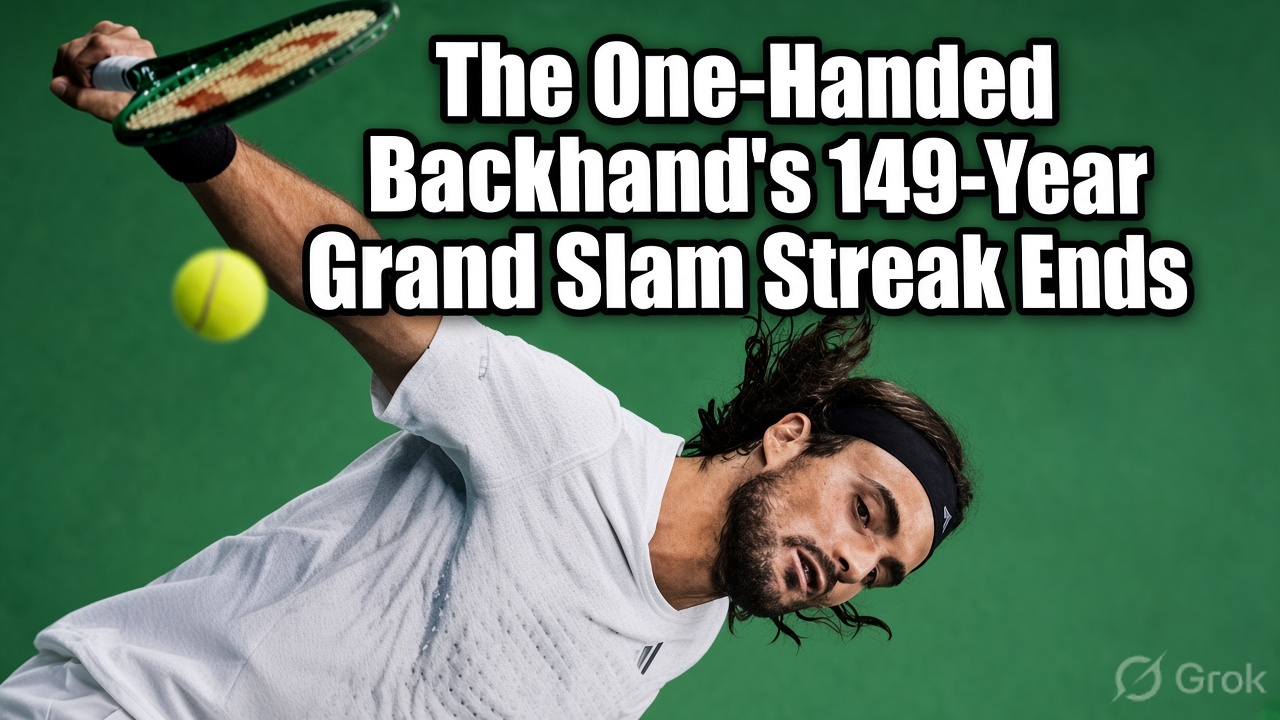
For 149 years, one-handed backhands survived every era of tennis. In 2026, the streak finally ended in New York.
For 149 years, tennis carried one quiet promise. No matter who won a Grand Slam, at least one player using a one-handed backhand would make the men's singles semi-final.
The streak began at the very first Wimbledon in 1877. It survived two World Wars, the shift from wooden rackets to graphite, and the arrival of players capable of serving at 240 kilometres an hour.
It survived almost everything, in fact, except Ben Shelton's forehand on a September night in New York.
Stefanos Tsitsipas entered the fourth round of the 2026 US Open as the last man standing for an entire style of tennis. Every other one-hander in the draw was already gone.
Denis Shapovalov had lost to Shelton three days earlier. Lorenzo Musetti had exited in the second round. Stan Wawrinka, given a wildcard for what may be his final US Open, retired after his opening match.
That left Tsitsipas, ranked 53rd in the world, carrying a shot invented before the light bulb into a sport now built around two-handed power.
He could not carry it any further.
Shelton beat Tsitsipas in straight sets, ending a streak that had outlasted John McEnroe, Ivan Lendl, Pete Sampras, Stefan Edberg, Gustavo Kuerten, Roger Federer and Dominic Thiem.
For the first time in the modern history of the four Grand Slams, every men's singles semi-final in a calendar year, Melbourne, Paris, Wimbledon and New York, has been contested entirely by players using two-handed backhands.
Why the One-Hander Is Disappearing
The numbers make the decline look less like a sudden collapse and more like the final stage of a long transformation.
Tsitsipas himself has pointed out that in the 1950s, close to every player on tour used a one-handed backhand. Today, by his estimate, barely two or three players in every hundred do.
The reasons are mechanical as much as stylistic.
Modern courts often play slower than they once did, while heavier, higher-bouncing balls reward players who can generate power and stability with both hands. The two-handed backhand also offers a simpler defensive option when the ball rises above shoulder height.
For young players, it is easier to teach, easier to learn and generally more forgiving under pressure.
The one-handed backhand, by contrast, demands timing, balance and precise technique. When executed well, it can produce extraordinary variety, including slice, disguise, touch and attacking angles. But modern professional tennis leaves little room for weaknesses, and coaches naturally tend to favour the shot that gives young players greater stability.
There is also a coaching pipeline problem.
Most coaches working at the highest levels today grew up playing with two hands. As a result, most young players are introduced to the two-handed backhand almost by default.
A one-handed backhand has increasingly become something a player discovers despite the coaching system, rather than because of it.
Tsitsipas has experienced this personally. He now mentors a teenager in Japan whose father once wrote to him simply to ask whether playing with one hand was still allowed.
The question may sound amusing, but it captures the larger change in tennis.
When Style Mattered as Much as Power
What makes Tsitsipas's defeat significant is not simply the end of a statistical streak. It is what the decline of the one-handed backhand represents.
Tennis was once a sport of sharply contrasting identities.
There were serve-and-volleyers who rushed the net, counter-punchers who turned defence into an art, baseline grinders who were willing to play for hours, and stylists who wanted to finish a rally in three shots rather than thirty.
Different players seemed to speak different tactical languages.
Tsitsipas has argued that this variety has narrowed. Modern tennis, he suggests, increasingly rewards a single dominant template: powerful serves, heavy baseline strokes, relentless movement and a two-handed backhand capable of absorbing and returning tremendous pace.
The decline of the one-handed backhand is therefore more than the disappearance of a particular technique. It is perhaps the clearest visual sign of tennis becoming more uniform.
A Record Ends, but the Shot Lives On
None of this diminishes what Tsitsipas achieved in New York.
Reaching the fourth round is his best US Open performance to date. More importantly, he did it while openly carrying the weight of tennis history with him.
Before facing Shelton, Tsitsipas posted that he was taking a "150-year streak" onto the court, rounding up slightly for effect.
Whether the number is 149 or 150 hardly matters now.
What matters is that, in 2026, no man using a one-handed backhand reached a Grand Slam semi-final.
A shot that once defined generations of champions has finally been pushed outside the sport's final four.
Shelton becomes an accidental villain in a story that is really about evolution rather than one player ending an era. His two-handed backhand, one of the most reliable weapons in the men's game, simply proved too much for the last man defending a technique that once ruled tennis.
The one-hander is not extinct.
Tsitsipas will keep using it. So will Musetti and a small number of other professionals. It will continue to produce moments of elegance, disguise and old-fashioned tennis artistry.
But after 149 years of finding a place in the final four, the one-handed backhand now has to fight its way back into Grand Slam history.
One tournament at a time.
For 149 years, tennis carried one quiet promise. No matter who won a Grand Slam, at least one player using a one-handed backhand would make the men's singles semi-final.
The streak began at the very first Wimbledon in 1877. It survived two World Wars, the shift from wooden rackets to graphite, and the arrival of players capable of serving at 240 kilometres an hour.
It survived almost everything, in fact, except Ben Shelton's forehand on a September night in New York.
Stefanos Tsitsipas entered the fourth round of the 2026 US Open as the last man standing for an entire style of tennis. Every other one-hander in the draw was already gone.
Denis Shapovalov had lost to Shelton three days earlier. Lorenzo Musetti had exited in the second round. Stan Wawrinka, given a wildcard for what may be his final US Open, retired after his opening match.
That left Tsitsipas, ranked 53rd in the world, carrying a shot invented before the light bulb into a sport now built around two-handed power.
He could not carry it any further.
Shelton beat Tsitsipas in straight sets, ending a streak that had outlasted John McEnroe, Ivan Lendl, Pete Sampras, Stefan Edberg, Gustavo Kuerten, Roger Federer and Dominic Thiem.
For the first time in the modern history of the four Grand Slams, every men's singles semi-final in a calendar year, Melbourne, Paris, Wimbledon and New York, has been contested entirely by players using two-handed backhands.
Why the One-Hander Is Disappearing
The numbers make the decline look less like a sudden collapse and more like the final stage of a long transformation.
Tsitsipas himself has pointed out that in the 1950s, close to every player on tour used a one-handed backhand. Today, by his estimate, barely two or three players in every hundred do.
The reasons are mechanical as much as stylistic.
Modern courts often play slower than they once did, while heavier, higher-bouncing balls reward players who can generate power and stability with both hands. The two-handed backhand also offers a simpler defensive option when the ball rises above shoulder height.
For young players, it is easier to teach, easier to learn and generally more forgiving under pressure.
The one-handed backhand, by contrast, demands timing, balance and precise technique. When executed well, it can produce extraordinary variety, including slice, disguise, touch and attacking angles. But modern professional tennis leaves little room for weaknesses, and coaches naturally tend to favour the shot that gives young players greater stability.
There is also a coaching pipeline problem.
Most coaches working at the highest levels today grew up playing with two hands. As a result, most young players are introduced to the two-handed backhand almost by default.
A one-handed backhand has increasingly become something a player discovers despite the coaching system, rather than because of it.
Tsitsipas has experienced this personally. He now mentors a teenager in Japan whose father once wrote to him simply to ask whether playing with one hand was still allowed.
The question may sound amusing, but it captures the larger change in tennis.
When Style Mattered as Much as Power
What makes Tsitsipas's defeat significant is not simply the end of a statistical streak. It is what the decline of the one-handed backhand represents.
Tennis was once a sport of sharply contrasting identities.
There were serve-and-volleyers who rushed the net, counter-punchers who turned defence into an art, baseline grinders who were willing to play for hours, and stylists who wanted to finish a rally in three shots rather than thirty.
Different players seemed to speak different tactical languages.
Tsitsipas has argued that this variety has narrowed. Modern tennis, he suggests, increasingly rewards a single dominant template: powerful serves, heavy baseline strokes, relentless movement and a two-handed backhand capable of absorbing and returning tremendous pace.
The decline of the one-handed backhand is therefore more than the disappearance of a particular technique. It is perhaps the clearest visual sign of tennis becoming more uniform.
A Record Ends, but the Shot Lives On
None of this diminishes what Tsitsipas achieved in New York.
Reaching the fourth round is his best US Open performance to date. More importantly, he did it while openly carrying the weight of tennis history with him.
Before facing Shelton, Tsitsipas posted that he was taking a "150-year streak" onto the court, rounding up slightly for effect.
Whether the number is 149 or 150 hardly matters now.
What matters is that, in 2026, no man using a one-handed backhand reached a Grand Slam semi-final.
A shot that once defined generations of champions has finally been pushed outside the sport's final four.
Shelton becomes an accidental villain in a story that is really about evolution rather than one player ending an era. His two-handed backhand, one of the most reliable weapons in the men's game, simply proved too much for the last man defending a technique that once ruled tennis.
The one-hander is not extinct.
Tsitsipas will keep using it. So will Musetti and a small number of other professionals. It will continue to produce moments of elegance, disguise and old-fashioned tennis artistry.
But after 149 years of finding a place in the final four, the one-handed backhand now has to fight its way back into Grand Slam history.
One tournament at a time.



















Leave a Comment