
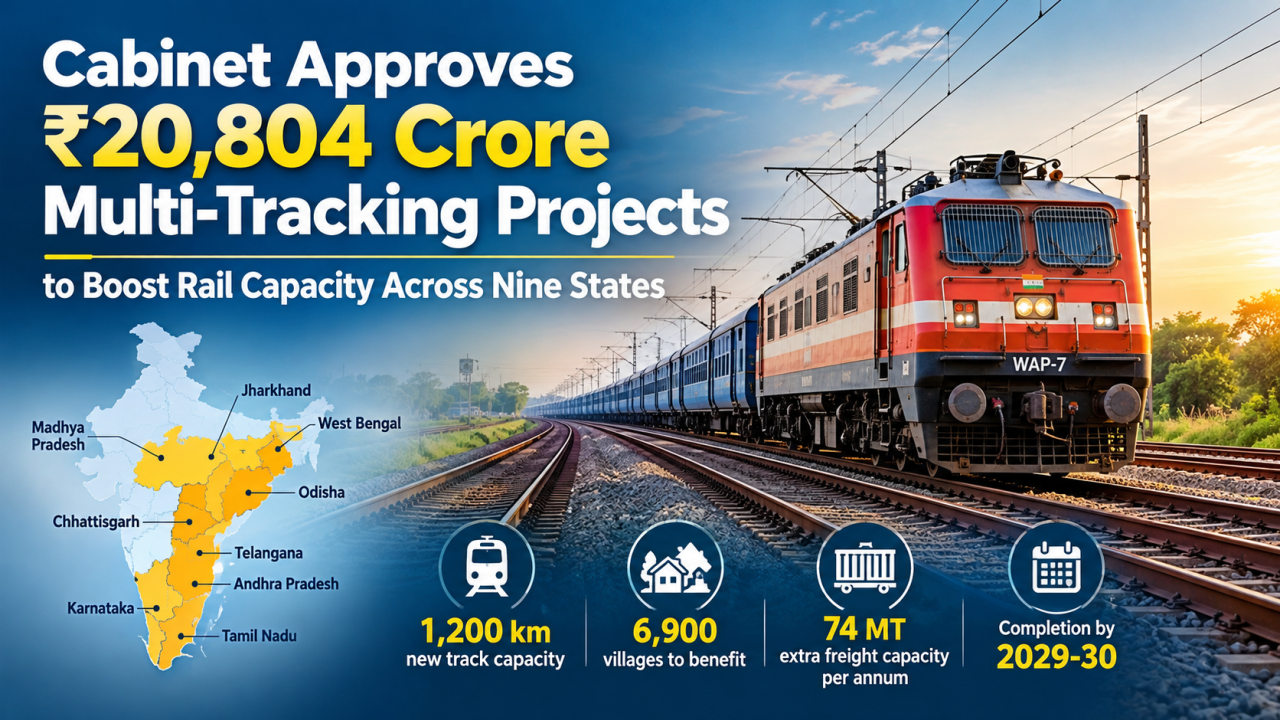
Eight railway projects worth ₹20,804 crore will add nearly 1,200 km of track capacity across nine states, targeting congestion, freight movement and regional connectivity.
In a significant push to modernise and expand India’s railway infrastructure, the Union Cabinet has cleared eight multi-tracking projects valued at ₹20,804 crore. The initiative, approved by the Cabinet Committee on Economic Affairs under the chairmanship of Prime Minister Narendra Modi, will add nearly 1,200 kilometres of new track capacity across nine states. The projects are designed to ease chronic congestion on some of the network’s busiest passenger and freight corridors while strengthening connectivity in both mineral-rich and industrial regions.
The sanctioned works span 31 districts in West Bengal, Jharkhand, Odisha, Madhya Pradesh, Chhattisgarh, Tamil Nadu, Andhra Pradesh, Karnataka and Telangana. Once completed, they are expected to improve rail access for nearly 6,900 villages with a combined population of about 10.8 million people. Union Minister for Railways and Information & Broadcasting Ashwini Vaishnaw described the expansion as a strategic effort to raise line capacity on routes that currently handle large volumes of coal, cement, iron and steel, containers, automobiles, foodgrains, petroleum products and fertilisers.
Vaishnaw noted that the programme follows the spirit of the Golden Quadrilateral railway initiatives launched during the tenure of former Prime Minister Atal Bihari Vajpayee. The government estimates that the additional tracks will create roughly 74 million tonnes per annum of extra freight-handling capacity. This is expected to lower logistics costs by shifting a greater share of cargo from road to rail and reduce dependence on highway transport.
Two Groups of Multi-Tracking Projects
The eight projects have been divided into two groups.
The first group comprises three corridors totalling 656 kilometres and costing an estimated ₹10,783 crore. These include the fourth line between Kharagpur and Jharsuguda (Bagdehi), the fourth line between Katni and Pendra Road, and the third line between Bilaspur (Uslapur) and Pendra Road. These alignments run through key mineral and industrial belts and are critical for the smooth movement of bulk commodities such as coal, cement, iron and steel.
The second group consists of five projects covering approximately 540 kilometres at an estimated cost of ₹10,021 crore. They include third and fourth lines between Arakkonam and Renigunta (77 km), third and fourth lines between Whitefield and Bangarpet (47 km), doubling of the Hosur-Omalur section (147 km), doubling of the Salem-Karur-Dindigul section (159 km), and multi-tracking of the Secunderabad (Ghatkesar)–Kazipet section (110 km).
These southern projects will strengthen routes that carry industrial goods, automobiles, containers and agricultural produce, supporting manufacturing and logistics hubs in Tamil Nadu, Karnataka, Andhra Pradesh and Telangana.
Projects Targeted for Completion by 2029-30
All eight projects are scheduled for completion by 2029-30. Officials say the additional tracks will improve operational efficiency, reduce bottlenecks and give railway planners greater flexibility in scheduling both passenger and freight trains.
The works have been aligned with the PM Gati Shakti National Master Plan, which emphasises integrated planning and multi-modal connectivity.
The economic rationale is particularly strong in the eastern and central corridors. The Kharagpur–Jharsuguda, Katni–Pendra Road and Bilaspur–Pendra Road sections serve regions where mineral extraction and heavy industry generate high volumes of freight.
Enhancing capacity here is expected to cut transit times, improve reliability and support the competitiveness of industries dependent on bulk transport. In the southern states, the new and doubled tracks will ease pressure on routes linking manufacturing centres, ports and hinterland markets, facilitating faster movement of finished goods and agricultural commodities.
Focus on Freight and Passenger Connectivity
Prime Minister Narendra Modi welcomed the Cabinet’s decision, highlighting its potential to deliver stronger connectivity, faster passenger services and lower logistics costs. In a post on X, he observed that lakhs of people stand to benefit from the improved network and that the approval ensures additional freight capacity alongside better passenger movement.
Beyond the immediate capacity gains, the projects form part of a broader strategy to modernise Indian Railways. Multi-tracking and doubling allow higher train frequencies without compromising safety or punctuality. They also create opportunities for more efficient utilisation of existing stations, yards and signalling systems.
By reducing road congestion and associated emissions, the shift of freight to rail is expected to yield environmental co-benefits as well.
Infrastructure Investment and Regional Growth
The scale of investment, nearly ₹21,000 crore, underscores the government’s continued focus on infrastructure as a driver of growth and regional development.
For communities in the 31 districts covered by the projects, improved rail links are likely to mean better access to markets, employment opportunities and essential services. For industry, the additional capacity offers the prospect of more predictable and cost-effective logistics.
As construction progresses over the next few years, the projects will generate employment in civil works, track laying, signalling and related activities. Once operational, they will form an integral part of a denser, more resilient national rail network capable of meeting rising demand from both passengers and freight customers.
The Cabinet’s approval marks another concrete step toward realising the vision of a modern, high-capacity railway system that supports India’s economic ambitions while serving the needs of its people.
In a significant push to modernise and expand India’s railway infrastructure, the Union Cabinet has cleared eight multi-tracking projects valued at ₹20,804 crore. The initiative, approved by the Cabinet Committee on Economic Affairs under the chairmanship of Prime Minister Narendra Modi, will add nearly 1,200 kilometres of new track capacity across nine states. The projects are designed to ease chronic congestion on some of the network’s busiest passenger and freight corridors while strengthening connectivity in both mineral-rich and industrial regions.
The sanctioned works span 31 districts in West Bengal, Jharkhand, Odisha, Madhya Pradesh, Chhattisgarh, Tamil Nadu, Andhra Pradesh, Karnataka and Telangana. Once completed, they are expected to improve rail access for nearly 6,900 villages with a combined population of about 10.8 million people. Union Minister for Railways and Information & Broadcasting Ashwini Vaishnaw described the expansion as a strategic effort to raise line capacity on routes that currently handle large volumes of coal, cement, iron and steel, containers, automobiles, foodgrains, petroleum products and fertilisers.
Vaishnaw noted that the programme follows the spirit of the Golden Quadrilateral railway initiatives launched during the tenure of former Prime Minister Atal Bihari Vajpayee. The government estimates that the additional tracks will create roughly 74 million tonnes per annum of extra freight-handling capacity. This is expected to lower logistics costs by shifting a greater share of cargo from road to rail and reduce dependence on highway transport.
Two Groups of Multi-Tracking Projects
The eight projects have been divided into two groups.
The first group comprises three corridors totalling 656 kilometres and costing an estimated ₹10,783 crore. These include the fourth line between Kharagpur and Jharsuguda (Bagdehi), the fourth line between Katni and Pendra Road, and the third line between Bilaspur (Uslapur) and Pendra Road. These alignments run through key mineral and industrial belts and are critical for the smooth movement of bulk commodities such as coal, cement, iron and steel.
The second group consists of five projects covering approximately 540 kilometres at an estimated cost of ₹10,021 crore. They include third and fourth lines between Arakkonam and Renigunta (77 km), third and fourth lines between Whitefield and Bangarpet (47 km), doubling of the Hosur-Omalur section (147 km), doubling of the Salem-Karur-Dindigul section (159 km), and multi-tracking of the Secunderabad (Ghatkesar)–Kazipet section (110 km).
These southern projects will strengthen routes that carry industrial goods, automobiles, containers and agricultural produce, supporting manufacturing and logistics hubs in Tamil Nadu, Karnataka, Andhra Pradesh and Telangana.
Projects Targeted for Completion by 2029-30
All eight projects are scheduled for completion by 2029-30. Officials say the additional tracks will improve operational efficiency, reduce bottlenecks and give railway planners greater flexibility in scheduling both passenger and freight trains.
The works have been aligned with the PM Gati Shakti National Master Plan, which emphasises integrated planning and multi-modal connectivity.
The economic rationale is particularly strong in the eastern and central corridors. The Kharagpur–Jharsuguda, Katni–Pendra Road and Bilaspur–Pendra Road sections serve regions where mineral extraction and heavy industry generate high volumes of freight.
Enhancing capacity here is expected to cut transit times, improve reliability and support the competitiveness of industries dependent on bulk transport. In the southern states, the new and doubled tracks will ease pressure on routes linking manufacturing centres, ports and hinterland markets, facilitating faster movement of finished goods and agricultural commodities.
Focus on Freight and Passenger Connectivity
Prime Minister Narendra Modi welcomed the Cabinet’s decision, highlighting its potential to deliver stronger connectivity, faster passenger services and lower logistics costs. In a post on X, he observed that lakhs of people stand to benefit from the improved network and that the approval ensures additional freight capacity alongside better passenger movement.
Beyond the immediate capacity gains, the projects form part of a broader strategy to modernise Indian Railways. Multi-tracking and doubling allow higher train frequencies without compromising safety or punctuality. They also create opportunities for more efficient utilisation of existing stations, yards and signalling systems.
By reducing road congestion and associated emissions, the shift of freight to rail is expected to yield environmental co-benefits as well.
Infrastructure Investment and Regional Growth
The scale of investment, nearly ₹21,000 crore, underscores the government’s continued focus on infrastructure as a driver of growth and regional development.
For communities in the 31 districts covered by the projects, improved rail links are likely to mean better access to markets, employment opportunities and essential services. For industry, the additional capacity offers the prospect of more predictable and cost-effective logistics.
As construction progresses over the next few years, the projects will generate employment in civil works, track laying, signalling and related activities. Once operational, they will form an integral part of a denser, more resilient national rail network capable of meeting rising demand from both passengers and freight customers.
The Cabinet’s approval marks another concrete step toward realising the vision of a modern, high-capacity railway system that supports India’s economic ambitions while serving the needs of its people.
























Leave a Comment