
Seven people died in Satya Niketan. The harder question is not who expressed sorrow, but why the system failed to make their building safe before it collapsed.
Seven people are dead in South Delhi.
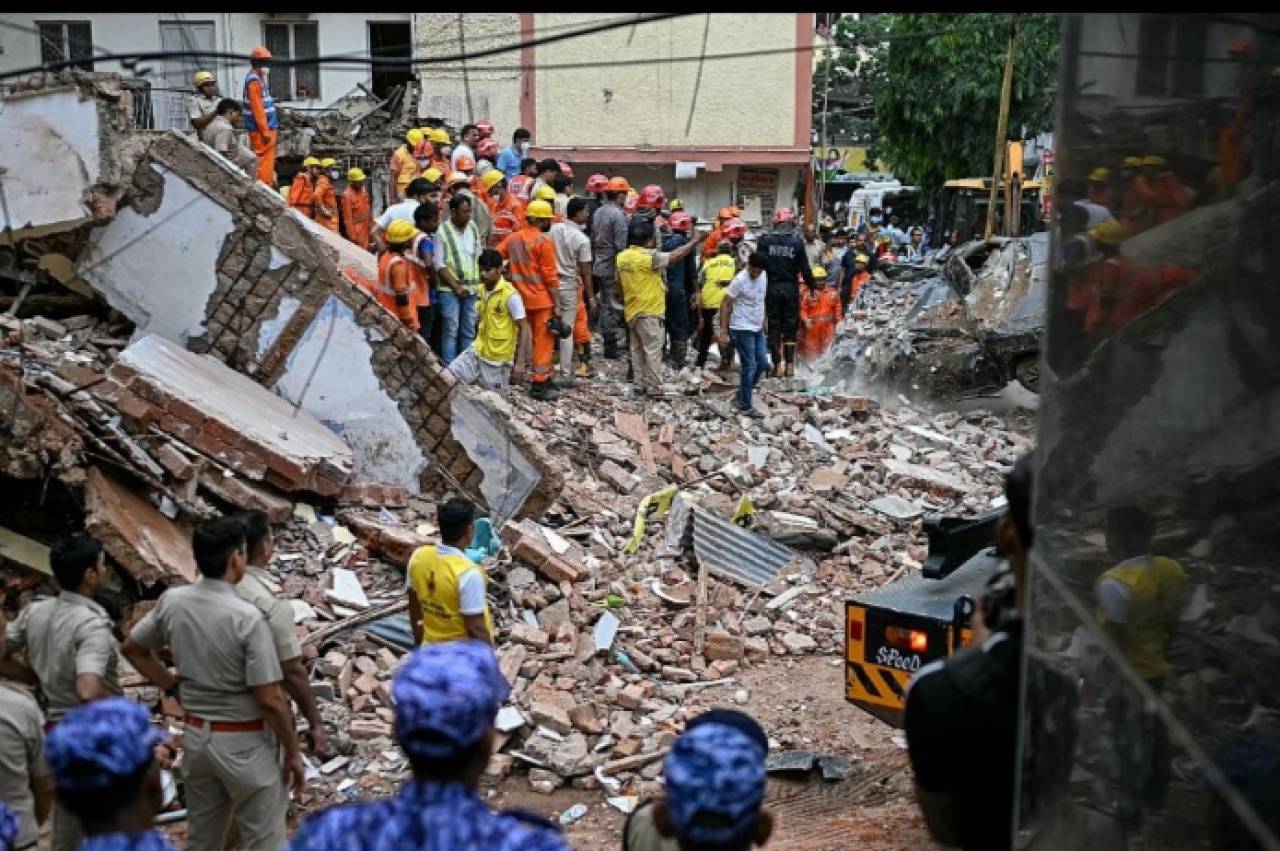
They were living in a paying-guest accommodation in Satya Niketan, a neighbourhood built around the housing needs of Delhi University students. On September 6, a five-storey building collapsed, trapping residents beneath the rubble. Rescue teams worked through the debris, while the authorities began investigating the building's construction, alterations and safety record.
The tragedy has since exposed a familiar urban reality: old buildings being adapted for intensive commercial use, additional construction that may not have had the required approvals, weak enforcement and a private student-housing market that has expanded much faster than the city's ability to regulate it.
That is where the Satya Niketan story becomes larger than one collapsed building.
It becomes a question of what India chooses to regulate before people die, and what it chooses to address only afterwards.
There is also a political argument surrounding the tragedy that needs to be separated from the facts.
On the same day as the collapse, Prime Minister Narendra Modi issued a condolence message expressing distress over the deaths and praying for the recovery of those injured. Authorities, he said, were working at the site.
Later that day, he addressed the inauguration of the BAPS Swaminarayan Hindu Mandir in the Paris region through video conference. In his remarks, Modi described the temple as a symbol of India's cultural ties with France and spoke about its potential contribution to India's civilisational and cultural presence in Europe.
So the claim that the Prime Minister simply ignored the Satya Niketan deaths is not supported by the record.
But correcting that claim does not end the political or constitutional question.
It makes the more serious question possible.
The problem is bigger than a condolence message
A condolence message is appropriate after a tragedy. But it cannot substitute for the systems that prevent such tragedies.
Delhi has seen repeated failures involving buildings used by students and young people. The Satya Niketan collapse follows the wider safety concerns exposed in places such as Mukherjee Nagar and Old Rajinder Nagar. Each incident raises questions about building permissions, inspections, commercial conversions, emergency preparedness and the accountability of officials responsible for enforcement.
The emerging investigation into Satya Niketan has already raised questions about unauthorised construction and structural alterations. Reports have also pointed to the age and condition of the building and possible weaknesses associated with construction and renovation work.
The important question, therefore, is not simply who will be arrested after a building collapses.
It is why the building was allowed to remain occupied before it collapsed.
That distinction matters.
An FIR can establish criminal responsibility. A demolition order can remove a dangerous structure. Neither, by itself, explains why the regulatory system failed to identify the danger early enough.
Why students end up in risky buildings
There is another uncomfortable part of the Satya Niketan story.
Delhi University has more than 2.5 lakh regular students, while its hostel capacity is only around 9,000 beds, according to recent reporting. Many students, particularly those coming from outside Delhi, therefore have little choice but to depend on private accommodation.
This is not a minor housing inconvenience.
It creates a market in which student accommodation becomes a profitable business while safety regulation struggles to keep pace.
Satya Niketan is surrounded by colleges and has consequently become a major student-housing zone. When formal hostel capacity is limited, private PGs fill the gap. But a private market cannot be expected to solve a public housing problem without strong rules, inspections and enforcement.
The result is a dangerous bargain.
Students need affordable rooms. Property owners want higher returns. PG operators want more beds. Buildings are altered to accommodate more people. And civic enforcement often arrives after something has gone wrong.
The student is the weakest party in that arrangement.
The temple question is legitimate, but it must be asked honestly
The Paris temple adds another layer to the debate.
There is nothing inherently wrong with India's Prime Minister participating virtually in the inauguration of an Indian religious or cultural institution abroad. India's diaspora diplomacy has long involved temples, gurdwaras, cultural institutions and community organisations.
The BAPS Swaminarayan Hindu Mandir in the Paris region is also being presented as a cultural and community institution, with a wider programme around India's heritage and relations with France.
The constitutional question is therefore not whether a Prime Minister is allowed to speak at a temple event.
The question is about the symbolism attached to the office.
India's Constitution describes the country as a secular republic. That does not mean the state must remain distant from every religious institution. It does mean that public institutions must be careful about how religious identity, state authority and political symbolism intersect.
The concern becomes sharper when an overseas temple inauguration and a deadly domestic infrastructure failure occur on the same day.
But the two events should not be falsely presented as cause and effect.
Delhi's students did not die because the Prime Minister addressed a temple inauguration.
They died because a building used to house students collapsed.
That distinction is essential.
If political criticism begins with a false allegation, it eventually protects the people and institutions that deserve scrutiny.
The real test begins after the cameras leave
The government's response now needs to move beyond demolition.
Delhi needs a comprehensive audit of PG accommodations in major student neighbourhoods. The exercise should examine structural safety, unauthorised additions, electrical systems, fire preparedness, occupancy limits and emergency exits.
But an audit alone will not be enough.
There must also be a public system through which students can check whether a PG is legally approved and safety-certified before paying a deposit.
Universities have a role too.
If thousands of students are pushed into private accommodation because campuses cannot provide enough hostel space, student housing cannot remain someone else's problem. Delhi University and its colleges need a long-term housing strategy that treats accommodation as part of educational infrastructure.
The civic administration, meanwhile, must answer a harder question: how did buildings operating in densely populated student neighbourhoods escape effective enforcement for so long?
And accountability cannot stop with the property owner.
Where negligence by officials is established, responsibility must travel up the chain.
Otherwise, the cycle will remain predictable.
A building becomes unsafe.
Students continue living there.
A tragedy occurs.
Rescue teams arrive.
An FIR is registered.
The structure is demolished.
Promises are made.
And attention moves elsewhere.
What Satya Niketan really tells us
The most useful lesson from Satya Niketan is not that India chose a temple over its students.
That is too simple, and the facts do not support it.
The deeper lesson is that India remains far better at responding to visible tragedies than preventing the invisible risks that precede them.
We build grand cultural symbols abroad and celebrate India's civilisational reach. There is nothing wrong with that.
But civilisation is also measured by something much less glamorous.
Whether a student renting a room in Delhi can reasonably expect the building around him to remain standing.
Whether a young person arriving in the capital to study has access to safe and affordable housing.
Whether an official inspection means something before a disaster, rather than after it.
And whether the death of seven people produces a lasting change in the system instead of another short-lived news cycle.
The question after Satya Niketan is therefore not whether anyone expressed sorrow.
It is whether the state will remember the building after the rubble is cleared.
That is where accountability begins.
Seven people are dead in South Delhi.
They were living in a paying-guest accommodation in Satya Niketan, a neighbourhood built around the housing needs of Delhi University students. On September 6, a five-storey building collapsed, trapping residents beneath the rubble. Rescue teams worked through the debris, while the authorities began investigating the building's construction, alterations and safety record.
The tragedy has since exposed a familiar urban reality: old buildings being adapted for intensive commercial use, additional construction that may not have had the required approvals, weak enforcement and a private student-housing market that has expanded much faster than the city's ability to regulate it.
That is where the Satya Niketan story becomes larger than one collapsed building.
It becomes a question of what India chooses to regulate before people die, and what it chooses to address only afterwards.
There is also a political argument surrounding the tragedy that needs to be separated from the facts.
On the same day as the collapse, Prime Minister Narendra Modi issued a condolence message expressing distress over the deaths and praying for the recovery of those injured. Authorities, he said, were working at the site.
Later that day, he addressed the inauguration of the BAPS Swaminarayan Hindu Mandir in the Paris region through video conference. In his remarks, Modi described the temple as a symbol of India's cultural ties with France and spoke about its potential contribution to India's civilisational and cultural presence in Europe.
So the claim that the Prime Minister simply ignored the Satya Niketan deaths is not supported by the record.
But correcting that claim does not end the political or constitutional question.
It makes the more serious question possible.
The problem is bigger than a condolence message
A condolence message is appropriate after a tragedy. But it cannot substitute for the systems that prevent such tragedies.
Delhi has seen repeated failures involving buildings used by students and young people. The Satya Niketan collapse follows the wider safety concerns exposed in places such as Mukherjee Nagar and Old Rajinder Nagar. Each incident raises questions about building permissions, inspections, commercial conversions, emergency preparedness and the accountability of officials responsible for enforcement.
The emerging investigation into Satya Niketan has already raised questions about unauthorised construction and structural alterations. Reports have also pointed to the age and condition of the building and possible weaknesses associated with construction and renovation work.
The important question, therefore, is not simply who will be arrested after a building collapses.
It is why the building was allowed to remain occupied before it collapsed.
That distinction matters.
An FIR can establish criminal responsibility. A demolition order can remove a dangerous structure. Neither, by itself, explains why the regulatory system failed to identify the danger early enough.
Why students end up in risky buildings
There is another uncomfortable part of the Satya Niketan story.
Delhi University has more than 2.5 lakh regular students, while its hostel capacity is only around 9,000 beds, according to recent reporting. Many students, particularly those coming from outside Delhi, therefore have little choice but to depend on private accommodation.
This is not a minor housing inconvenience.
It creates a market in which student accommodation becomes a profitable business while safety regulation struggles to keep pace.
Satya Niketan is surrounded by colleges and has consequently become a major student-housing zone. When formal hostel capacity is limited, private PGs fill the gap. But a private market cannot be expected to solve a public housing problem without strong rules, inspections and enforcement.
The result is a dangerous bargain.
Students need affordable rooms. Property owners want higher returns. PG operators want more beds. Buildings are altered to accommodate more people. And civic enforcement often arrives after something has gone wrong.
The student is the weakest party in that arrangement.
The temple question is legitimate, but it must be asked honestly
The Paris temple adds another layer to the debate.
There is nothing inherently wrong with India's Prime Minister participating virtually in the inauguration of an Indian religious or cultural institution abroad. India's diaspora diplomacy has long involved temples, gurdwaras, cultural institutions and community organisations.
The BAPS Swaminarayan Hindu Mandir in the Paris region is also being presented as a cultural and community institution, with a wider programme around India's heritage and relations with France.
The constitutional question is therefore not whether a Prime Minister is allowed to speak at a temple event.
The question is about the symbolism attached to the office.
India's Constitution describes the country as a secular republic. That does not mean the state must remain distant from every religious institution. It does mean that public institutions must be careful about how religious identity, state authority and political symbolism intersect.
The concern becomes sharper when an overseas temple inauguration and a deadly domestic infrastructure failure occur on the same day.
But the two events should not be falsely presented as cause and effect.
Delhi's students did not die because the Prime Minister addressed a temple inauguration.
They died because a building used to house students collapsed.
That distinction is essential.
If political criticism begins with a false allegation, it eventually protects the people and institutions that deserve scrutiny.
The real test begins after the cameras leave
The government's response now needs to move beyond demolition.
Delhi needs a comprehensive audit of PG accommodations in major student neighbourhoods. The exercise should examine structural safety, unauthorised additions, electrical systems, fire preparedness, occupancy limits and emergency exits.
But an audit alone will not be enough.
There must also be a public system through which students can check whether a PG is legally approved and safety-certified before paying a deposit.
Universities have a role too.
If thousands of students are pushed into private accommodation because campuses cannot provide enough hostel space, student housing cannot remain someone else's problem. Delhi University and its colleges need a long-term housing strategy that treats accommodation as part of educational infrastructure.
The civic administration, meanwhile, must answer a harder question: how did buildings operating in densely populated student neighbourhoods escape effective enforcement for so long?
And accountability cannot stop with the property owner.
Where negligence by officials is established, responsibility must travel up the chain.
Otherwise, the cycle will remain predictable.
A building becomes unsafe.
Students continue living there.
A tragedy occurs.
Rescue teams arrive.
An FIR is registered.
The structure is demolished.
Promises are made.
And attention moves elsewhere.
What Satya Niketan really tells us
The most useful lesson from Satya Niketan is not that India chose a temple over its students.
That is too simple, and the facts do not support it.
The deeper lesson is that India remains far better at responding to visible tragedies than preventing the invisible risks that precede them.
We build grand cultural symbols abroad and celebrate India's civilisational reach. There is nothing wrong with that.
But civilisation is also measured by something much less glamorous.
Whether a student renting a room in Delhi can reasonably expect the building around him to remain standing.
Whether a young person arriving in the capital to study has access to safe and affordable housing.
Whether an official inspection means something before a disaster, rather than after it.
And whether the death of seven people produces a lasting change in the system instead of another short-lived news cycle.
The question after Satya Niketan is therefore not whether anyone expressed sorrow.
It is whether the state will remember the building after the rubble is cleared.
That is where accountability begins.























Leave a Comment