
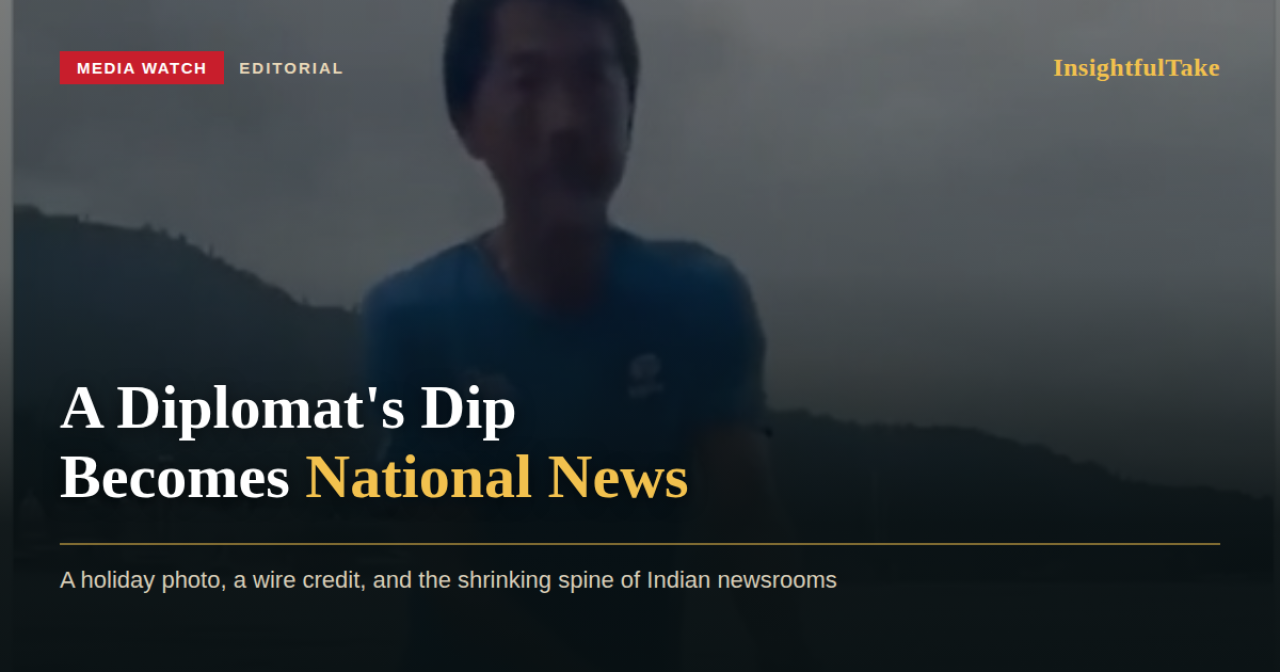
A Japanese ambassador took a dip in the Ganga, drank chai and went rafting. The real story may not be his holiday, but why Indian newsrooms thought it was news.
Japan's Ambassador to India, Ono Keiichi, recently posted on social media about a personal trip to Rishikesh. He described taking a holy dip in the Ganga, called the experience one of "awe, humility, and gratitude," shared a selfie, and wrote about drinking chai and trying river rafting. It was, by any reasonable measure, a pleasant weekend post from a foreign diplomat enjoying a tourist destination.
Within days, it was a headline story across major Indian news outlets, complete with reproduced quotes, screenshots of social media reactions, and follow-up pieces on what "netizens said." A private citizen's holiday photo had been elevated to the status of a national news event.
What Actually Happened Here
Strip away the coverage and the underlying facts are almost comically thin. An ambassador went on a personal trip. He enjoyed it. He posted about it, the way millions of people post vacation photos every day. Indian users replied with warmth and humour, offering tips about the local boatmen and rafting guides. That is the entire story.
There is no policy angle. There is no diplomatic development. There is no bilateral significance. Ono Keiichi did not announce a trade deal, comment on a strategic partnership, or make a statement relevant to India-Japan relations. He went for a swim and liked it.
Yet this got the same editorial treatment usually reserved for actual news: a snappy headline, an image, a "what social media said" section, and wire agency credit.
The Pattern Behind the Story
This is not an isolated incident. Indian media has developed a recurring template for stories involving foreign nationals, especially diplomats, and their engagement with Indian culture.
A foreign ambassador eats a golgappa is news. A foreign diplomat wears a kurta on a festival is news. A foreigner learns three words of Hindi is news.
The formula is reliable, cheap to produce, and virtually guaranteed clicks, because it flatters a certain audience instinct: the desire to see Indian culture validated by an outsider's approval.
The problem is not that these moments are covered at all. A brief, honest mention would be harmless. The problem is the inflation: treating a personal social media post as if it carries institutional weight, running it as a standalone story rather than a passing mention, and manufacturing an entire narrative arc around "unforgettable moments" and public reactions that add nothing to public understanding of anything.
What This Reveals About Editorial Priorities
Real journalism requires effort: sourcing documents, verifying claims, following up with officials, sitting through uncomfortable answers.
Reproducing a diplomat's Twitter post requires none of that. It requires a screenshot and a paragraph of paraphrase.
That is precisely why this kind of content has proliferated: it is inexpensive to produce, low-risk, and algorithm-friendly, while genuine investigative reporting on governance failures, judicial delays, or policy consequences remains comparatively rare and underfunded.
This is the quiet erosion worth naming. It is not that any single outlet ran one soft story. It is that newsrooms have increasingly organised themselves around content that guarantees engagement over content that demands scrutiny.
A diplomat's holiday photo travels faster through the news cycle than a report on farmer distress or hospital infrastructure, because outrage and warmth are both easier products to sell than complexity.
Diplomacy Deserves Better Scrutiny Too
There is a deeper irony here. Ambassadors are precisely the figures whose public conduct should be covered with genuine analytical rigour. Their statements on trade, visa policy, security cooperation, and bilateral disputes matter enormously to ordinary Indians.
When newsrooms spend their limited attention on a personal dip in the Ganga instead of substantive coverage of what an ambassador's country is actually doing in India, they are not just wasting space. They are failing at the specific job that justifies covering diplomats in the first place.
The Larger Cost
None of this is to begrudge Ono Keiichi his holiday, or to suggest warmth toward visitors is a bad instinct.
It is to ask why Indian newsrooms, with finite editorial resources and finite public attention to spend, chose to spend both on a story that changes nothing and informs no one.
Every hour spent packaging a diplomat's Instagram caption into a news article is an hour not spent asking harder questions of people who actually hold power.
That, ultimately, is the real story.
Not the dip in the Ganga, but the dip in editorial standards required to report it as news.
Japan's Ambassador to India, Ono Keiichi, recently posted on social media about a personal trip to Rishikesh. He described taking a holy dip in the Ganga, called the experience one of "awe, humility, and gratitude," shared a selfie, and wrote about drinking chai and trying river rafting. It was, by any reasonable measure, a pleasant weekend post from a foreign diplomat enjoying a tourist destination.
Within days, it was a headline story across major Indian news outlets, complete with reproduced quotes, screenshots of social media reactions, and follow-up pieces on what "netizens said." A private citizen's holiday photo had been elevated to the status of a national news event.
What Actually Happened Here
Strip away the coverage and the underlying facts are almost comically thin. An ambassador went on a personal trip. He enjoyed it. He posted about it, the way millions of people post vacation photos every day. Indian users replied with warmth and humour, offering tips about the local boatmen and rafting guides. That is the entire story.
There is no policy angle. There is no diplomatic development. There is no bilateral significance. Ono Keiichi did not announce a trade deal, comment on a strategic partnership, or make a statement relevant to India-Japan relations. He went for a swim and liked it.
Yet this got the same editorial treatment usually reserved for actual news: a snappy headline, an image, a "what social media said" section, and wire agency credit.
The Pattern Behind the Story
This is not an isolated incident. Indian media has developed a recurring template for stories involving foreign nationals, especially diplomats, and their engagement with Indian culture.
A foreign ambassador eats a golgappa is news. A foreign diplomat wears a kurta on a festival is news. A foreigner learns three words of Hindi is news.
The formula is reliable, cheap to produce, and virtually guaranteed clicks, because it flatters a certain audience instinct: the desire to see Indian culture validated by an outsider's approval.
The problem is not that these moments are covered at all. A brief, honest mention would be harmless. The problem is the inflation: treating a personal social media post as if it carries institutional weight, running it as a standalone story rather than a passing mention, and manufacturing an entire narrative arc around "unforgettable moments" and public reactions that add nothing to public understanding of anything.
What This Reveals About Editorial Priorities
Real journalism requires effort: sourcing documents, verifying claims, following up with officials, sitting through uncomfortable answers.
Reproducing a diplomat's Twitter post requires none of that. It requires a screenshot and a paragraph of paraphrase.
That is precisely why this kind of content has proliferated: it is inexpensive to produce, low-risk, and algorithm-friendly, while genuine investigative reporting on governance failures, judicial delays, or policy consequences remains comparatively rare and underfunded.
This is the quiet erosion worth naming. It is not that any single outlet ran one soft story. It is that newsrooms have increasingly organised themselves around content that guarantees engagement over content that demands scrutiny.
A diplomat's holiday photo travels faster through the news cycle than a report on farmer distress or hospital infrastructure, because outrage and warmth are both easier products to sell than complexity.
Diplomacy Deserves Better Scrutiny Too
There is a deeper irony here. Ambassadors are precisely the figures whose public conduct should be covered with genuine analytical rigour. Their statements on trade, visa policy, security cooperation, and bilateral disputes matter enormously to ordinary Indians.
When newsrooms spend their limited attention on a personal dip in the Ganga instead of substantive coverage of what an ambassador's country is actually doing in India, they are not just wasting space. They are failing at the specific job that justifies covering diplomats in the first place.
The Larger Cost
None of this is to begrudge Ono Keiichi his holiday, or to suggest warmth toward visitors is a bad instinct.
It is to ask why Indian newsrooms, with finite editorial resources and finite public attention to spend, chose to spend both on a story that changes nothing and informs no one.
Every hour spent packaging a diplomat's Instagram caption into a news article is an hour not spent asking harder questions of people who actually hold power.
That, ultimately, is the real story.
Not the dip in the Ganga, but the dip in editorial standards required to report it as news.






















Leave a Comment