
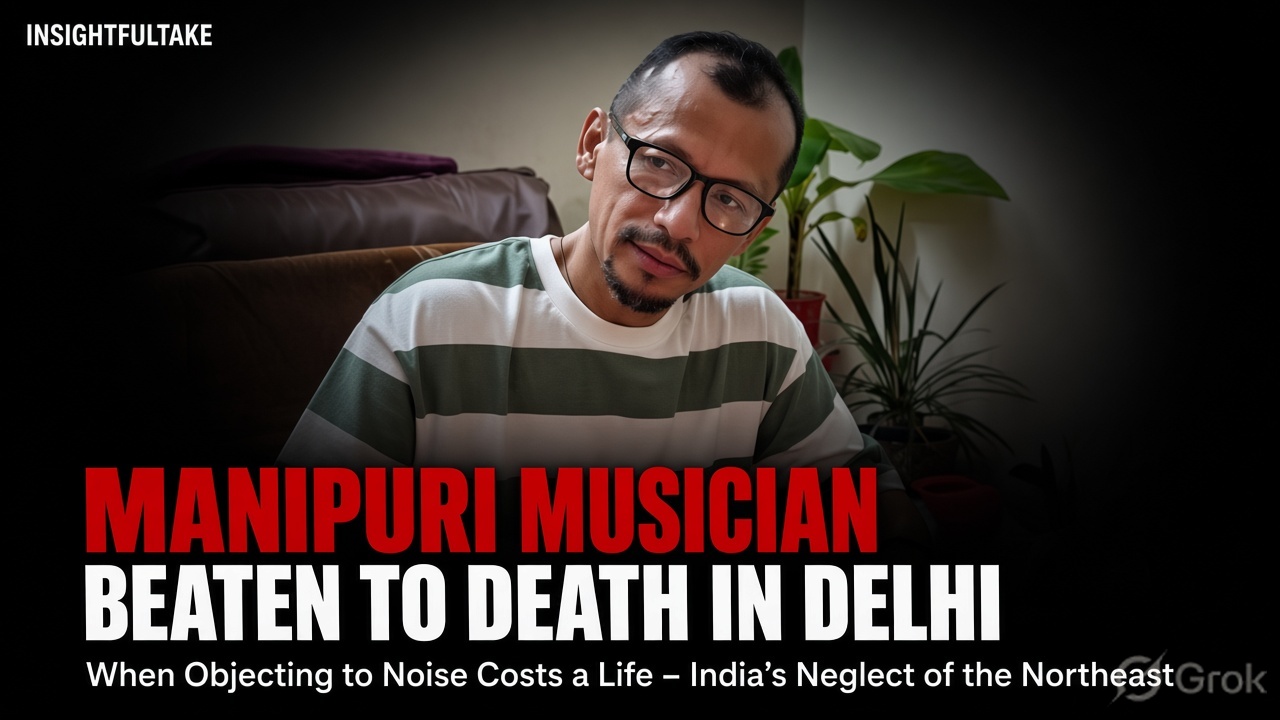
A musician went downstairs to ask for quiet. He never returned home alive. His death now raises a larger question about how India treats its Northeast.
In the quiet hours of a late Sunday night in September 2026, a 54-year-old music teacher from Manipur stepped out of his home in Kilokari village near Ashram in southeast Delhi to object to loud noise and disturbance.
By Monday morning, Chongtham Vikram Singh was dead.
What began as a complaint about shouting and nuisance allegedly involving delivery workers and staff from a nearby dhaba ended in a brutal assault that claimed the life of a man who had spent decades enriching India's musical landscape.
Eight people, including a minor, were arrested. Police described the accused as workers from different dhabas and food stalls.
The official narrative frames the incident as a dispute that turned violent. Yet for many people from India's Northeast, the killing of Vikram Singh raises questions that go beyond one night of violence. It brings back a long and painful conversation about othering, discrimination, neglect and the persistent feeling among many Northeastern Indians that they are treated as outsiders in their own country.
A Musician Who Built Bridges Through Art
Vikram Singh was no ordinary resident of Delhi.
A pioneering guitarist from Manipur's early Western music scene, he had played with bands such as Phoenix, Ultra Vires and Eastern Dark. He was the son of legendary Manipuri singer Chongtham Kamala, a defining voice in the state's classical and film music.
After establishing himself in Imphal, Vikram Singh moved to Delhi nearly two decades ago. He taught guitar, mentored young musicians, ran a music school and contributed quietly to the capital's cultural life.
Colleagues remembered him as kind and soft-spoken, a man who rarely sought confrontation.
He lived with his wife, Joshna, and their son, Yaiphaba, a law student.
On the night of September 6, when the noise outside reportedly became unbearable, Singh went downstairs to raise the matter. According to accounts, he was confronted, punched and kicked. He tried to escape back to his third-floor home.
The attackers allegedly followed him inside the building and continued the assault.
His son found him injured and rushed him to Holy Family Hospital. Vikram Singh died the following day from his injuries.
CCTV footage reportedly showed eight men leaving the building after the attack.
The arrests came swiftly. Senior police officers met the family. Union Minister Kiren Rijiju publicly sought the strictest possible punishment and said a chargesheet was expected within days. Manipur's Chief Minister also wrote to his Delhi counterpart seeking a fair investigation under senior supervision.
In Imphal, candlelight vigils were held.
On paper, the system appeared to be responding.
But the deeper questions remain.
When a Local Dispute Opens a National Wound
Why can an ordinary disagreement over noise escalate into fatal violence?
Why do so many people from India's Northeast continue to report being called terms such as "Chinese" or "chinky" in streets, markets, educational institutions and workplaces across major Indian cities?
And why does a region of eight states, with its own histories, languages, literature, music, political movements and cultural traditions, remain so poorly understood by large sections of the country?
These questions are not abstract.
For many Northeastern Indians, they are part of everyday life.
India's Northeast, comprising Arunachal Pradesh, Assam, Manipur, Meghalaya, Mizoram, Nagaland, Sikkim and Tripura, occupies a paradoxical position in the national imagination.
It is celebrated in tourism campaigns for its mountains, forests, food, music and cultural diversity. Yet outside moments of crisis, its people and histories often receive limited attention in mainstream education, media and popular culture.
Generations of Indians have grown up knowing remarkably little about the region beyond a handful of geographical facts, military conflicts or images of natural beauty.
The problem is not simply ignorance.
Ignorance can become a form of exclusion.
When people know little about a community, stereotypes easily fill the gap.
A Region Reduced to a Footnote
The histories of India's Northeast are complex. They include indigenous traditions, kingdoms, colonial encounters, movements for autonomy, political negotiations, conflicts and eventual integration into the Indian constitutional framework.
Its cultural contribution is equally rich.
Manipuri dance and music, Assamese literature, Naga artistic traditions, Mizo culture and the diverse languages and customs of the region are part of India's larger cultural inheritance.
Yet the Northeast is frequently presented as a distant frontier rather than an integral part of the Republic.
That absence matters.
A child who grows up learning little about the Northeast may later encounter someone from Manipur, Nagaland or Mizoram primarily through appearance. A different facial structure, language or accent can then become a reason for stereotyping.
What should be recognised as diversity becomes a marker of foreignness.
The consequences can be serious.
Northeast students and professionals in cities such as Delhi, Bengaluru and Pune have repeatedly reported racial slurs, housing discrimination, workplace prejudice and physical harassment.
During the COVID-19 pandemic, people from the region faced particular hostility because of their East Asian features and were sometimes accused of being responsible for spreading the virus.
The pattern reveals something uncomfortable.
When society decides that someone looks different, that difference can become a vulnerability.
The Question of Racism
There is no public evidence establishing that racial prejudice was the motive behind Vikram Singh's killing. Police have described the immediate incident as a dispute over noise, and the investigation must establish what actually happened.
That distinction matters.
But the absence of a confirmed racial motive does not make the larger question irrelevant.
For many people from the Northeast, the incident resonates because it occurs against a background of repeated experiences of being treated as less Indian, less familiar or somehow foreign.
Calling someone from Manipur, Nagaland, Mizoram or Arunachal Pradesh "Chinese" is not merely a comment on appearance.
It collapses distinct identities into a foreign stereotype.
It ignores the history of these communities and their place within India. It overlooks their contributions to the armed forces, civil services, sports, arts, education and science.
Most importantly, it sends a deeply troubling message: that some Indians must repeatedly prove their Indianness to other Indians.
That is a failure of belonging.
The Northeast and the National Imagination
India's political system recognises the Northeast as an integral part of the Union. Its states are constitutional units of the Republic. Its citizens possess the same rights and responsibilities as citizens anywhere else.
But constitutional equality alone cannot eliminate social prejudice.
Belonging is also created through education, representation and everyday interaction.
It is created when schoolchildren learn about Northeastern writers, musicians, freedom fighters, athletes and political leaders as part of Indian history rather than as occasional footnotes.
It is created when mainstream media reports on the region beyond insurgency, elections, floods, disasters and conflict.
It is created when people in India's major cities understand that someone from Imphal, Kohima or Aizawl is not a visitor from another country.
This is where the national conversation remains unfinished.
The Northeast's strategic importance is frequently acknowledged in terms of borders, security and geopolitics.
Its cultural importance deserves the same seriousness.
Vikram Singh's Life Was a Counter-Narrative
Perhaps the most painful irony of Vikram Singh's story is that his life represented exactly the kind of connection India needs more of.
He came from Manipur and built a life in Delhi.
He carried forward a rich musical inheritance while embracing Western music. He taught young people. He mentored musicians. He contributed to the cultural life of a city far from his birthplace.
Music became his language of connection.
His mother, Chongtham Kamala, was a towering figure in Manipuri music and cinema. Vikram Singh continued that legacy in his own way.
He was not an outsider who had arrived in Delhi yesterday.
He had spent nearly two decades there.
He had taught there, worked there, lived there and built relationships there.
And yet, according to accounts of the incident, a confrontation over noise ended with him being pursued into his own building and beaten so severely that he died.
That is what makes the case so disturbing.
Justice Must Go Beyond the Chargesheet
The immediate priority is straightforward.
The investigation must be thorough. Those responsible must face the law. The family deserves justice, transparency and accountability.
But a chargesheet, however necessary, cannot answer every question raised by this tragedy.
India also needs to ask why prejudice against Northeastern communities survives so comfortably in everyday life.
Why are racial slurs still normalised?
Why are Northeastern students sometimes made to feel foreign in Indian classrooms?
Why do stereotypes about appearance remain so persistent?
Why does an entire region continue to receive disproportionately little space in the country's cultural and educational imagination?
These questions cannot be answered by the police alone.
They require schools, universities, media organisations, political institutions and ordinary citizens to examine their own assumptions.
An Unfinished Conversation
The eight accused will face the law.
Vikram Singh's family will continue to grieve a husband and father who should still have been teaching guitar, making music and mentoring the next generation.
The country, meanwhile, faces a choice.
It can treat this as another crime story, follow the arrests and chargesheet for a few days, and then move on to the next headline.
Or it can see the case as an opportunity to confront a deeper question.
What does it mean to belong to India?
The answer cannot depend on how someone looks, speaks, dresses or where their ancestors lived.
India's Northeast is not an appendix to the nation. It is part of its history, its culture and its present.
Chongtham Vikram Singh's death should therefore not become only a story about one violent night in Delhi.
It should become part of a larger national conversation about dignity, prejudice and belonging.
Because the real measure of a country is not merely whether it can punish violence after it happens.
It is whether it can create a society in which difference does not make a person more vulnerable to it.
In the quiet hours of a late Sunday night in September 2026, a 54-year-old music teacher from Manipur stepped out of his home in Kilokari village near Ashram in southeast Delhi to object to loud noise and disturbance.
By Monday morning, Chongtham Vikram Singh was dead.
What began as a complaint about shouting and nuisance allegedly involving delivery workers and staff from a nearby dhaba ended in a brutal assault that claimed the life of a man who had spent decades enriching India's musical landscape.
Eight people, including a minor, were arrested. Police described the accused as workers from different dhabas and food stalls.
The official narrative frames the incident as a dispute that turned violent. Yet for many people from India's Northeast, the killing of Vikram Singh raises questions that go beyond one night of violence. It brings back a long and painful conversation about othering, discrimination, neglect and the persistent feeling among many Northeastern Indians that they are treated as outsiders in their own country.
A Musician Who Built Bridges Through Art
Vikram Singh was no ordinary resident of Delhi.
A pioneering guitarist from Manipur's early Western music scene, he had played with bands such as Phoenix, Ultra Vires and Eastern Dark. He was the son of legendary Manipuri singer Chongtham Kamala, a defining voice in the state's classical and film music.
After establishing himself in Imphal, Vikram Singh moved to Delhi nearly two decades ago. He taught guitar, mentored young musicians, ran a music school and contributed quietly to the capital's cultural life.
Colleagues remembered him as kind and soft-spoken, a man who rarely sought confrontation.
He lived with his wife, Joshna, and their son, Yaiphaba, a law student.
On the night of September 6, when the noise outside reportedly became unbearable, Singh went downstairs to raise the matter. According to accounts, he was confronted, punched and kicked. He tried to escape back to his third-floor home.
The attackers allegedly followed him inside the building and continued the assault.
His son found him injured and rushed him to Holy Family Hospital. Vikram Singh died the following day from his injuries.
CCTV footage reportedly showed eight men leaving the building after the attack.
The arrests came swiftly. Senior police officers met the family. Union Minister Kiren Rijiju publicly sought the strictest possible punishment and said a chargesheet was expected within days. Manipur's Chief Minister also wrote to his Delhi counterpart seeking a fair investigation under senior supervision.
In Imphal, candlelight vigils were held.
On paper, the system appeared to be responding.
But the deeper questions remain.
When a Local Dispute Opens a National Wound
Why can an ordinary disagreement over noise escalate into fatal violence?
Why do so many people from India's Northeast continue to report being called terms such as "Chinese" or "chinky" in streets, markets, educational institutions and workplaces across major Indian cities?
And why does a region of eight states, with its own histories, languages, literature, music, political movements and cultural traditions, remain so poorly understood by large sections of the country?
These questions are not abstract.
For many Northeastern Indians, they are part of everyday life.
India's Northeast, comprising Arunachal Pradesh, Assam, Manipur, Meghalaya, Mizoram, Nagaland, Sikkim and Tripura, occupies a paradoxical position in the national imagination.
It is celebrated in tourism campaigns for its mountains, forests, food, music and cultural diversity. Yet outside moments of crisis, its people and histories often receive limited attention in mainstream education, media and popular culture.
Generations of Indians have grown up knowing remarkably little about the region beyond a handful of geographical facts, military conflicts or images of natural beauty.
The problem is not simply ignorance.
Ignorance can become a form of exclusion.
When people know little about a community, stereotypes easily fill the gap.
A Region Reduced to a Footnote
The histories of India's Northeast are complex. They include indigenous traditions, kingdoms, colonial encounters, movements for autonomy, political negotiations, conflicts and eventual integration into the Indian constitutional framework.
Its cultural contribution is equally rich.
Manipuri dance and music, Assamese literature, Naga artistic traditions, Mizo culture and the diverse languages and customs of the region are part of India's larger cultural inheritance.
Yet the Northeast is frequently presented as a distant frontier rather than an integral part of the Republic.
That absence matters.
A child who grows up learning little about the Northeast may later encounter someone from Manipur, Nagaland or Mizoram primarily through appearance. A different facial structure, language or accent can then become a reason for stereotyping.
What should be recognised as diversity becomes a marker of foreignness.
The consequences can be serious.
Northeast students and professionals in cities such as Delhi, Bengaluru and Pune have repeatedly reported racial slurs, housing discrimination, workplace prejudice and physical harassment.
During the COVID-19 pandemic, people from the region faced particular hostility because of their East Asian features and were sometimes accused of being responsible for spreading the virus.
The pattern reveals something uncomfortable.
When society decides that someone looks different, that difference can become a vulnerability.
The Question of Racism
There is no public evidence establishing that racial prejudice was the motive behind Vikram Singh's killing. Police have described the immediate incident as a dispute over noise, and the investigation must establish what actually happened.
That distinction matters.
But the absence of a confirmed racial motive does not make the larger question irrelevant.
For many people from the Northeast, the incident resonates because it occurs against a background of repeated experiences of being treated as less Indian, less familiar or somehow foreign.
Calling someone from Manipur, Nagaland, Mizoram or Arunachal Pradesh "Chinese" is not merely a comment on appearance.
It collapses distinct identities into a foreign stereotype.
It ignores the history of these communities and their place within India. It overlooks their contributions to the armed forces, civil services, sports, arts, education and science.
Most importantly, it sends a deeply troubling message: that some Indians must repeatedly prove their Indianness to other Indians.
That is a failure of belonging.
The Northeast and the National Imagination
India's political system recognises the Northeast as an integral part of the Union. Its states are constitutional units of the Republic. Its citizens possess the same rights and responsibilities as citizens anywhere else.
But constitutional equality alone cannot eliminate social prejudice.
Belonging is also created through education, representation and everyday interaction.
It is created when schoolchildren learn about Northeastern writers, musicians, freedom fighters, athletes and political leaders as part of Indian history rather than as occasional footnotes.
It is created when mainstream media reports on the region beyond insurgency, elections, floods, disasters and conflict.
It is created when people in India's major cities understand that someone from Imphal, Kohima or Aizawl is not a visitor from another country.
This is where the national conversation remains unfinished.
The Northeast's strategic importance is frequently acknowledged in terms of borders, security and geopolitics.
Its cultural importance deserves the same seriousness.
Vikram Singh's Life Was a Counter-Narrative
Perhaps the most painful irony of Vikram Singh's story is that his life represented exactly the kind of connection India needs more of.
He came from Manipur and built a life in Delhi.
He carried forward a rich musical inheritance while embracing Western music. He taught young people. He mentored musicians. He contributed to the cultural life of a city far from his birthplace.
Music became his language of connection.
His mother, Chongtham Kamala, was a towering figure in Manipuri music and cinema. Vikram Singh continued that legacy in his own way.
He was not an outsider who had arrived in Delhi yesterday.
He had spent nearly two decades there.
He had taught there, worked there, lived there and built relationships there.
And yet, according to accounts of the incident, a confrontation over noise ended with him being pursued into his own building and beaten so severely that he died.
That is what makes the case so disturbing.
Justice Must Go Beyond the Chargesheet
The immediate priority is straightforward.
The investigation must be thorough. Those responsible must face the law. The family deserves justice, transparency and accountability.
But a chargesheet, however necessary, cannot answer every question raised by this tragedy.
India also needs to ask why prejudice against Northeastern communities survives so comfortably in everyday life.
Why are racial slurs still normalised?
Why are Northeastern students sometimes made to feel foreign in Indian classrooms?
Why do stereotypes about appearance remain so persistent?
Why does an entire region continue to receive disproportionately little space in the country's cultural and educational imagination?
These questions cannot be answered by the police alone.
They require schools, universities, media organisations, political institutions and ordinary citizens to examine their own assumptions.
An Unfinished Conversation
The eight accused will face the law.
Vikram Singh's family will continue to grieve a husband and father who should still have been teaching guitar, making music and mentoring the next generation.
The country, meanwhile, faces a choice.
It can treat this as another crime story, follow the arrests and chargesheet for a few days, and then move on to the next headline.
Or it can see the case as an opportunity to confront a deeper question.
What does it mean to belong to India?
The answer cannot depend on how someone looks, speaks, dresses or where their ancestors lived.
India's Northeast is not an appendix to the nation. It is part of its history, its culture and its present.
Chongtham Vikram Singh's death should therefore not become only a story about one violent night in Delhi.
It should become part of a larger national conversation about dignity, prejudice and belonging.
Because the real measure of a country is not merely whether it can punish violence after it happens.
It is whether it can create a society in which difference does not make a person more vulnerable to it.



















Leave a Comment