

Hindi has the numbers, the cultural reach and official status. But when it comes to jobs, wages and economic mobility, English still holds the stronger hand.
India observed Hindi Diwas on September 14, marking 77 years since the Constituent Assembly adopted Hindi in the Devanagari script as the Official Language of the Union in 1949.
Union Home Minister Amit Shah inaugurated the 6th All India Official Language Conference in Navi Mumbai, distributed Rajbhasha awards, and spoke of Hindi's role in national integration.
The ritual repeats every year: speeches, essay competitions and award ceremonies. What does not repeat is any serious movement of Hindi from a symbol of cultural pride to a language that expands a person's economic prospects.
This gap, not any lack of official ceremony, is the real crisis facing Hindi today.
Hindi Has Numbers. English Has Economic Power
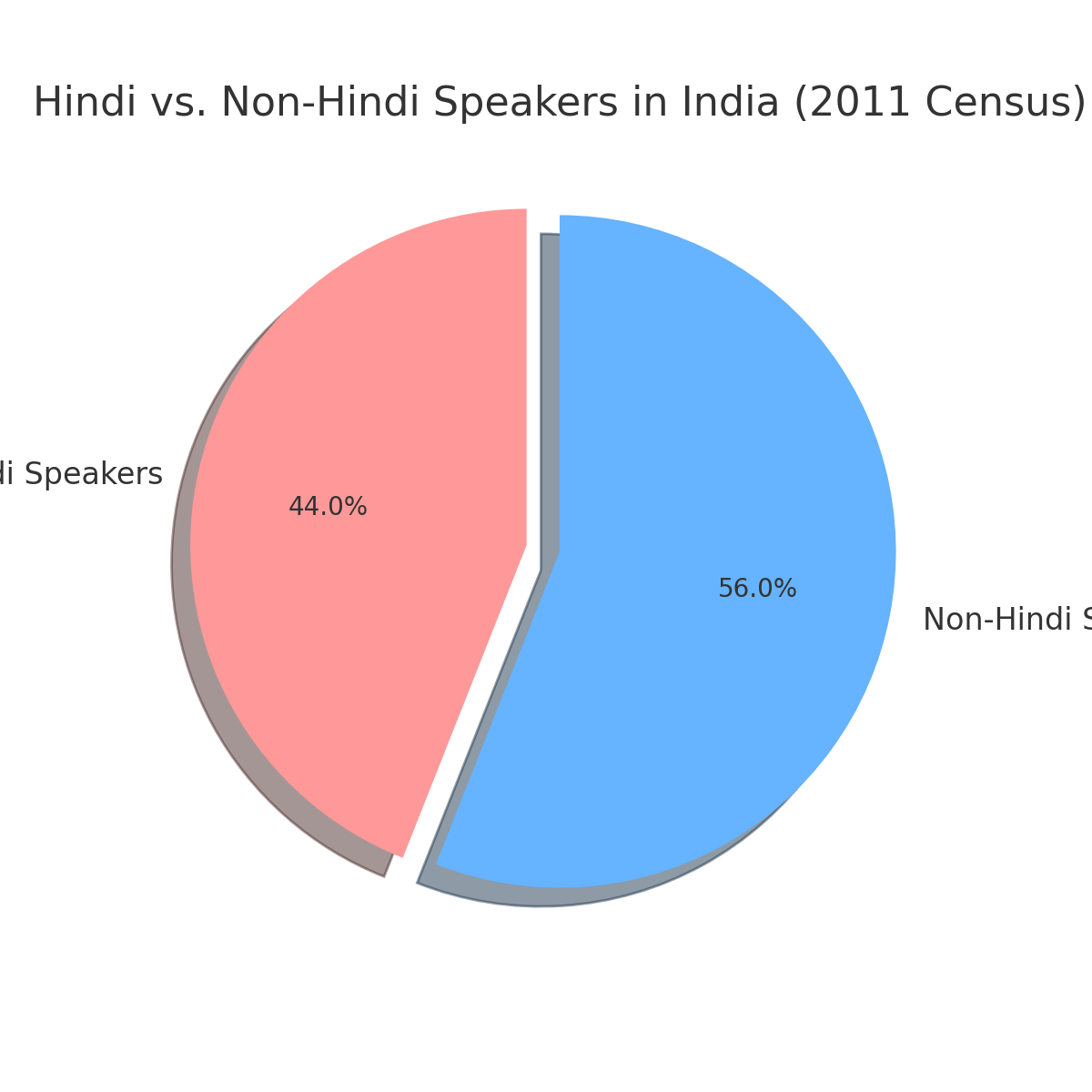
By raw numbers, Hindi looks unassailable. The 2011 Census recorded roughly 528 million people who listed Hindi as their mother tongue, about 43.6 percent of the population, concentrated in Uttar Pradesh, Bihar, Madhya Pradesh and Rajasthan.
Including second- and third-language speakers, total Hindi proficiency touches 57 percent of Indians. Yet English, spoken fluently or partially by roughly 10 percent of the population, continues to determine access to the country's best-paying jobs, its higher judiciary, its elite civil services, and its technology and finance sectors.
Numerical dominance in speakers has not translated into economic dominance in outcomes. That disconnect is precisely what a Hindi Diwas built around ceremony rather than policy keeps failing to address.
What the Wage Data Actually Shows
Economists have measured this gap directly. Research using the India Human Development Survey found that men fluent in English earn about 34 percent more per hour than those with no English ability, while women fluent in English earn roughly 22 percent more.
Even limited English ability carried a 13 percent wage premium for men. A separate study in West Bengal linked a one percentage point fall in the likelihood of learning English to a 1.6 percent drop in weekly wages.
These are not marginal effects. They describe a labour market where English functions as a gatekeeping credential, layered on top of formal education rather than substituting for it.
Hindi, despite its constitutional status, carries no comparable premium in white-collar recruitment, banking or the private sector.
The Problem Is Not English
The argument should not be reduced to Hindi versus English.
English has become an important working language in India's economy because it connects Indian workers to global markets, technology, higher education, multinational companies and international research. Removing that advantage would not automatically strengthen Hindi.
The more important question is why Hindi has failed to develop comparable economic value across large parts of the domestic economy.
A language becomes economically powerful when employers need it, institutions use it, consumers demand it and workers can use it to access better opportunities. Official recognition alone cannot create that ecosystem.
Where Hindi Loses Economic Ground
A student may complete schooling in Hindi and still find that the most valuable professional courses, competitive examinations, corporate recruitment processes and technical material are disproportionately available in English.
A job seeker may be highly articulate in Hindi but discover that fluency in English is treated as a proxy for professional competence.
A small business owner may operate successfully in Hindi but need English for banking, technology platforms, contracts, exports or communication with larger corporate clients.
This creates a peculiar hierarchy. Hindi is the language of mass communication, politics, popular culture and everyday interaction across much of North India. English remains the language that can unlock a disproportionate share of economic mobility.
The result is not simply a language divide. It is an opportunity divide.
Hindi Diwas Needs to Move Beyond Symbolism
The annual celebration of Hindi has value. Languages carry history, literature, memory and identity. Hindi has played an enormous role in India's public life and cultural landscape.
But cultural pride cannot be the endpoint of language policy.
If governments want Hindi to become more useful economically, the focus has to shift from speeches to infrastructure.
Technical education in Hindi must improve in quality. Professional terminology needs to become accessible rather than unnecessarily Sanskritised. Government services should be available in functional, modern Hindi. Digital tools, artificial intelligence systems and software interfaces need strong Hindi capabilities. High-quality textbooks, research material and professional courses must be available in Hindi.
Most importantly, Hindi should become a language in which a young person can study, acquire a professional skill, start a business, use technology and compete for a well-paid job.
That is a much bigger challenge than organising a Hindi Diwas conference.
A Language Cannot Be Made Powerful by Government Circulars
Government departments can encourage Hindi use in official communication. They can issue awards, organise conferences and set targets for official-language implementation.
But no government circular can manufacture economic utility.
Workers and businesses ultimately determine which language has value in the marketplace. If English continues to provide a measurable wage advantage, families will continue to invest in English education, regardless of how many Hindi Diwas speeches are delivered.
This is why the debate needs to become more practical.
The objective should not be to replace English with Hindi. Nor should learning English be treated as a betrayal of Indian languages.
The objective should be to ensure that knowing Hindi does not become an economic disadvantage.
The Real Test of Hindi Diwas
The real success of Hindi Diwas should not be measured by the number of conferences held, awards distributed or speeches delivered.
It should be measured by whether a Hindi-speaking student from Bihar, Uttar Pradesh, Madhya Pradesh or Rajasthan can use Hindi to access high-quality education, acquire professional skills and compete in a modern economy without being forced to abandon the language of their social and cultural world.
India does not need less English. It needs more economically useful Indian languages.
Hindi already has the numbers. It has a vast literary tradition, a huge media ecosystem and hundreds of millions of speakers.
What it lacks is a sufficiently strong economic ecosystem around those strengths.
Until that changes, Hindi Diwas will remain largely a celebration of what Hindi represents rather than a serious discussion of what Hindi can enable.
And that is the difference between symbolic pride and economic utility.
India observed Hindi Diwas on September 14, marking 77 years since the Constituent Assembly adopted Hindi in the Devanagari script as the Official Language of the Union in 1949.
Union Home Minister Amit Shah inaugurated the 6th All India Official Language Conference in Navi Mumbai, distributed Rajbhasha awards, and spoke of Hindi's role in national integration.
The ritual repeats every year: speeches, essay competitions and award ceremonies. What does not repeat is any serious movement of Hindi from a symbol of cultural pride to a language that expands a person's economic prospects.
This gap, not any lack of official ceremony, is the real crisis facing Hindi today.
Hindi Has Numbers. English Has Economic Power
By raw numbers, Hindi looks unassailable. The 2011 Census recorded roughly 528 million people who listed Hindi as their mother tongue, about 43.6 percent of the population, concentrated in Uttar Pradesh, Bihar, Madhya Pradesh and Rajasthan.
Including second- and third-language speakers, total Hindi proficiency touches 57 percent of Indians. Yet English, spoken fluently or partially by roughly 10 percent of the population, continues to determine access to the country's best-paying jobs, its higher judiciary, its elite civil services, and its technology and finance sectors.
Numerical dominance in speakers has not translated into economic dominance in outcomes. That disconnect is precisely what a Hindi Diwas built around ceremony rather than policy keeps failing to address.
What the Wage Data Actually Shows
Economists have measured this gap directly. Research using the India Human Development Survey found that men fluent in English earn about 34 percent more per hour than those with no English ability, while women fluent in English earn roughly 22 percent more.
Even limited English ability carried a 13 percent wage premium for men. A separate study in West Bengal linked a one percentage point fall in the likelihood of learning English to a 1.6 percent drop in weekly wages.
These are not marginal effects. They describe a labour market where English functions as a gatekeeping credential, layered on top of formal education rather than substituting for it.
Hindi, despite its constitutional status, carries no comparable premium in white-collar recruitment, banking or the private sector.
The Problem Is Not English
The argument should not be reduced to Hindi versus English.
English has become an important working language in India's economy because it connects Indian workers to global markets, technology, higher education, multinational companies and international research. Removing that advantage would not automatically strengthen Hindi.
The more important question is why Hindi has failed to develop comparable economic value across large parts of the domestic economy.
A language becomes economically powerful when employers need it, institutions use it, consumers demand it and workers can use it to access better opportunities. Official recognition alone cannot create that ecosystem.
Where Hindi Loses Economic Ground
A student may complete schooling in Hindi and still find that the most valuable professional courses, competitive examinations, corporate recruitment processes and technical material are disproportionately available in English.
A job seeker may be highly articulate in Hindi but discover that fluency in English is treated as a proxy for professional competence.
A small business owner may operate successfully in Hindi but need English for banking, technology platforms, contracts, exports or communication with larger corporate clients.
This creates a peculiar hierarchy. Hindi is the language of mass communication, politics, popular culture and everyday interaction across much of North India. English remains the language that can unlock a disproportionate share of economic mobility.
The result is not simply a language divide. It is an opportunity divide.
Hindi Diwas Needs to Move Beyond Symbolism
The annual celebration of Hindi has value. Languages carry history, literature, memory and identity. Hindi has played an enormous role in India's public life and cultural landscape.
But cultural pride cannot be the endpoint of language policy.
If governments want Hindi to become more useful economically, the focus has to shift from speeches to infrastructure.
Technical education in Hindi must improve in quality. Professional terminology needs to become accessible rather than unnecessarily Sanskritised. Government services should be available in functional, modern Hindi. Digital tools, artificial intelligence systems and software interfaces need strong Hindi capabilities. High-quality textbooks, research material and professional courses must be available in Hindi.
Most importantly, Hindi should become a language in which a young person can study, acquire a professional skill, start a business, use technology and compete for a well-paid job.
That is a much bigger challenge than organising a Hindi Diwas conference.
A Language Cannot Be Made Powerful by Government Circulars
Government departments can encourage Hindi use in official communication. They can issue awards, organise conferences and set targets for official-language implementation.
But no government circular can manufacture economic utility.
Workers and businesses ultimately determine which language has value in the marketplace. If English continues to provide a measurable wage advantage, families will continue to invest in English education, regardless of how many Hindi Diwas speeches are delivered.
This is why the debate needs to become more practical.
The objective should not be to replace English with Hindi. Nor should learning English be treated as a betrayal of Indian languages.
The objective should be to ensure that knowing Hindi does not become an economic disadvantage.
The Real Test of Hindi Diwas
The real success of Hindi Diwas should not be measured by the number of conferences held, awards distributed or speeches delivered.
It should be measured by whether a Hindi-speaking student from Bihar, Uttar Pradesh, Madhya Pradesh or Rajasthan can use Hindi to access high-quality education, acquire professional skills and compete in a modern economy without being forced to abandon the language of their social and cultural world.
India does not need less English. It needs more economically useful Indian languages.
Hindi already has the numbers. It has a vast literary tradition, a huge media ecosystem and hundreds of millions of speakers.
What it lacks is a sufficiently strong economic ecosystem around those strengths.
Until that changes, Hindi Diwas will remain largely a celebration of what Hindi represents rather than a serious discussion of what Hindi can enable.
And that is the difference between symbolic pride and economic utility.












Leave a Comment