
Joint pain is no longer simply an age-related problem. Rising obesity, sedentary lifestyles and untreated injuries are bringing osteoarthritis to younger adults.
Joint pain has long been treated as a problem that arrives with old age. New data tells a different story.
Across the world, and increasingly in India, osteoarthritis and other musculoskeletal conditions are affecting people decades earlier than expected, driven not only by ageing but also by weight gain, sedentary routines, occupational strain and untreated injuries.
The Numbers Behind the Shift
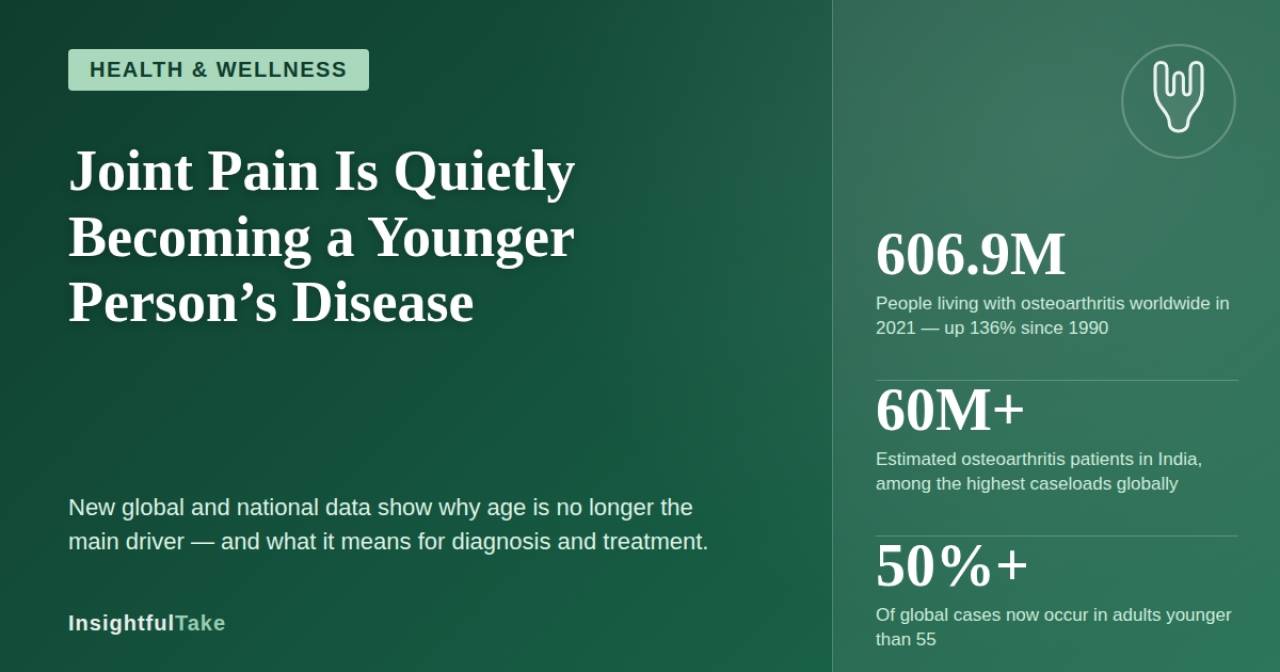
Globally, the number of people living with osteoarthritis, the most common form of joint disease, rose from roughly 256 million in 1990 to nearly 607 million in 2021, a 136 percent increase in three decades.
Population growth and longer lifespans explain part of this rise, but they do not tell the whole story. More than half of all new osteoarthritis cases recorded worldwide in 2021 occurred among adults aged 40 to 59, making middle age an increasingly important period for the disease.
More than half of current cases globally are also found in people younger than 55. Researchers have linked this trend to rising obesity as well as joint injuries sustained during sport and physically demanding work.
India's position within this trend is particularly significant. National estimates place osteoarthritis prevalence in the country between 22 and 39 percent, depending on the region and population studied. Some projections suggest India could soon have one of the world's largest osteoarthritis caseloads, potentially exceeding 60 million patients.
The knee remains the joint most commonly affected, accounting for roughly six in ten arthritis cases reported in national estimates.
Age, however, is only one part of the equation.
India's occupational patterns add another layer of risk. A large section of the workforce is engaged in labour-intensive occupations involving repeated squatting, kneeling, lifting and other physically demanding movements. Prolonged exposure to such stresses has been associated with an increased risk of joint degeneration.
At the same time, rising obesity and increasingly sedentary urban lifestyles are creating another source of strain. Together, these factors can place considerable stress on joints long before a person reaches old age.
Beyond Osteoarthritis: The Wider Pain Burden
Osteoarthritis is only part of the picture.
Musculoskeletal pain more broadly, including chronic back and joint pain unrelated to acute injury, affects a substantial section of India's population, according to community health surveys conducted under national rheumatic disease research programmes.
Hospital-based data tracking low back pain between 2019 and 2023 found prevalence rising from just under 19 percent to more than 22 percent among patients screened. Women were affected roughly twice as often as men. More than six in ten of these patients were classified as overweight or obese, reinforcing the relationship between body weight and musculoskeletal strain.
Severity data also shows why joint pain cannot simply be dismissed as a minor inconvenience.
Among older adults diagnosed with arthritis in a national ageing study, nearly half reported severe pain accompanied by extreme difficulty in movement. About one in seven said their condition made normal movement effectively impossible.
Health authorities have separately estimated that around 80 percent of people living with osteoarthritis experience some restriction in movement, while one in four are unable to perform major daily activities without assistance.
The consequences, therefore, extend beyond physical discomfort. Persistent joint pain can affect mobility, independence, work and everyday quality of life.
Why Diagnosis Matters More Than Age
Doctors specialising in joint care stress that the location and pattern of pain, rather than age alone, should guide diagnosis and treatment.
A knee that hurts while climbing stairs may have a different underlying cause from a knee that gives way during physical activity. Similarly, shoulder pain can result from a rotator cuff problem, instability or arthritis. Each condition can require a different treatment approach.
Persistent swelling, stiffness or difficulty performing everyday activities should therefore not automatically be dismissed as normal ageing. Clinically, joint pain is a symptom rather than a diagnosis in itself.
Sports-related injuries deserve particular attention.
Research tracking young adults after knee injuries has found that their risk of developing osteoarthritis later in life can be four to six times higher than among people who have never sustained such an injury.
That finding becomes increasingly relevant as recreational sports participation grows. Young people may recover from an injury and return to normal activity, only to experience joint problems years later if the original injury was not properly assessed or rehabilitated.
Treatment Is Not One-Size-Fits-All
Medical guidance increasingly moves away from the assumption that persistent joint pain automatically means surgery.
Depending on the underlying condition and severity, treatment can include physiotherapy, weight management, activity modification, medication, injections and structured rehabilitation. Joint replacement is generally considered when symptoms substantially affect quality of life and non-surgical approaches no longer provide adequate relief.
Clinical decisions are expected to consider symptoms, physical examination findings, functional limitations and a person's daily requirements together. Imaging alone does not necessarily determine the appropriate treatment.
Weight also plays a major role.
High body mass index is identified as the largest modifiable risk factor for osteoarthritis in global disease burden studies and is estimated to contribute to roughly one in five cases worldwide.
That makes maintaining a healthy weight, along with preventing and properly treating joint injuries, an important part of prevention rather than something to consider only after a diagnosis.
The Larger Takeaway
The numbers point towards a growing global burden.
Projections suggest that osteoarthritis cases will rise sharply by 2050, with knee osteoarthritis alone expected to increase by roughly three-quarters from current levels.
For India, the challenge is particularly complex. The country is ageing, but at the same time, lifestyle and occupational factors are exposing younger adults to risks traditionally associated with later life.
The emerging lesson is simple: joint pain should not be judged by age alone.
Persistent pain, stiffness, swelling, instability or difficulty with everyday movement deserves attention, whether the person experiencing it is 25, 45 or 65.
Joint problems may become more common with age, but age is not a diagnosis. Understanding the cause, addressing modifiable risks and seeking appropriate treatment early could make the difference between living with avoidable disability and maintaining mobility for years to come.
Joint pain has long been treated as a problem that arrives with old age. New data tells a different story.
Across the world, and increasingly in India, osteoarthritis and other musculoskeletal conditions are affecting people decades earlier than expected, driven not only by ageing but also by weight gain, sedentary routines, occupational strain and untreated injuries.
The Numbers Behind the Shift
Globally, the number of people living with osteoarthritis, the most common form of joint disease, rose from roughly 256 million in 1990 to nearly 607 million in 2021, a 136 percent increase in three decades.
Population growth and longer lifespans explain part of this rise, but they do not tell the whole story. More than half of all new osteoarthritis cases recorded worldwide in 2021 occurred among adults aged 40 to 59, making middle age an increasingly important period for the disease.
More than half of current cases globally are also found in people younger than 55. Researchers have linked this trend to rising obesity as well as joint injuries sustained during sport and physically demanding work.
India's position within this trend is particularly significant. National estimates place osteoarthritis prevalence in the country between 22 and 39 percent, depending on the region and population studied. Some projections suggest India could soon have one of the world's largest osteoarthritis caseloads, potentially exceeding 60 million patients.
The knee remains the joint most commonly affected, accounting for roughly six in ten arthritis cases reported in national estimates.
Age, however, is only one part of the equation.
India's occupational patterns add another layer of risk. A large section of the workforce is engaged in labour-intensive occupations involving repeated squatting, kneeling, lifting and other physically demanding movements. Prolonged exposure to such stresses has been associated with an increased risk of joint degeneration.
At the same time, rising obesity and increasingly sedentary urban lifestyles are creating another source of strain. Together, these factors can place considerable stress on joints long before a person reaches old age.
Beyond Osteoarthritis: The Wider Pain Burden
Osteoarthritis is only part of the picture.
Musculoskeletal pain more broadly, including chronic back and joint pain unrelated to acute injury, affects a substantial section of India's population, according to community health surveys conducted under national rheumatic disease research programmes.
Hospital-based data tracking low back pain between 2019 and 2023 found prevalence rising from just under 19 percent to more than 22 percent among patients screened. Women were affected roughly twice as often as men. More than six in ten of these patients were classified as overweight or obese, reinforcing the relationship between body weight and musculoskeletal strain.
Severity data also shows why joint pain cannot simply be dismissed as a minor inconvenience.
Among older adults diagnosed with arthritis in a national ageing study, nearly half reported severe pain accompanied by extreme difficulty in movement. About one in seven said their condition made normal movement effectively impossible.
Health authorities have separately estimated that around 80 percent of people living with osteoarthritis experience some restriction in movement, while one in four are unable to perform major daily activities without assistance.
The consequences, therefore, extend beyond physical discomfort. Persistent joint pain can affect mobility, independence, work and everyday quality of life.
Why Diagnosis Matters More Than Age
Doctors specialising in joint care stress that the location and pattern of pain, rather than age alone, should guide diagnosis and treatment.
A knee that hurts while climbing stairs may have a different underlying cause from a knee that gives way during physical activity. Similarly, shoulder pain can result from a rotator cuff problem, instability or arthritis. Each condition can require a different treatment approach.
Persistent swelling, stiffness or difficulty performing everyday activities should therefore not automatically be dismissed as normal ageing. Clinically, joint pain is a symptom rather than a diagnosis in itself.
Sports-related injuries deserve particular attention.
Research tracking young adults after knee injuries has found that their risk of developing osteoarthritis later in life can be four to six times higher than among people who have never sustained such an injury.
That finding becomes increasingly relevant as recreational sports participation grows. Young people may recover from an injury and return to normal activity, only to experience joint problems years later if the original injury was not properly assessed or rehabilitated.
Treatment Is Not One-Size-Fits-All
Medical guidance increasingly moves away from the assumption that persistent joint pain automatically means surgery.
Depending on the underlying condition and severity, treatment can include physiotherapy, weight management, activity modification, medication, injections and structured rehabilitation. Joint replacement is generally considered when symptoms substantially affect quality of life and non-surgical approaches no longer provide adequate relief.
Clinical decisions are expected to consider symptoms, physical examination findings, functional limitations and a person's daily requirements together. Imaging alone does not necessarily determine the appropriate treatment.
Weight also plays a major role.
High body mass index is identified as the largest modifiable risk factor for osteoarthritis in global disease burden studies and is estimated to contribute to roughly one in five cases worldwide.
That makes maintaining a healthy weight, along with preventing and properly treating joint injuries, an important part of prevention rather than something to consider only after a diagnosis.
The Larger Takeaway
The numbers point towards a growing global burden.
Projections suggest that osteoarthritis cases will rise sharply by 2050, with knee osteoarthritis alone expected to increase by roughly three-quarters from current levels.
For India, the challenge is particularly complex. The country is ageing, but at the same time, lifestyle and occupational factors are exposing younger adults to risks traditionally associated with later life.
The emerging lesson is simple: joint pain should not be judged by age alone.
Persistent pain, stiffness, swelling, instability or difficulty with everyday movement deserves attention, whether the person experiencing it is 25, 45 or 65.
Joint problems may become more common with age, but age is not a diagnosis. Understanding the cause, addressing modifiable risks and seeking appropriate treatment early could make the difference between living with avoidable disability and maintaining mobility for years to come.




















Leave a Comment