
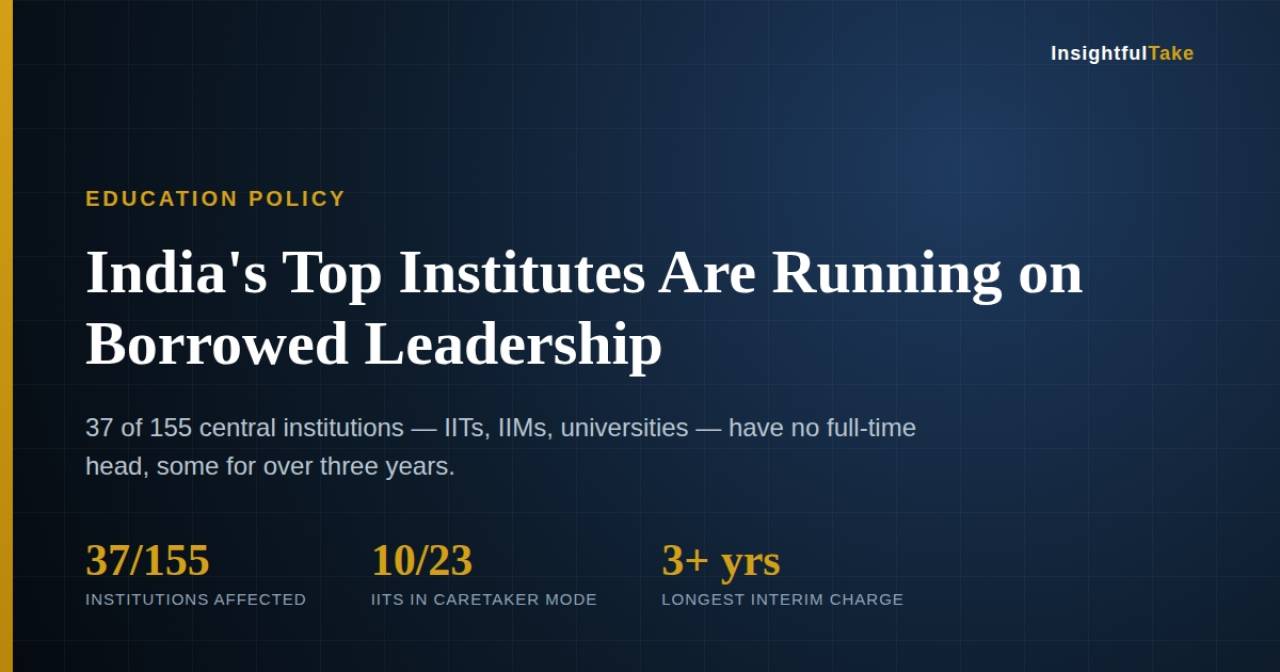
At least 37 of India’s premier central institutions are running without permanent leadership. In some cases, temporary arrangements have lasted for years.
At least 37 of India’s premier central higher-education institutions are currently being run without a regular, full-time vice-chancellor or director. What was meant to be a short-term arrangement in some cases, it has stretched into years, leaving some of the country’s most important academic institutions operating under leadership that was never intended to last this long.
An analysis of 155 central institutions, including IITs, IIMs, NITs, IISERs and central universities, found that nearly one in four is functioning with an interim head, acting in-charge or an official serving on an extended tenure. In some cases, the wait for a permanent appointment has crossed three years.
For students and parents, an empty chair in the director’s or vice-chancellor’s office may sound like an administrative problem. Inside the campus, however, the consequences can be much more tangible. Recruitment can slow, major academic decisions can be deferred, research proposals can wait for approval and long-term projects can remain stuck because the person taking the decision knows they may not be there to see it through.
The question, then, is no longer simply why these institutions have temporary heads. It is why a system designed to provide interim leadership has allowed temporary arrangements to become a way of running some of India’s most important campuses.
What an “Acting” Head Can and Cannot Do
Consider the position an in-charge director is placed in. They did not apply for a five-year term with a clear mandate. They were often the senior-most person in the room when a leadership position fell vacant, asked to hold things together until someone else arrived.
Yet the job does not shrink to match the temporary label. Budgets still need approval, recruitment panels still need a chair, academic programmes still need decisions, and disputes between departments still require someone willing to take a firm, potentially unpopular stand.
Many people temporarily holding these positions may choose caution instead. A new academic programme, a pending infrastructure project or a difficult personnel matter can be deferred with the familiar reasoning that “the next full-time head should decide.”
It is an understandable instinct. Nobody wants to be remembered as the temporary office-holder who overstepped.
But multiply that caution across dozens of institutions and several years, and the cost becomes harder to dismiss. Students and faculty can end up working under leadership that has responsibility for the institution but lacks the security or mandate to make long-term decisions.
Among the Indian Institutes of Technology, ten of 23 currently function this way. Among central universities, 11 of 48 lack a functioning vice-chancellor. Even institutions with hard-won reputations for research and academic excellence are not exempt.
A Process That Keeps Missing Its Own Deadlines
What makes the pattern harder to excuse is that it is rarely about a shortage of qualified candidates.
India has no scarcity of accomplished academics capable of leading a university or technical institute. The problem lies largely in the appointment process itself, with search committees taking months to convene, files moving slowly between institutions and the ministry, and appointments requiring approvals at levels far removed from the campus concerned.
People familiar with these appointments describe a process that often begins only after an incumbent’s term has already ended, rather than well before it. By the time a shortlist reaches the approval stage, another year may have quietly passed.
In some cases, the search process appears to restart when an appointment is not completed within the expected timeframe, pushing the timeline further out.
The result is a peculiar administrative cycle. An institution knows that its leader’s term is ending. A replacement is needed. Yet the process for finding that replacement can begin too late, move too slowly and leave the institution dependent on an interim arrangement for an indefinite period.
This is not unique to any one government or institution type. It has persisted long enough to become an almost expected feature of how some of India’s top academic institutions are administered.
That may be the most troubling part.
A system can tolerate an occasional delay. It becomes a governance problem when delay itself becomes routine.
Why This Should Worry More People
Universities are, at their core, long-horizon institutions.
A curriculum reform, a new research centre or a shift in academic culture can take years to plan and even longer to produce results. That kind of thinking requires someone in the top office who is expected to see the process through, not someone counting down the months until a permanent appointment is made.
Students graduate and move on within three or four years, often without knowing who approved their institution’s strategic plan or whether one exists at all.
Faculty experience the effects more directly. Recruitment can slow. Promotions can stall. Research proposals can wait for approvals. Infrastructure projects can lose momentum. Academic collaborations may remain on hold because decisions that require institutional authority are repeatedly deferred.
None of these consequences necessarily makes headlines on its own.
There is no dramatic campus shutdown. No single decision captures the problem. Instead, institutional momentum gradually weakens.
That is what makes prolonged temporary leadership particularly difficult to measure and easy to overlook.
The Cost of Governing in the Interim
An acting director or vice-chancellor can keep an institution functioning. That is precisely why the system can survive for so long.
Classes continue. Exams are conducted. Salaries are paid. Research continues. Students graduate.
From the outside, everything may appear normal.
But higher education is not simply about keeping the lights on. Its strongest institutions are expected to make decisions about what they want to become five, ten or even twenty years from now.
Who should the institution recruit? Which research areas deserve investment? What new programmes should be introduced? Which international partnerships should be pursued? How should scarce resources be allocated?
These are not routine administrative questions.
They require leadership with both authority and a credible tenure.
An interim head may be perfectly capable of making such decisions. But when the appointment itself is temporary, the incentive to make difficult long-term choices can be weaker. The safest decision can become the default decision.
And in institutions that educate the country’s future scientists, engineers, researchers, teachers and administrators, institutional caution can carry a cost far beyond the campus itself.
The Larger Governance Question
The issue is therefore bigger than the number of vacant vice-chancellor and director positions.
It raises a basic question about how India governs its public institutions.
If a position is important enough to require a full-time leader, the appointment process should be designed to ensure that the institution does not spend years waiting for one.
There will always be unforeseen delays. Candidates may withdraw. Selection processes may have to be reconsidered. Governments may need additional time to complete scrutiny.
But those exceptions cannot become the operating model.
The institutions involved are not obscure colleges struggling for recognition. They include IITs, IIMs, NITs, IISERs and central universities that occupy a central place in India’s education and research ecosystem.
For millions of students and parents, these institutions represent the promise of social mobility, professional opportunity and national academic excellence.
That promise deserves more than temporary leadership becoming permanent by default.
The real question is not whether an acting director or vice-chancellor can keep a campus functioning.
It is whether India’s premier academic institutions can afford to keep waiting for leaders with the mandate, stability and time required to shape their future.
At least 37 of India’s premier central higher-education institutions are currently being run without a regular, full-time vice-chancellor or director. What was meant to be a short-term arrangement in some cases, it has stretched into years, leaving some of the country’s most important academic institutions operating under leadership that was never intended to last this long.
An analysis of 155 central institutions, including IITs, IIMs, NITs, IISERs and central universities, found that nearly one in four is functioning with an interim head, acting in-charge or an official serving on an extended tenure. In some cases, the wait for a permanent appointment has crossed three years.
For students and parents, an empty chair in the director’s or vice-chancellor’s office may sound like an administrative problem. Inside the campus, however, the consequences can be much more tangible. Recruitment can slow, major academic decisions can be deferred, research proposals can wait for approval and long-term projects can remain stuck because the person taking the decision knows they may not be there to see it through.
The question, then, is no longer simply why these institutions have temporary heads. It is why a system designed to provide interim leadership has allowed temporary arrangements to become a way of running some of India’s most important campuses.
What an “Acting” Head Can and Cannot Do
Consider the position an in-charge director is placed in. They did not apply for a five-year term with a clear mandate. They were often the senior-most person in the room when a leadership position fell vacant, asked to hold things together until someone else arrived.
Yet the job does not shrink to match the temporary label. Budgets still need approval, recruitment panels still need a chair, academic programmes still need decisions, and disputes between departments still require someone willing to take a firm, potentially unpopular stand.
Many people temporarily holding these positions may choose caution instead. A new academic programme, a pending infrastructure project or a difficult personnel matter can be deferred with the familiar reasoning that “the next full-time head should decide.”
It is an understandable instinct. Nobody wants to be remembered as the temporary office-holder who overstepped.
But multiply that caution across dozens of institutions and several years, and the cost becomes harder to dismiss. Students and faculty can end up working under leadership that has responsibility for the institution but lacks the security or mandate to make long-term decisions.
Among the Indian Institutes of Technology, ten of 23 currently function this way. Among central universities, 11 of 48 lack a functioning vice-chancellor. Even institutions with hard-won reputations for research and academic excellence are not exempt.
A Process That Keeps Missing Its Own Deadlines
What makes the pattern harder to excuse is that it is rarely about a shortage of qualified candidates.
India has no scarcity of accomplished academics capable of leading a university or technical institute. The problem lies largely in the appointment process itself, with search committees taking months to convene, files moving slowly between institutions and the ministry, and appointments requiring approvals at levels far removed from the campus concerned.
People familiar with these appointments describe a process that often begins only after an incumbent’s term has already ended, rather than well before it. By the time a shortlist reaches the approval stage, another year may have quietly passed.
In some cases, the search process appears to restart when an appointment is not completed within the expected timeframe, pushing the timeline further out.
The result is a peculiar administrative cycle. An institution knows that its leader’s term is ending. A replacement is needed. Yet the process for finding that replacement can begin too late, move too slowly and leave the institution dependent on an interim arrangement for an indefinite period.
This is not unique to any one government or institution type. It has persisted long enough to become an almost expected feature of how some of India’s top academic institutions are administered.
That may be the most troubling part.
A system can tolerate an occasional delay. It becomes a governance problem when delay itself becomes routine.
Why This Should Worry More People
Universities are, at their core, long-horizon institutions.
A curriculum reform, a new research centre or a shift in academic culture can take years to plan and even longer to produce results. That kind of thinking requires someone in the top office who is expected to see the process through, not someone counting down the months until a permanent appointment is made.
Students graduate and move on within three or four years, often without knowing who approved their institution’s strategic plan or whether one exists at all.
Faculty experience the effects more directly. Recruitment can slow. Promotions can stall. Research proposals can wait for approvals. Infrastructure projects can lose momentum. Academic collaborations may remain on hold because decisions that require institutional authority are repeatedly deferred.
None of these consequences necessarily makes headlines on its own.
There is no dramatic campus shutdown. No single decision captures the problem. Instead, institutional momentum gradually weakens.
That is what makes prolonged temporary leadership particularly difficult to measure and easy to overlook.
The Cost of Governing in the Interim
An acting director or vice-chancellor can keep an institution functioning. That is precisely why the system can survive for so long.
Classes continue. Exams are conducted. Salaries are paid. Research continues. Students graduate.
From the outside, everything may appear normal.
But higher education is not simply about keeping the lights on. Its strongest institutions are expected to make decisions about what they want to become five, ten or even twenty years from now.
Who should the institution recruit? Which research areas deserve investment? What new programmes should be introduced? Which international partnerships should be pursued? How should scarce resources be allocated?
These are not routine administrative questions.
They require leadership with both authority and a credible tenure.
An interim head may be perfectly capable of making such decisions. But when the appointment itself is temporary, the incentive to make difficult long-term choices can be weaker. The safest decision can become the default decision.
And in institutions that educate the country’s future scientists, engineers, researchers, teachers and administrators, institutional caution can carry a cost far beyond the campus itself.
The Larger Governance Question
The issue is therefore bigger than the number of vacant vice-chancellor and director positions.
It raises a basic question about how India governs its public institutions.
If a position is important enough to require a full-time leader, the appointment process should be designed to ensure that the institution does not spend years waiting for one.
There will always be unforeseen delays. Candidates may withdraw. Selection processes may have to be reconsidered. Governments may need additional time to complete scrutiny.
But those exceptions cannot become the operating model.
The institutions involved are not obscure colleges struggling for recognition. They include IITs, IIMs, NITs, IISERs and central universities that occupy a central place in India’s education and research ecosystem.
For millions of students and parents, these institutions represent the promise of social mobility, professional opportunity and national academic excellence.
That promise deserves more than temporary leadership becoming permanent by default.
The real question is not whether an acting director or vice-chancellor can keep a campus functioning.
It is whether India’s premier academic institutions can afford to keep waiting for leaders with the mandate, stability and time required to shape their future.















Leave a Comment