
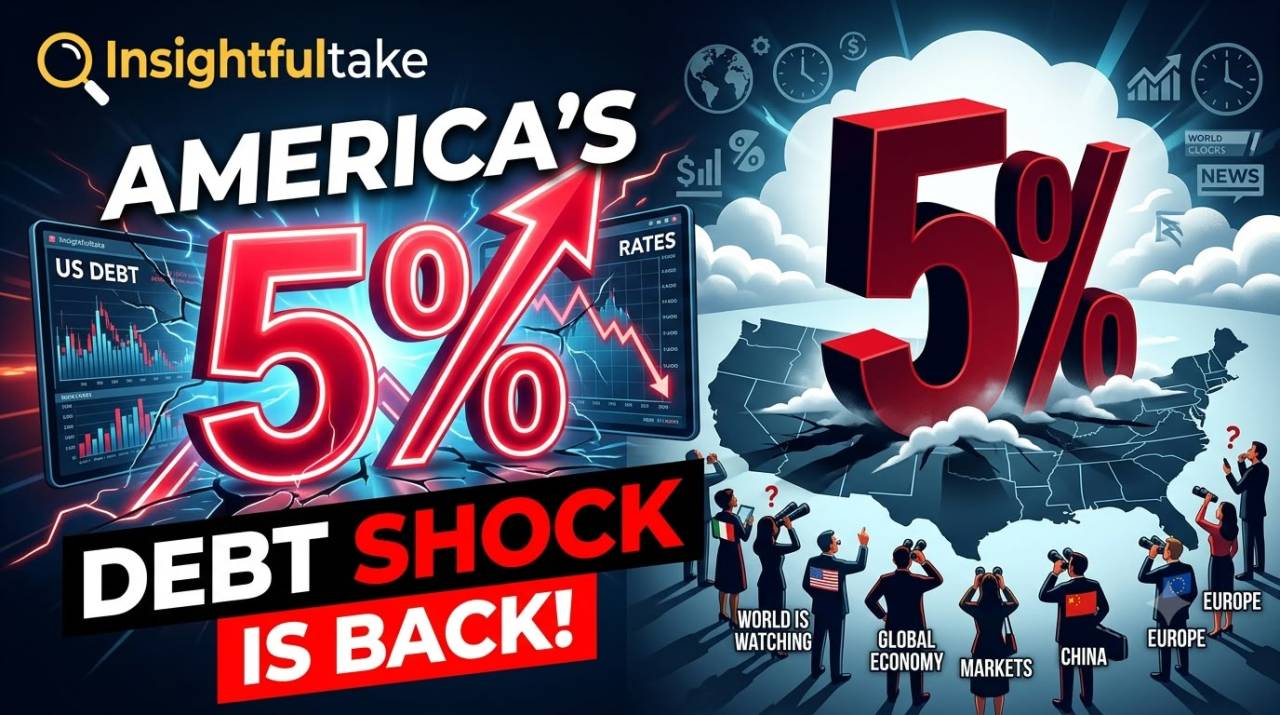
America’s borrowing costs are rising again, and the return of a 5% yield on its most important government bond is putting investors, businesses and households on alert.
For the first time, the yield on America’s benchmark 10-year Treasury bond touched 5%. The move may look small on a market chart, but its implications reach far beyond Wall Street.
The 10-year Treasury yield influences borrowing costs across the global economy. It affects mortgages, corporate loans, government borrowing and bond markets. When it rises sharply, the cost of money rises with it.
What Actually Happened
The US 10-year Treasury yield briefly crossed 5.01% before slipping back to around 4.94%.
For most people, a move of a few basis points may not sound important. But the 10-year Treasury is one of the most closely watched financial benchmarks in the world. Its yield helps determine the cost of borrowing for governments, companies and households.
The last time the yield touched 5% was in October 2023. That episode was short-lived, with the yield falling back soon afterwards.
This time, however, the increase has been building for months. The 10-year yield has recorded seven consecutive monthly increases, matching its longest such run since 2011.
That persistence is what has caught the attention of investors.
Why Are US Bond Yields Rising?
Two major forces are pushing yields higher.
The first is inflation.
Oil prices have surged, with Brent crude moving towards $110 a barrel amid the fallout from the Iran conflict. Higher oil prices can quickly spread through an economy because energy affects transportation, manufacturing and the cost of producing goods.
That has renewed concerns about inflation.
Hotter-than-expected consumer price data for August has added to those worries. Markets are now reassessing the path of US interest rates and the possibility that the Federal Reserve may have to keep rates higher for longer, or potentially raise them again.
Higher expected interest rates generally make government bonds more attractive at higher yields.
The second factor is broader and more structural: borrowing.
Governments and companies around the world are borrowing heavily. Large fiscal deficits are increasing government financing requirements, while enormous investment in artificial intelligence infrastructure is adding to corporate demand for capital.
When more borrowers compete for available money, lenders can demand higher returns.
That pressure is no longer limited to the United States. A global measure of government borrowing costs has climbed to levels not seen since 2007.
Zach Griffiths of CreditSights has pointed to several underlying pressures that could keep rates elevated, suggesting that higher yields have increasingly become the market's path of least resistance.
Why This Matters Beyond Wall Street
A 5% yield on the US 10-year Treasury is not simply a number for traders to watch.
Higher Treasury yields can feed into mortgage rates, corporate borrowing costs and valuations across financial markets.
For businesses, more expensive borrowing can make expansion and investment harder to justify. For households, higher interest rates can raise the cost of mortgages and other loans.
Stock markets can also come under pressure because higher bond yields make relatively safe government debt more competitive with riskier assets.
The effects extend beyond the United States.
US Treasury yields influence global financial markets because American government bonds are widely treated as a benchmark for pricing assets around the world. A sustained rise in US yields can therefore affect borrowing costs and investment decisions in emerging markets, including India.
The timing also matters. The 10-year yield is now roughly a full percentage point above its level before the Iran war began, showing how quickly geopolitical shocks can alter financial conditions.
Is 5% a Ceiling Again?
The big question is whether 5% will once again act as a psychological ceiling.
When Treasury yields approached this level in 2023, investors began finding bonds attractive enough to step back into the market. Increased buying pushed yields lower.
Some analysts believe a similar pattern could emerge this time.
But the market has so far shown limited response to the measures being discussed to support Treasury demand. Reported efforts by the US Treasury to encourage bond buybacks and manage long-term debt issuance have not stopped the upward pressure on yields.
That leaves investors watching closely to see whether buyers return around the 5% level or whether yields move higher.
The Bigger Picture
What is happening in the US Treasury market is bigger than a one-day movement in bond prices.
It reflects a changing global environment in which inflation risks, geopolitical shocks, government deficits and enormous investment requirements are colliding.
The United States remains the world's largest economy, and its government bond market sits at the centre of the global financial system. When the cost of borrowing in America rises, the consequences can travel far beyond American borders.
Whether 5% becomes a ceiling or simply another milestone will depend on what happens to inflation, oil prices, Federal Reserve policy, government borrowing and investor demand.
For households and businesses, however, the cost of money is rising again.
And when the world's biggest borrower has to pay more to borrow, the rest of the world cannot afford to ignore it.
For the first time, the yield on America’s benchmark 10-year Treasury bond touched 5%. The move may look small on a market chart, but its implications reach far beyond Wall Street.
The 10-year Treasury yield influences borrowing costs across the global economy. It affects mortgages, corporate loans, government borrowing and bond markets. When it rises sharply, the cost of money rises with it.
What Actually Happened
The US 10-year Treasury yield briefly crossed 5.01% before slipping back to around 4.94%.
For most people, a move of a few basis points may not sound important. But the 10-year Treasury is one of the most closely watched financial benchmarks in the world. Its yield helps determine the cost of borrowing for governments, companies and households.
The last time the yield touched 5% was in October 2023. That episode was short-lived, with the yield falling back soon afterwards.
This time, however, the increase has been building for months. The 10-year yield has recorded seven consecutive monthly increases, matching its longest such run since 2011.
That persistence is what has caught the attention of investors.
Why Are US Bond Yields Rising?
Two major forces are pushing yields higher.
The first is inflation.
Oil prices have surged, with Brent crude moving towards $110 a barrel amid the fallout from the Iran conflict. Higher oil prices can quickly spread through an economy because energy affects transportation, manufacturing and the cost of producing goods.
That has renewed concerns about inflation.
Hotter-than-expected consumer price data for August has added to those worries. Markets are now reassessing the path of US interest rates and the possibility that the Federal Reserve may have to keep rates higher for longer, or potentially raise them again.
Higher expected interest rates generally make government bonds more attractive at higher yields.
The second factor is broader and more structural: borrowing.
Governments and companies around the world are borrowing heavily. Large fiscal deficits are increasing government financing requirements, while enormous investment in artificial intelligence infrastructure is adding to corporate demand for capital.
When more borrowers compete for available money, lenders can demand higher returns.
That pressure is no longer limited to the United States. A global measure of government borrowing costs has climbed to levels not seen since 2007.
Zach Griffiths of CreditSights has pointed to several underlying pressures that could keep rates elevated, suggesting that higher yields have increasingly become the market's path of least resistance.
Why This Matters Beyond Wall Street
A 5% yield on the US 10-year Treasury is not simply a number for traders to watch.
Higher Treasury yields can feed into mortgage rates, corporate borrowing costs and valuations across financial markets.
For businesses, more expensive borrowing can make expansion and investment harder to justify. For households, higher interest rates can raise the cost of mortgages and other loans.
Stock markets can also come under pressure because higher bond yields make relatively safe government debt more competitive with riskier assets.
The effects extend beyond the United States.
US Treasury yields influence global financial markets because American government bonds are widely treated as a benchmark for pricing assets around the world. A sustained rise in US yields can therefore affect borrowing costs and investment decisions in emerging markets, including India.
The timing also matters. The 10-year yield is now roughly a full percentage point above its level before the Iran war began, showing how quickly geopolitical shocks can alter financial conditions.
Is 5% a Ceiling Again?
The big question is whether 5% will once again act as a psychological ceiling.
When Treasury yields approached this level in 2023, investors began finding bonds attractive enough to step back into the market. Increased buying pushed yields lower.
Some analysts believe a similar pattern could emerge this time.
But the market has so far shown limited response to the measures being discussed to support Treasury demand. Reported efforts by the US Treasury to encourage bond buybacks and manage long-term debt issuance have not stopped the upward pressure on yields.
That leaves investors watching closely to see whether buyers return around the 5% level or whether yields move higher.
The Bigger Picture
What is happening in the US Treasury market is bigger than a one-day movement in bond prices.
It reflects a changing global environment in which inflation risks, geopolitical shocks, government deficits and enormous investment requirements are colliding.
The United States remains the world's largest economy, and its government bond market sits at the centre of the global financial system. When the cost of borrowing in America rises, the consequences can travel far beyond American borders.
Whether 5% becomes a ceiling or simply another milestone will depend on what happens to inflation, oil prices, Federal Reserve policy, government borrowing and investor demand.
For households and businesses, however, the cost of money is rising again.
And when the world's biggest borrower has to pay more to borrow, the rest of the world cannot afford to ignore it.


























Leave a Comment