
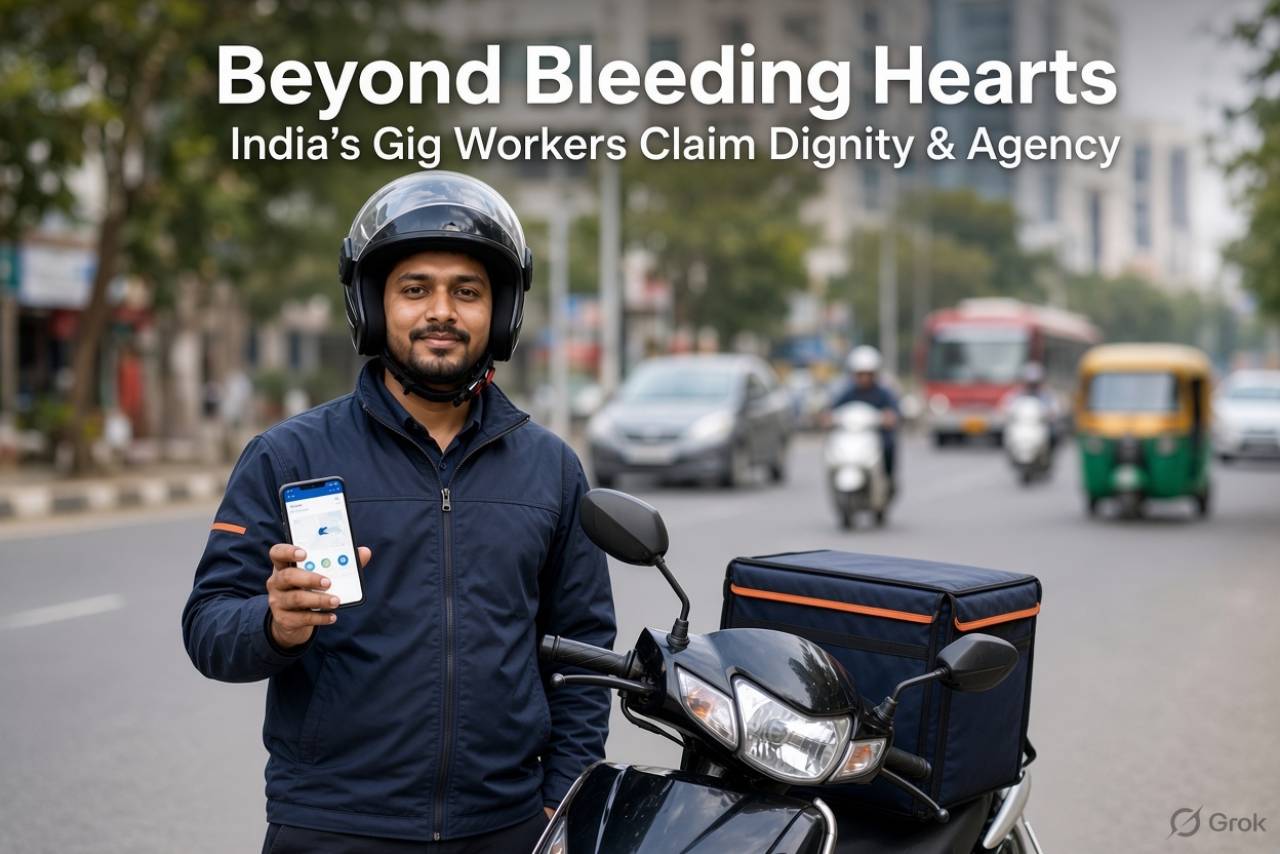
India’s gig economy is changing. Beyond concerns over exploitation, workers are gaining financial identities, social-security recognition and greater control over how they work.
Two decades ago, critics worried about “digital coolies” tied to desks in India’s emerging IT industry. Today, a similar concern surrounds delivery riders and platform workers who move through crowded streets carrying food, groceries and packages.
The concerns are real: long hours, personal risk, uncertain income and limited traditional job security. But the lived experience of gig workers, along with the formalisation now taking place around them, is more complicated than a simple story of exploitation.
For many workers, platform work also means control over time, digital payments, a documented income trail and access to services that were difficult to obtain in the informal economy.
India’s gig economy is expanding rapidly. The Economic Survey 2025-26 estimates that the country had around 1.2 crore gig workers in FY25, up 55 per cent from 77 lakh in FY21. Gig workers now account for more than 2 per cent of India’s total workforce. The Survey also projects that non-agricultural gig work could account for 6.7 per cent of the workforce by 2029-30 and contribute around ₹2.35 lakh crore to GDP.
E-commerce is the largest segment, followed by logistics and several other digitally mediated services. The growth reflects not only the expansion of platforms but also the increasing use of smartphones, digital payments and app-based work arrangements.
Flexibility Is Part of the Attraction
One of the biggest advantages workers associate with platform work is control over time.
Unlike a factory, shop or office job with fixed shifts, platform workers can often decide when to log in and how many hours to work. That flexibility can matter to people managing family responsibilities, education or more than one source of income.
For women, platform-based work can also provide a more structured and visible alternative to some forms of informal employment. Working through an established platform, receiving digital payments and having a record of transactions can create a sense of legitimacy and financial independence.
The Economic Survey itself notes that gig work offers flexibility in deciding when, where and how much to work, making it attractive to people balancing employment with caregiving or education.
That does not mean flexibility automatically translates into good working conditions. It means workers should not be viewed only through the lens of vulnerability. Many are making calculated choices within the opportunities available to them.
The Financial Identity Is Changing
An important but less visible development is the growing connection between gig work and the formal financial system.
In September 2026, Swiggy said more than 50,000 delivery workers had filed income-tax returns through facilities provided through its partner app and claimed refunds totalling ₹6.5 crore. More than one-third were first-time filers. The company said the tax-filing process could also help workers establish a documented financial record for purposes such as loans and rental agreements.
This matters because formalisation is not simply about getting a government identity card.
A worker who has documented income, files a tax return, receives digital payments and maintains a financial record is easier for banks and other institutions to recognise. That can gradually change access to credit, housing and other formal financial services.
The process is still limited and uneven. But it represents a practical form of formalisation that is easy to overlook when the gig economy is discussed only in terms of wages and working conditions.
The Law Is Catching Up
The policy framework has also changed significantly.
The Code on Social Security, 2020 formally recognised gig workers and platform workers within India's social-security architecture. The Code came into force, along with the other labour codes, in November 2025. The Social Security (Central) Rules, 2026 were subsequently notified on May 8, 2026, providing operational rules for registration and social-security contributions.
Under the 2026 Rules, gig and platform workers aged 16 or above can register on the designated Central Government portal through self-declaration using Aadhaar and other prescribed documents. Aggregators must share worker details with the designated portal and register new workers in real time or on a daily basis through electronic systems. Workers can also receive a digital or physical identity card.
Eligibility for benefits under schemes framed for gig and platform workers can require at least 90 days of engagement with one aggregator, or 120 days across multiple aggregators, during the previous financial year.
The Code also provides for aggregator contributions towards social security. Section 114 provides for a contribution of 1 to 2 per cent of annual turnover, subject to a ceiling linked to payments made to gig and platform workers. The Rules provide the mechanism for assessing and depositing those contributions into the Social Security Fund.
The framework envisages social-security schemes covering areas such as life and disability protection, accident insurance, health and maternity benefits and old-age protection.
Implementation Will Decide the Outcome
Having rules on paper is only the beginning.
Registration, contribution collection, worker awareness and actual delivery of benefits will determine whether the new framework changes everyday working conditions.
State governments have also moved into this space. Rajasthan enacted a dedicated gig-worker welfare law in 2023. Karnataka, Bihar and Jharkhand have subsequently developed their own legal frameworks covering issues such as registration, social security and grievance redressal.
But implementation has not been uniform. Reporting on the state frameworks has highlighted delays and continuing questions over how welfare boards, funds and contribution mechanisms will operate in practice.
That gap between legislation and implementation is important. A worker does not benefit from a welfare provision merely because it exists in a statute.
The Problems Are Real
None of this removes the difficulties faced by gig workers.
Income volatility remains a major concern. Workers can also face road accidents, physical exhaustion and long working hours. Algorithms influence task allocation, incentives, ratings and, in some cases, access to the platform itself. The reasons behind changes in earnings or account restrictions may not always be sufficiently transparent.
There is also a question about who ultimately bears the cost of social protection.
If platforms face higher mandatory contributions, part of that cost could potentially affect incentives, commissions or other aspects of the platform's payment structure. How companies respond will therefore matter as much as the contribution rate written into law.
The eligibility thresholds also deserve attention. Workers who participate only occasionally, move frequently between platforms or combine gig work with other employment may find it harder to maintain continuous access to benefits.
These are not arguments against formalisation. They are reasons to make it more portable, transparent and worker-friendly.
Beyond Exploitation Versus Protection
The debate around gig work is often framed as a choice between two narratives.
One presents workers primarily as victims of a new form of precarious labour. The other presents platform work as a modern, flexible alternative to traditional employment.
Neither description captures the whole picture.
Some workers use gig work temporarily while preparing for another career. Others depend on it as their primary source of income. Some value flexibility more than a fixed schedule. Others may accept flexibility because better alternatives are unavailable.
The common factor is agency.
Workers make decisions within economic constraints. They compare available jobs, working hours, earnings and personal responsibilities. The fact that those choices are constrained does not mean that the choices themselves are meaningless.
That distinction matters for public policy.
What Formalisation Should Deliver
India does not need to choose between flexibility and protection. The harder task is to make the two work together.
Social-security benefits should be portable so that workers do not lose protection when they move from one platform to another. Pay structures and incentive systems should be communicated clearly. Grievance mechanisms should be accessible and capable of producing timely decisions.
Financial literacy can also become part of the formalisation process. A worker earning irregularly needs tools that help convert fluctuating income into savings, insurance and access to responsible credit.
Platforms have an interest here too. Tax-filing assistance, insurance products, training and clearer financial records can reduce worker churn while improving service reliability.
The relationship does not have to be framed as a permanent conflict between platform and worker. Better systems can create value for both.
A New Layer in India's Labour Market
India's labour market has long been divided between a relatively protected formal sector and a much larger informal economy.
The gig economy is creating another layer: digitally mediated, measurable and increasingly visible to policymakers.
The Social Security Code and the 2026 Central Rules represent an attempt to bring this workforce into a national social-security framework without simply forcing gig work into the traditional employer-employee model.
The real test will come through implementation.
Can a delivery worker register without difficulty? Can a worker carry social-security coverage from one platform to another? Can an accident trigger meaningful support? Can documented earnings improve access to formal credit? Can workers challenge unfair decisions? And can they retain the flexibility that attracted them to platform work in the first place?
Those questions matter more than the volume of sympathy expressed about gig workers.
Gig work is not a perfect substitute for secure, well-paid employment. But for many Indians, it is a real economic choice and, in some circumstances, a useful one.
Treating workers only as objects of pity risks overlooking the agency they already exercise. Treating them only as flexible entrepreneurs risks overlooking the risks they carry.
The better approach is to recognise both realities.
Dignity in the gig economy will not come from romanticising platform work or condemning it. It will come from giving workers a documented economic identity, portable protections, meaningful grievance mechanisms and enough freedom to make choices without being left unprotected when those choices go wrong.
Two decades ago, critics worried about “digital coolies” tied to desks in India’s emerging IT industry. Today, a similar concern surrounds delivery riders and platform workers who move through crowded streets carrying food, groceries and packages.
The concerns are real: long hours, personal risk, uncertain income and limited traditional job security. But the lived experience of gig workers, along with the formalisation now taking place around them, is more complicated than a simple story of exploitation.
For many workers, platform work also means control over time, digital payments, a documented income trail and access to services that were difficult to obtain in the informal economy.
India’s gig economy is expanding rapidly. The Economic Survey 2025-26 estimates that the country had around 1.2 crore gig workers in FY25, up 55 per cent from 77 lakh in FY21. Gig workers now account for more than 2 per cent of India’s total workforce. The Survey also projects that non-agricultural gig work could account for 6.7 per cent of the workforce by 2029-30 and contribute around ₹2.35 lakh crore to GDP.
E-commerce is the largest segment, followed by logistics and several other digitally mediated services. The growth reflects not only the expansion of platforms but also the increasing use of smartphones, digital payments and app-based work arrangements.
Flexibility Is Part of the Attraction
One of the biggest advantages workers associate with platform work is control over time.
Unlike a factory, shop or office job with fixed shifts, platform workers can often decide when to log in and how many hours to work. That flexibility can matter to people managing family responsibilities, education or more than one source of income.
For women, platform-based work can also provide a more structured and visible alternative to some forms of informal employment. Working through an established platform, receiving digital payments and having a record of transactions can create a sense of legitimacy and financial independence.
The Economic Survey itself notes that gig work offers flexibility in deciding when, where and how much to work, making it attractive to people balancing employment with caregiving or education.
That does not mean flexibility automatically translates into good working conditions. It means workers should not be viewed only through the lens of vulnerability. Many are making calculated choices within the opportunities available to them.
The Financial Identity Is Changing
An important but less visible development is the growing connection between gig work and the formal financial system.
In September 2026, Swiggy said more than 50,000 delivery workers had filed income-tax returns through facilities provided through its partner app and claimed refunds totalling ₹6.5 crore. More than one-third were first-time filers. The company said the tax-filing process could also help workers establish a documented financial record for purposes such as loans and rental agreements.
This matters because formalisation is not simply about getting a government identity card.
A worker who has documented income, files a tax return, receives digital payments and maintains a financial record is easier for banks and other institutions to recognise. That can gradually change access to credit, housing and other formal financial services.
The process is still limited and uneven. But it represents a practical form of formalisation that is easy to overlook when the gig economy is discussed only in terms of wages and working conditions.
The Law Is Catching Up
The policy framework has also changed significantly.
The Code on Social Security, 2020 formally recognised gig workers and platform workers within India's social-security architecture. The Code came into force, along with the other labour codes, in November 2025. The Social Security (Central) Rules, 2026 were subsequently notified on May 8, 2026, providing operational rules for registration and social-security contributions.
Under the 2026 Rules, gig and platform workers aged 16 or above can register on the designated Central Government portal through self-declaration using Aadhaar and other prescribed documents. Aggregators must share worker details with the designated portal and register new workers in real time or on a daily basis through electronic systems. Workers can also receive a digital or physical identity card.
Eligibility for benefits under schemes framed for gig and platform workers can require at least 90 days of engagement with one aggregator, or 120 days across multiple aggregators, during the previous financial year.
The Code also provides for aggregator contributions towards social security. Section 114 provides for a contribution of 1 to 2 per cent of annual turnover, subject to a ceiling linked to payments made to gig and platform workers. The Rules provide the mechanism for assessing and depositing those contributions into the Social Security Fund.
The framework envisages social-security schemes covering areas such as life and disability protection, accident insurance, health and maternity benefits and old-age protection.
Implementation Will Decide the Outcome
Having rules on paper is only the beginning.
Registration, contribution collection, worker awareness and actual delivery of benefits will determine whether the new framework changes everyday working conditions.
State governments have also moved into this space. Rajasthan enacted a dedicated gig-worker welfare law in 2023. Karnataka, Bihar and Jharkhand have subsequently developed their own legal frameworks covering issues such as registration, social security and grievance redressal.
But implementation has not been uniform. Reporting on the state frameworks has highlighted delays and continuing questions over how welfare boards, funds and contribution mechanisms will operate in practice.
That gap between legislation and implementation is important. A worker does not benefit from a welfare provision merely because it exists in a statute.
The Problems Are Real
None of this removes the difficulties faced by gig workers.
Income volatility remains a major concern. Workers can also face road accidents, physical exhaustion and long working hours. Algorithms influence task allocation, incentives, ratings and, in some cases, access to the platform itself. The reasons behind changes in earnings or account restrictions may not always be sufficiently transparent.
There is also a question about who ultimately bears the cost of social protection.
If platforms face higher mandatory contributions, part of that cost could potentially affect incentives, commissions or other aspects of the platform's payment structure. How companies respond will therefore matter as much as the contribution rate written into law.
The eligibility thresholds also deserve attention. Workers who participate only occasionally, move frequently between platforms or combine gig work with other employment may find it harder to maintain continuous access to benefits.
These are not arguments against formalisation. They are reasons to make it more portable, transparent and worker-friendly.
Beyond Exploitation Versus Protection
The debate around gig work is often framed as a choice between two narratives.
One presents workers primarily as victims of a new form of precarious labour. The other presents platform work as a modern, flexible alternative to traditional employment.
Neither description captures the whole picture.
Some workers use gig work temporarily while preparing for another career. Others depend on it as their primary source of income. Some value flexibility more than a fixed schedule. Others may accept flexibility because better alternatives are unavailable.
The common factor is agency.
Workers make decisions within economic constraints. They compare available jobs, working hours, earnings and personal responsibilities. The fact that those choices are constrained does not mean that the choices themselves are meaningless.
That distinction matters for public policy.
What Formalisation Should Deliver
India does not need to choose between flexibility and protection. The harder task is to make the two work together.
Social-security benefits should be portable so that workers do not lose protection when they move from one platform to another. Pay structures and incentive systems should be communicated clearly. Grievance mechanisms should be accessible and capable of producing timely decisions.
Financial literacy can also become part of the formalisation process. A worker earning irregularly needs tools that help convert fluctuating income into savings, insurance and access to responsible credit.
Platforms have an interest here too. Tax-filing assistance, insurance products, training and clearer financial records can reduce worker churn while improving service reliability.
The relationship does not have to be framed as a permanent conflict between platform and worker. Better systems can create value for both.
A New Layer in India's Labour Market
India's labour market has long been divided between a relatively protected formal sector and a much larger informal economy.
The gig economy is creating another layer: digitally mediated, measurable and increasingly visible to policymakers.
The Social Security Code and the 2026 Central Rules represent an attempt to bring this workforce into a national social-security framework without simply forcing gig work into the traditional employer-employee model.
The real test will come through implementation.
Can a delivery worker register without difficulty? Can a worker carry social-security coverage from one platform to another? Can an accident trigger meaningful support? Can documented earnings improve access to formal credit? Can workers challenge unfair decisions? And can they retain the flexibility that attracted them to platform work in the first place?
Those questions matter more than the volume of sympathy expressed about gig workers.
Gig work is not a perfect substitute for secure, well-paid employment. But for many Indians, it is a real economic choice and, in some circumstances, a useful one.
Treating workers only as objects of pity risks overlooking the agency they already exercise. Treating them only as flexible entrepreneurs risks overlooking the risks they carry.
The better approach is to recognise both realities.
Dignity in the gig economy will not come from romanticising platform work or condemning it. It will come from giving workers a documented economic identity, portable protections, meaningful grievance mechanisms and enough freedom to make choices without being left unprotected when those choices go wrong.






















Leave a Comment