
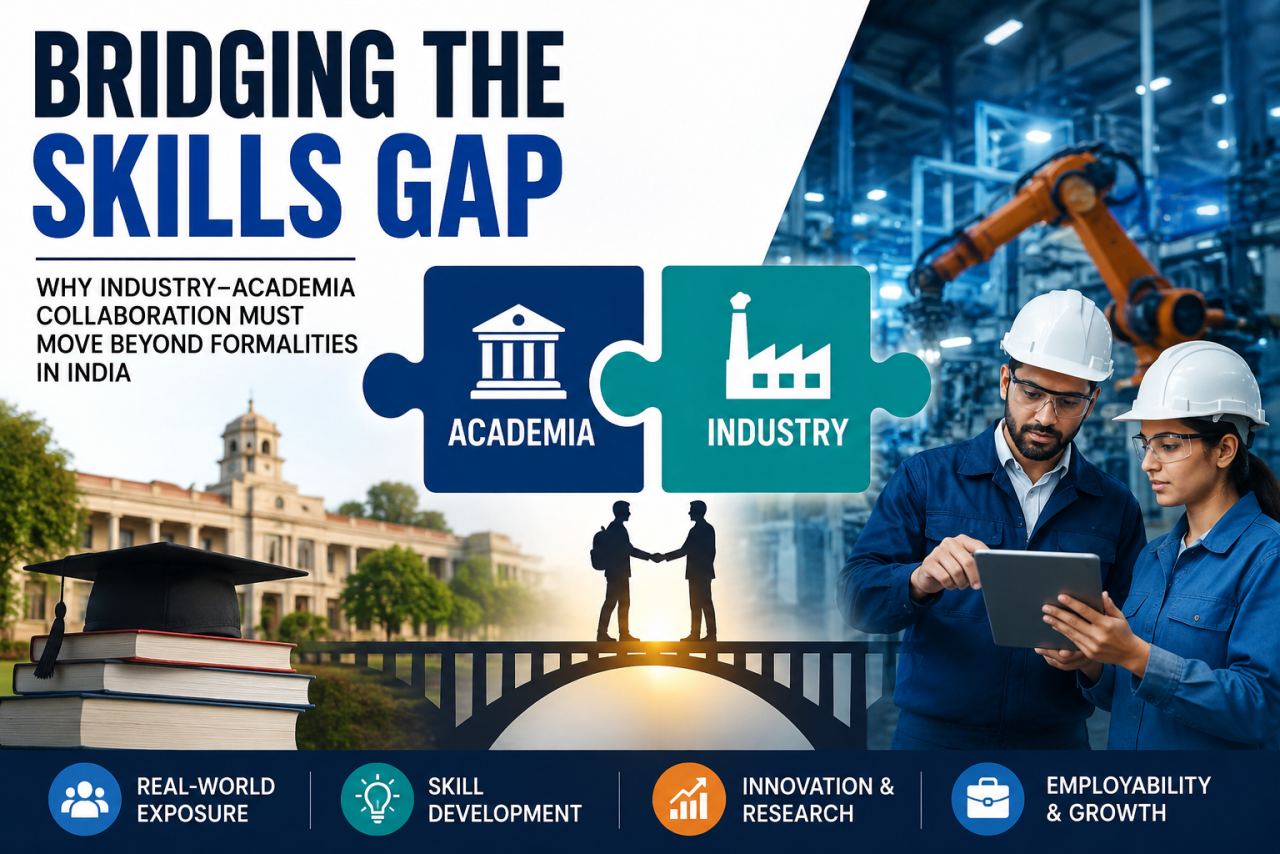
India's graduate talent pool is vast, but employers still struggle to find job-ready professionals. The missing link may not be skills alone—it may be the absence of meaningful industry-academia collaboration.
India produces one of the world's largest pools of graduates every year, yet employers continue to report difficulty finding job-ready talent. The problem is often framed as a skills gap, but the real issue may be far simpler: students and industries rarely work together long enough to understand each other's realities.
For decades, India's education system has excelled at expanding access to higher education. Universities and colleges across the country have enabled millions of young people to pursue professional degrees in engineering, management, science, and technology. Yet the transition from classroom to workplace remains a challenge for a significant section of graduates. While students possess theoretical knowledge, many struggle to apply it in practical environments where real-world problems rarely arrive neatly packaged within textbook chapters.
This disconnect has sparked countless discussions about employability, curriculum reform, and workforce readiness. However, one crucial aspect often receives less attention than it deserves: the quality of collaboration between academia and industry.
Today, industry-academia partnerships have become a common feature of higher education. Institutions regularly announce memorandums of understanding, host industry visits, organize seminars, and facilitate internships. While these initiatives are valuable, many remain limited in scope and impact. Too often, collaboration becomes a box-ticking exercise rather than a meaningful partnership capable of transforming learning outcomes.
The challenge is not a lack of intent. Universities want their students to succeed, and industries need skilled professionals to sustain growth. The problem lies in the structure of engagement. Most interactions occur at the margins of education rather than at its core. Students may attend a workshop or complete a short internship, but they seldom participate in long-term projects that expose them to the complexities of real industrial challenges.
This matters because genuine learning often happens when theory encounters reality. A mechanical engineering student working on manufacturing inefficiencies, a biotechnology student contributing to research trials, or a computer science student helping solve operational problems gains far more than technical knowledge. Such experiences develop critical thinking, communication skills, teamwork, and adaptability—qualities that employers consistently seek.
The benefits of deeper collaboration extend well beyond employability. Industry participation can help educational institutions identify emerging skill requirements and update curricula accordingly. Companies gain access to fresh perspectives, innovative ideas, and a pipeline of future talent. Researchers receive opportunities to address practical challenges with societal and commercial relevance. When collaboration functions effectively, all stakeholders benefit.
India's innovation ecosystem already provides a strong foundation for such partnerships. The country is home to globally respected research organizations, a rapidly growing startup culture, and an expanding network of universities. Government initiatives promoting innovation, entrepreneurship, and skill development have further strengthened the ecosystem. Yet the potential of these efforts remains underutilized when institutions and industries continue to operate in separate silos.
One persistent weakness is the lack of continuity. Partnerships often generate excitement at launch but fade once the initial event or project concludes. Sustainable collaboration requires long-term commitment rather than one-time engagement. Industry leaders should contribute to curriculum design, mentoring programs, guest lectures, and collaborative research initiatives. Likewise, academic institutions must create incentives for faculty members to engage with industry challenges and integrate practical applications into their teaching.
Another important consideration is geographic inequality. Meaningful industry exposure is often concentrated in metropolitan cities and premier institutions. Students studying in smaller towns and emerging educational hubs frequently have fewer opportunities to interact with professionals, researchers, and employers. As a result, talent remains underexposed despite possessing significant potential.
Digital technologies offer an opportunity to reduce this divide. Virtual mentorship programs, remote internships, collaborative research platforms, and online project-based learning can connect students with industry experts regardless of location. In a country as geographically diverse as India, such models can democratize access to professional networks and practical experience.
Equally important is the need to redefine how academic success is measured. Examination scores continue to dominate educational evaluation, often at the expense of creativity, innovation, and problem-solving ability. While academic rigor remains essential, employers increasingly value candidates who can apply knowledge, adapt to changing circumstances, and work effectively in multidisciplinary teams. Educational institutions must therefore encourage experiential learning alongside conventional academic achievement.
Faculty engagement is another critical piece of the puzzle. Professors who maintain active industry connections can bring contemporary insights into classrooms and expose students to evolving technologies, business practices, and professional expectations. This ensures that education remains relevant in an economy shaped by rapid technological change.
The urgency of stronger collaboration has only increased with the rise of artificial intelligence, automation, and data-driven industries. Jobs are evolving faster than traditional curricula can adapt. Graduates entering the workforce need not only foundational knowledge but also the ability to learn continuously and solve unfamiliar problems. Industry-academia partnerships can play a vital role in developing these capabilities.
India's demographic advantage is frequently celebrated as a key driver of future growth. However, a young population alone does not guarantee economic success. The true opportunity lies in transforming that population into a workforce capable of innovation, productivity, and leadership.
Achieving this goal requires moving beyond symbolic partnerships and embracing collaboration as a strategic national priority. When universities and industries work together in meaningful ways, education becomes more relevant, research becomes more impactful, and students become better prepared for the realities of the modern economy. Bridging this gap is not merely an educational reform—it is an investment in India's future competitiveness and growth.
India produces one of the world's largest pools of graduates every year, yet employers continue to report difficulty finding job-ready talent. The problem is often framed as a skills gap, but the real issue may be far simpler: students and industries rarely work together long enough to understand each other's realities.
For decades, India's education system has excelled at expanding access to higher education. Universities and colleges across the country have enabled millions of young people to pursue professional degrees in engineering, management, science, and technology. Yet the transition from classroom to workplace remains a challenge for a significant section of graduates. While students possess theoretical knowledge, many struggle to apply it in practical environments where real-world problems rarely arrive neatly packaged within textbook chapters.
This disconnect has sparked countless discussions about employability, curriculum reform, and workforce readiness. However, one crucial aspect often receives less attention than it deserves: the quality of collaboration between academia and industry.
Today, industry-academia partnerships have become a common feature of higher education. Institutions regularly announce memorandums of understanding, host industry visits, organize seminars, and facilitate internships. While these initiatives are valuable, many remain limited in scope and impact. Too often, collaboration becomes a box-ticking exercise rather than a meaningful partnership capable of transforming learning outcomes.
The challenge is not a lack of intent. Universities want their students to succeed, and industries need skilled professionals to sustain growth. The problem lies in the structure of engagement. Most interactions occur at the margins of education rather than at its core. Students may attend a workshop or complete a short internship, but they seldom participate in long-term projects that expose them to the complexities of real industrial challenges.
This matters because genuine learning often happens when theory encounters reality. A mechanical engineering student working on manufacturing inefficiencies, a biotechnology student contributing to research trials, or a computer science student helping solve operational problems gains far more than technical knowledge. Such experiences develop critical thinking, communication skills, teamwork, and adaptability—qualities that employers consistently seek.
The benefits of deeper collaboration extend well beyond employability. Industry participation can help educational institutions identify emerging skill requirements and update curricula accordingly. Companies gain access to fresh perspectives, innovative ideas, and a pipeline of future talent. Researchers receive opportunities to address practical challenges with societal and commercial relevance. When collaboration functions effectively, all stakeholders benefit.
India's innovation ecosystem already provides a strong foundation for such partnerships. The country is home to globally respected research organizations, a rapidly growing startup culture, and an expanding network of universities. Government initiatives promoting innovation, entrepreneurship, and skill development have further strengthened the ecosystem. Yet the potential of these efforts remains underutilized when institutions and industries continue to operate in separate silos.
One persistent weakness is the lack of continuity. Partnerships often generate excitement at launch but fade once the initial event or project concludes. Sustainable collaboration requires long-term commitment rather than one-time engagement. Industry leaders should contribute to curriculum design, mentoring programs, guest lectures, and collaborative research initiatives. Likewise, academic institutions must create incentives for faculty members to engage with industry challenges and integrate practical applications into their teaching.
Another important consideration is geographic inequality. Meaningful industry exposure is often concentrated in metropolitan cities and premier institutions. Students studying in smaller towns and emerging educational hubs frequently have fewer opportunities to interact with professionals, researchers, and employers. As a result, talent remains underexposed despite possessing significant potential.
Digital technologies offer an opportunity to reduce this divide. Virtual mentorship programs, remote internships, collaborative research platforms, and online project-based learning can connect students with industry experts regardless of location. In a country as geographically diverse as India, such models can democratize access to professional networks and practical experience.
Equally important is the need to redefine how academic success is measured. Examination scores continue to dominate educational evaluation, often at the expense of creativity, innovation, and problem-solving ability. While academic rigor remains essential, employers increasingly value candidates who can apply knowledge, adapt to changing circumstances, and work effectively in multidisciplinary teams. Educational institutions must therefore encourage experiential learning alongside conventional academic achievement.
Faculty engagement is another critical piece of the puzzle. Professors who maintain active industry connections can bring contemporary insights into classrooms and expose students to evolving technologies, business practices, and professional expectations. This ensures that education remains relevant in an economy shaped by rapid technological change.
The urgency of stronger collaboration has only increased with the rise of artificial intelligence, automation, and data-driven industries. Jobs are evolving faster than traditional curricula can adapt. Graduates entering the workforce need not only foundational knowledge but also the ability to learn continuously and solve unfamiliar problems. Industry-academia partnerships can play a vital role in developing these capabilities.
India's demographic advantage is frequently celebrated as a key driver of future growth. However, a young population alone does not guarantee economic success. The true opportunity lies in transforming that population into a workforce capable of innovation, productivity, and leadership.
Achieving this goal requires moving beyond symbolic partnerships and embracing collaboration as a strategic national priority. When universities and industries work together in meaningful ways, education becomes more relevant, research becomes more impactful, and students become better prepared for the realities of the modern economy. Bridging this gap is not merely an educational reform—it is an investment in India's future competitiveness and growth.





















Leave a Comment