
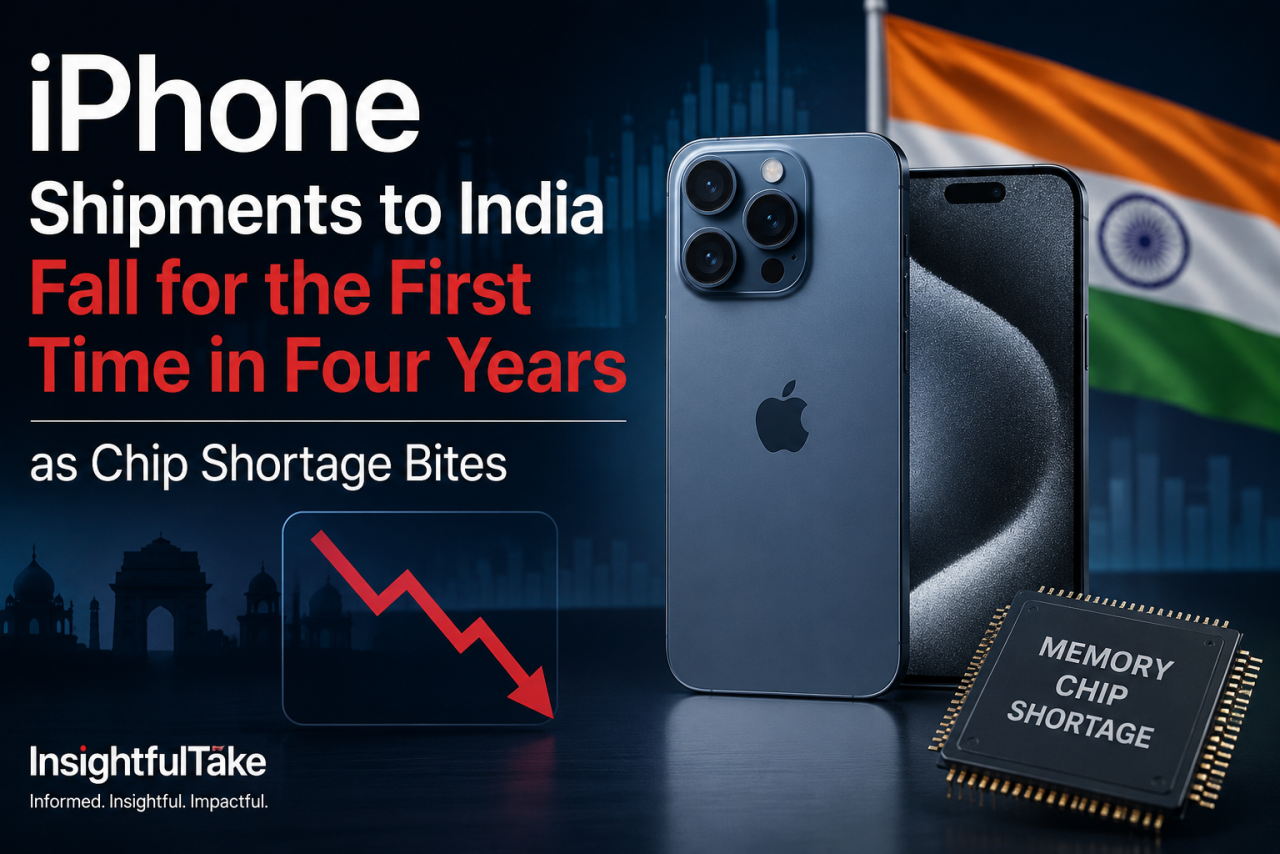
Apple's iPhone sales in India have stumbled for the first time in four years, not because demand has faded, but because a global chip shortage has left store shelves running short.
Apple's iPhone shipments to India declined in the April-June quarter of 2026, marking the first quarterly fall in over four years. The setback comes at a time when the company has increasingly relied on India as one of its most reliable growth markets, even as sales slow or stagnate elsewhere in the world.
According to a supply chain analysis released on 17 July by independent research firm Counterpoint, Apple's iPhone shipments in India fell 3 percent year-on-year during the quarter. This is the first quarterly decline the company has recorded in India in more than four years, a period during which the country had emerged as one of Apple's fastest-growing and most resilient consumer bases.
The primary reason behind the slump is not weak demand but constrained supply. A global shortage of memory chips has squeezed the availability of the iPhone 17, Apple's latest model, ever since it launched in September last year. Retailers across the country have reported persistent stock shortages, with customers frequently unable to get their preferred variant despite being willing to pay a premium.
Navkendar Singh, associate vice-president at research firm IDC, said the chip crunch has made it difficult for Apple to normalise iPhone 17 shipments. As memory chips become costlier globally, component vendors are renegotiating prices further up the supply chain, a process that takes time and continues to constrain how many units reach Indian retailers. Singh added that this supply squeeze may not ease meaningfully until Apple launches its next major iPhone lineup, and in a worst-case scenario, the resolution could stretch out as far as 2028.
Despite the pressure on its supply chain, Apple has so far chosen to shield the iPhone, its single biggest source of revenue, from price hikes, even as it raised prices on its Mac and iPad lineups on 25 June. Reports from The Wall Street Journal earlier in June suggested Apple had held iPhone prices steady for the time being, but cautioned that an increase later in the year could become difficult to avoid if chip costs keep climbing.
The broader Indian smartphone market has not fared much better. Overall smartphone shipments to retail channels in the country fell 10 percent during the same quarter, a decline steep enough to push Apple out of India's top five smartphone brands for the period. Samsung, Vivo, Oppo, Realme and Xiaomi held the top five positions instead, benefiting from Apple's supply-driven stumble even as the overall market contracted.
Counterpoint's analysts now project that India's overall smartphone shipments could decline by 12 to 15 percent over the course of 2026, which would make it the weakest year for the country's phone market since the Covid-19 pandemic. For Apple specifically, industry watchers expect full-year iPhone sales in India to remain largely flat or grow only marginally, a sharp slowdown compared to the aggressive growth the company has posted in the country over the past several years.
The irony is not lost on retailers, who point out that consumer appetite for Apple's devices in India remains intact even as shipments falter. Manish Khatri, a partner at a Mumbai-based retail chain, said demand for premium smartphones has stayed strong, with buyers largely unbothered by modest price increases as long as stock is available. Retailers in Delhi, Kolkata and Mumbai echoed similar concerns about the prospect of both higher prices and thinner supplies weighing on sales through the rest of the year.
Apple's outgoing chief executive Tim Cook had earlier praised India's performance, remarking on the country's growing importance to the company's global business. That optimism now sits alongside a more complicated reality: a market Apple has spent years cultivating is being held back not by falling demand, but by its own struggle to keep enough iPhones on Indian shelves.
Queries emailed to Apple India did not receive a response.
Apple's iPhone shipments to India declined in the April-June quarter of 2026, marking the first quarterly fall in over four years. The setback comes at a time when the company has increasingly relied on India as one of its most reliable growth markets, even as sales slow or stagnate elsewhere in the world.
According to a supply chain analysis released on 17 July by independent research firm Counterpoint, Apple's iPhone shipments in India fell 3 percent year-on-year during the quarter. This is the first quarterly decline the company has recorded in India in more than four years, a period during which the country had emerged as one of Apple's fastest-growing and most resilient consumer bases.
The primary reason behind the slump is not weak demand but constrained supply. A global shortage of memory chips has squeezed the availability of the iPhone 17, Apple's latest model, ever since it launched in September last year. Retailers across the country have reported persistent stock shortages, with customers frequently unable to get their preferred variant despite being willing to pay a premium.
Navkendar Singh, associate vice-president at research firm IDC, said the chip crunch has made it difficult for Apple to normalise iPhone 17 shipments. As memory chips become costlier globally, component vendors are renegotiating prices further up the supply chain, a process that takes time and continues to constrain how many units reach Indian retailers. Singh added that this supply squeeze may not ease meaningfully until Apple launches its next major iPhone lineup, and in a worst-case scenario, the resolution could stretch out as far as 2028.
Despite the pressure on its supply chain, Apple has so far chosen to shield the iPhone, its single biggest source of revenue, from price hikes, even as it raised prices on its Mac and iPad lineups on 25 June. Reports from The Wall Street Journal earlier in June suggested Apple had held iPhone prices steady for the time being, but cautioned that an increase later in the year could become difficult to avoid if chip costs keep climbing.
The broader Indian smartphone market has not fared much better. Overall smartphone shipments to retail channels in the country fell 10 percent during the same quarter, a decline steep enough to push Apple out of India's top five smartphone brands for the period. Samsung, Vivo, Oppo, Realme and Xiaomi held the top five positions instead, benefiting from Apple's supply-driven stumble even as the overall market contracted.
Counterpoint's analysts now project that India's overall smartphone shipments could decline by 12 to 15 percent over the course of 2026, which would make it the weakest year for the country's phone market since the Covid-19 pandemic. For Apple specifically, industry watchers expect full-year iPhone sales in India to remain largely flat or grow only marginally, a sharp slowdown compared to the aggressive growth the company has posted in the country over the past several years.
The irony is not lost on retailers, who point out that consumer appetite for Apple's devices in India remains intact even as shipments falter. Manish Khatri, a partner at a Mumbai-based retail chain, said demand for premium smartphones has stayed strong, with buyers largely unbothered by modest price increases as long as stock is available. Retailers in Delhi, Kolkata and Mumbai echoed similar concerns about the prospect of both higher prices and thinner supplies weighing on sales through the rest of the year.
Apple's outgoing chief executive Tim Cook had earlier praised India's performance, remarking on the country's growing importance to the company's global business. That optimism now sits alongside a more complicated reality: a market Apple has spent years cultivating is being held back not by falling demand, but by its own struggle to keep enough iPhones on Indian shelves.
Queries emailed to Apple India did not receive a response.

















Leave a Comment