
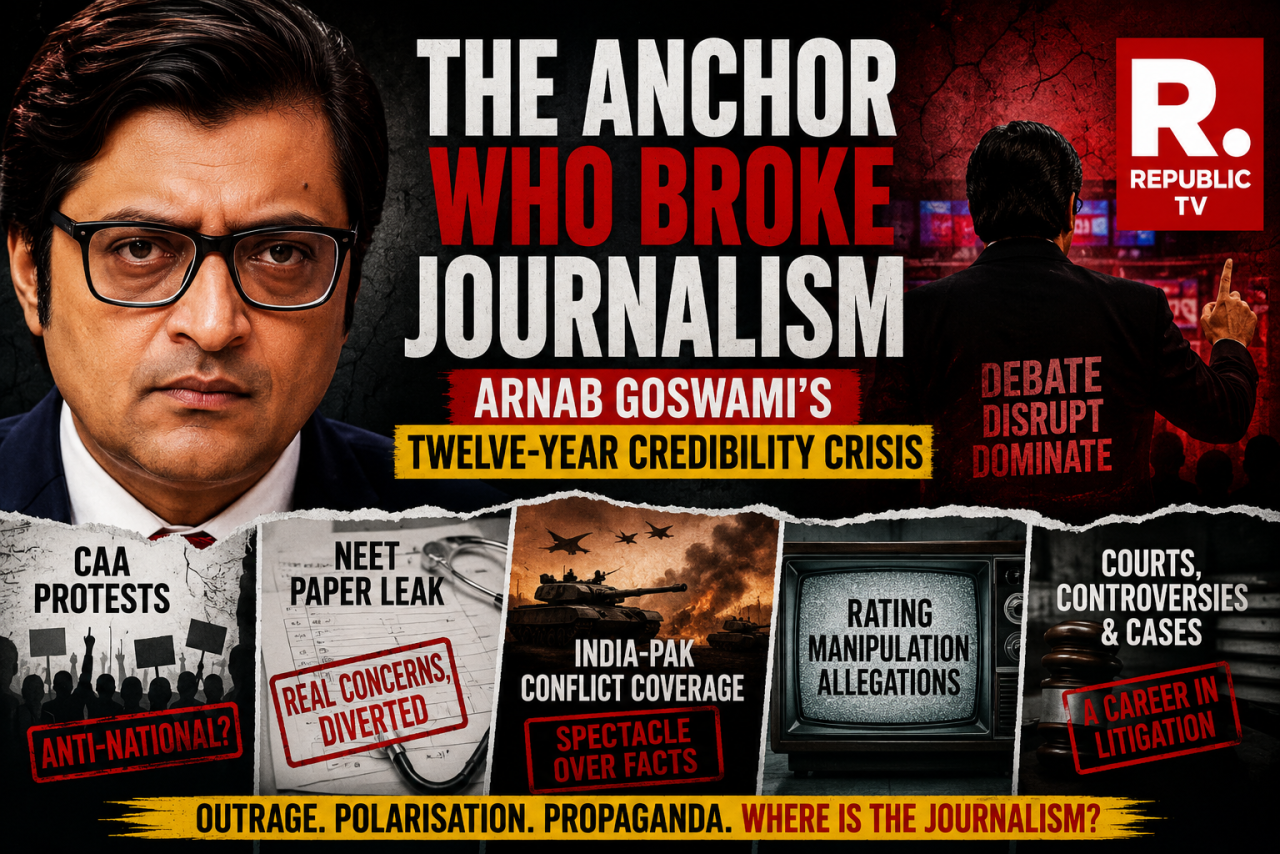
Did Arnab Goswami redefine Indian journalism—or push it toward spectacle, outrage and political theatre? This opinion examines twelve years of controversies that continue to shape India's television news landscape.
Few figures embody the decay of Indian television news as starkly as Arnab Goswami. Over roughly the same span that the Modi government has governed India, Goswami has built Republic TV and Republic Bharat into ratings juggernauts and, in the process, hollowed out the profession he claims to represent. The Wire's recent breakdown of a single week of Republic broadcasts, covering 25 broadcasts and nearly 59,000 words, is only the latest data point in a pattern that has been visible for over a decade.
Manufacturing Enemies Instead of Reporting News
Goswami's signature format has never been investigation; it is confrontation. Debates are engineered around a predetermined villain, whether Pakistan, China, "urban Naxals," the opposition, or, as recently documented, the United States, with panel composition and framing designed to produce outrage rather than understanding. This is not merely a stylistic choice; it is a business model. When a channel's own broadcasts refer to one country as a "hostile actor" nearly twice as often as its next-most-targeted adversary in a single week, that is no longer editorial judgment. It is narrative manufacturing.
Prime-time television, under Goswami's stewardship, has steadily shifted from questioning those in power to identifying enemies around whom nightly outrage can be organised. In that environment, nuance becomes a casualty and journalism gives way to performance.
A Body of Controversy, Not an Isolated Incident
The charge sheet against Goswami's professional conduct is long and well documented. In 2020, Mumbai Police alleged that Republic TV was part of a television ratings manipulation racket by paying selected households to inflate viewership. Goswami denied the allegations, but the matter resulted in prolonged litigation before the Supreme Court. That same year, his remarks questioning Sonia Gandhi's silence after the Palghar lynchings triggered more than a hundred FIRs across multiple states, while the Maharashtra government sought Supreme Court intervention over what it described as attempts to browbeat investigators through televised commentary.
His coverage of actor Sushant Singh Rajput's death became one of the defining media controversies of the decade. A petition before the Delhi High Court accused him and Republic TV of conducting a "witch hunt" and acting as "judge, jury and executioner" despite the AIIMS medical report concluding that the actor had died by suicide. The Maharashtra Assembly initiated breach-of-privilege proceedings against him, while the Supreme Court repeatedly dealt with petitions arising from multiple investigations. His arrest later that year in an unrelated abetment-to-suicide case involving an interior designer further reinforced the perception that his career had become deeply entangled with legal disputes.
More recently, Republic Bharat has faced criticism for airing fabricated stories, including a false account of a phone conversation between Donald Trump and Narendra Modi regarding wildfire relief helicopters, and for using AI-generated visuals to depict fictional scenarios involving world leaders. Independent media observers have also questioned the channel's practice of inviting Pakistani panellists primarily to provoke sensational exchanges, including one debate in which disparaging remarks against a former Indian Army chief went unchallenged by the anchor.
Criminalising Dissent Instead of Questioning Power
Goswami's editorial approach has also attracted criticism for its treatment of public protests and student movements. During the protests against the Citizenship (Amendment) Act (CAA), Republic TV was widely accused by civil rights groups, academics and opposition leaders of portraying student demonstrators as anti-national rather than engaging with the constitutional concerns they raised. The focus often appeared to be on discrediting protesters instead of examining the substance of their demands.
A similar pattern emerged during the nationwide controversy over the 2024 NEET examination. As lakhs of students demanded accountability over allegations of question paper leaks and irregularities, Republic's coverage frequently shifted attention towards questioning the motives of protesters and opposition parties. Instead of treating the issue primarily as a crisis affecting students' futures, critics argued that the channel framed legitimate public concerns through a partisan political lens. For many observers, this reflected a broader editorial philosophy in which dissent itself became the story while those exercising authority escaped equivalent scrutiny.
War as Prime-Time Spectacle
The same editorial instinct resurfaced during the heightened tensions between India and Pakistan following the Pahalgam terror attack. At a moment when restraint, verification and responsible reporting were essential, much of Republic's prime-time coverage adopted the language and aesthetics of a war room. Animated battle graphics, dramatic sound effects, emotionally charged rhetoric and sweeping military claims frequently overshadowed careful fact-based reporting.
As independent fact-checkers questioned several viral wartime claims circulating across television and social media, critics argued that Republic often amplified nationalism through spectacle rather than strengthening public understanding through verified information. The line separating journalism from patriotic theatre appeared increasingly blurred, raising concerns about whether television news was informing citizens or merely entertaining them during a national security crisis.
The Credibility Gap
What makes Goswami's case significant is not merely ideological bias, a feature hardly unique in contemporary television journalism. It is the widening gap between his image as a fearless truth-teller and a professional record marked by allegations of ratings manipulation, repeated judicial scrutiny of his reporting practices, controversies involving misinformation, and a growing dependence on sensationalism over verification. Former panellists who once regularly appeared on his debates have publicly stated that they eventually stopped participating because they no longer viewed the platform as fair or professionally credible.
Journalism derives its authority not from the loudness of its voice but from the credibility of its reporting. Yet over the past twelve years, Indian prime-time television has increasingly rewarded outrage over evidence, conflict over context and performance over public service. Arnab Goswami did not create every problem confronting Indian television news, but no individual has come to symbolise those failures more visibly.
He undeniably transformed Indian television journalism. He redefined the economics of prime-time news, reshaped political broadcasting and demonstrated how spectacle can command unprecedented audience attention. But influence alone is not a measure of journalistic excellence. If journalism ultimately exists to question power, verify facts and inform citizens, then Goswami's legacy raises an uncomfortable question for the profession itself: Can journalism remain journalism once it becomes indistinguishable from political theatre?
The answer to that question will define not only Arnab Goswami's place in India's media history, but also the future credibility of Indian television journalism itself.
Few figures embody the decay of Indian television news as starkly as Arnab Goswami. Over roughly the same span that the Modi government has governed India, Goswami has built Republic TV and Republic Bharat into ratings juggernauts and, in the process, hollowed out the profession he claims to represent. The Wire's recent breakdown of a single week of Republic broadcasts, covering 25 broadcasts and nearly 59,000 words, is only the latest data point in a pattern that has been visible for over a decade.
Manufacturing Enemies Instead of Reporting News
Goswami's signature format has never been investigation; it is confrontation. Debates are engineered around a predetermined villain, whether Pakistan, China, "urban Naxals," the opposition, or, as recently documented, the United States, with panel composition and framing designed to produce outrage rather than understanding. This is not merely a stylistic choice; it is a business model. When a channel's own broadcasts refer to one country as a "hostile actor" nearly twice as often as its next-most-targeted adversary in a single week, that is no longer editorial judgment. It is narrative manufacturing.
Prime-time television, under Goswami's stewardship, has steadily shifted from questioning those in power to identifying enemies around whom nightly outrage can be organised. In that environment, nuance becomes a casualty and journalism gives way to performance.
A Body of Controversy, Not an Isolated Incident
The charge sheet against Goswami's professional conduct is long and well documented. In 2020, Mumbai Police alleged that Republic TV was part of a television ratings manipulation racket by paying selected households to inflate viewership. Goswami denied the allegations, but the matter resulted in prolonged litigation before the Supreme Court. That same year, his remarks questioning Sonia Gandhi's silence after the Palghar lynchings triggered more than a hundred FIRs across multiple states, while the Maharashtra government sought Supreme Court intervention over what it described as attempts to browbeat investigators through televised commentary.
His coverage of actor Sushant Singh Rajput's death became one of the defining media controversies of the decade. A petition before the Delhi High Court accused him and Republic TV of conducting a "witch hunt" and acting as "judge, jury and executioner" despite the AIIMS medical report concluding that the actor had died by suicide. The Maharashtra Assembly initiated breach-of-privilege proceedings against him, while the Supreme Court repeatedly dealt with petitions arising from multiple investigations. His arrest later that year in an unrelated abetment-to-suicide case involving an interior designer further reinforced the perception that his career had become deeply entangled with legal disputes.
More recently, Republic Bharat has faced criticism for airing fabricated stories, including a false account of a phone conversation between Donald Trump and Narendra Modi regarding wildfire relief helicopters, and for using AI-generated visuals to depict fictional scenarios involving world leaders. Independent media observers have also questioned the channel's practice of inviting Pakistani panellists primarily to provoke sensational exchanges, including one debate in which disparaging remarks against a former Indian Army chief went unchallenged by the anchor.
Criminalising Dissent Instead of Questioning Power
Goswami's editorial approach has also attracted criticism for its treatment of public protests and student movements. During the protests against the Citizenship (Amendment) Act (CAA), Republic TV was widely accused by civil rights groups, academics and opposition leaders of portraying student demonstrators as anti-national rather than engaging with the constitutional concerns they raised. The focus often appeared to be on discrediting protesters instead of examining the substance of their demands.
A similar pattern emerged during the nationwide controversy over the 2024 NEET examination. As lakhs of students demanded accountability over allegations of question paper leaks and irregularities, Republic's coverage frequently shifted attention towards questioning the motives of protesters and opposition parties. Instead of treating the issue primarily as a crisis affecting students' futures, critics argued that the channel framed legitimate public concerns through a partisan political lens. For many observers, this reflected a broader editorial philosophy in which dissent itself became the story while those exercising authority escaped equivalent scrutiny.
War as Prime-Time Spectacle
The same editorial instinct resurfaced during the heightened tensions between India and Pakistan following the Pahalgam terror attack. At a moment when restraint, verification and responsible reporting were essential, much of Republic's prime-time coverage adopted the language and aesthetics of a war room. Animated battle graphics, dramatic sound effects, emotionally charged rhetoric and sweeping military claims frequently overshadowed careful fact-based reporting.
As independent fact-checkers questioned several viral wartime claims circulating across television and social media, critics argued that Republic often amplified nationalism through spectacle rather than strengthening public understanding through verified information. The line separating journalism from patriotic theatre appeared increasingly blurred, raising concerns about whether television news was informing citizens or merely entertaining them during a national security crisis.
The Credibility Gap
What makes Goswami's case significant is not merely ideological bias, a feature hardly unique in contemporary television journalism. It is the widening gap between his image as a fearless truth-teller and a professional record marked by allegations of ratings manipulation, repeated judicial scrutiny of his reporting practices, controversies involving misinformation, and a growing dependence on sensationalism over verification. Former panellists who once regularly appeared on his debates have publicly stated that they eventually stopped participating because they no longer viewed the platform as fair or professionally credible.
Journalism derives its authority not from the loudness of its voice but from the credibility of its reporting. Yet over the past twelve years, Indian prime-time television has increasingly rewarded outrage over evidence, conflict over context and performance over public service. Arnab Goswami did not create every problem confronting Indian television news, but no individual has come to symbolise those failures more visibly.
He undeniably transformed Indian television journalism. He redefined the economics of prime-time news, reshaped political broadcasting and demonstrated how spectacle can command unprecedented audience attention. But influence alone is not a measure of journalistic excellence. If journalism ultimately exists to question power, verify facts and inform citizens, then Goswami's legacy raises an uncomfortable question for the profession itself: Can journalism remain journalism once it becomes indistinguishable from political theatre?
The answer to that question will define not only Arnab Goswami's place in India's media history, but also the future credibility of Indian television journalism itself.







Leave a Comment