
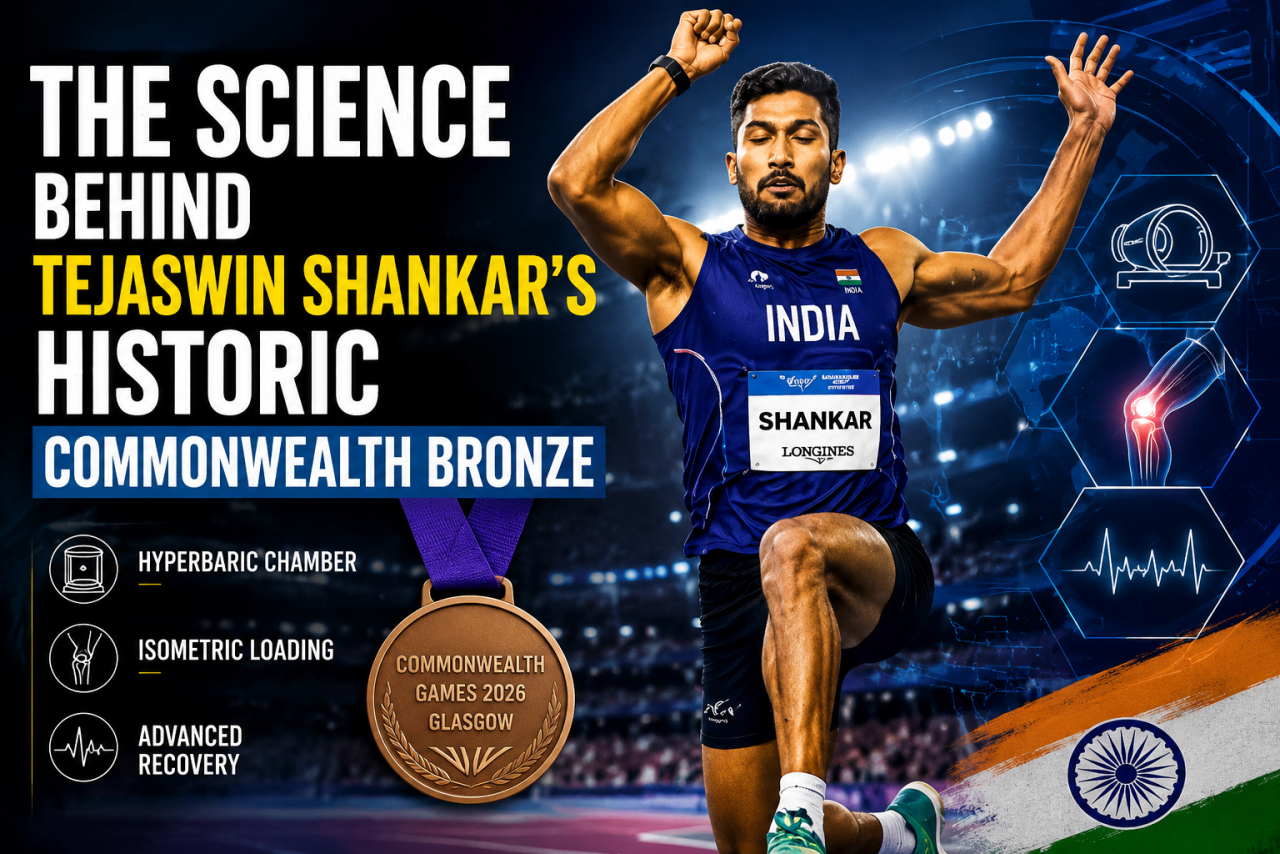
A historic bronze was won not just through grit but through cutting-edge sports science, revealing how modern recovery methods are transforming Indian athletics and keeping champions in the fight.
Tejaswin Shankar's bronze medal in the decathlon at the 2026 Commonwealth Games in Glasgow is being celebrated as a triumph of willpower. It is that. But the more instructive story sitting underneath the headlines is about infrastructure, specifically how a support system built around hyperbaric chambers, isometric loading protocols, and a sports scientist flown in mid-competition kept an athlete on the field who, a generation ago, would simply have withdrawn.
Tejaswin totalled 7,976 points across two gruelling days at Scotstoun Stadium, finishing behind Grenada's Lindon Victor and Canada's Damian Warner to become the first Indian to win a Commonwealth Games medal in the decathlon. It is also his second individual Commonwealth Games medal in two different events, after his high jump bronze in Birmingham in 2022. That alone makes him one of the most versatile athletes India has produced in track and field.
What makes this medal different from most Indian athletics stories is the sequence of events that preceded it. Four days before the decathlon began, Tejaswin was pulled out of the high jump final after his patellar tendon, injured badly enough in 2023 to threaten his career, flared up again. In most sporting systems with limited depth, that would have ended his Games. Instead, a support team led by strength and conditioning expert Wayne Lombard used anti-inflammatory medication to calm the joint, followed by isometric loading, a technique where controlled pressure is applied to a joint without movement and is increasingly used in tendon rehabilitation because it can reduce pain within a single session. A hyperbaric chamber and pulsed electromagnetic field therapy were added to compress a recovery timeline that would normally take weeks into about 48 hours.
This is worth dwelling on because Indian athletics has historically lost promising careers to exactly this kind of injury, not for lack of talent but for lack of access to rehabilitation science at the moment it mattered. Tejaswin himself has spoken about the mental toll of chronic tendinopathy since it first surfaced years ago. What changed in Glasgow was not his pain tolerance alone, he had that in 2022 as well, but the presence of a team capable of managing pain event by event across ten separate disciplines, each stressing the same injured knee differently.
The decathlon itself illustrates why this mattered so much. Long jump and high jump place enormous stress on the take-off knee, and Tejaswin's own account of assessing his body after each event, essentially competing on a rolling medical decision rather than a fixed plan, shows just how fine the margin was. A 7.82m long jump and a 2.15m high jump, both the best marks in the field on the opening day, were not just outstanding athletic performances. They were evidence that the recovery strategy was working under the highest level of competitive pressure.
There is a broader lesson for Indian sport here. Praveen Chithravel's silver in the men's triple jump on the same night, following his bronze in 2022, suggests a pattern rather than an isolated success. India's field events, long treated as an afterthought behind track sprinting and throws, are now producing consistent international medallists. What connects Tejaswin's decathlon bronze and Chithravel's success is less raw ability, which India has never lacked, and more the gradual arrival of specialist support, biomechanics experts, injury management protocols, and sports scientists working closely with individual athletes instead of being shared across an entire contingent.
Tejaswin's own reflection on the achievement, that he does not know how many athletes have managed a high jump medal and a decathlon medal four years apart, modestly understates the institutional shift behind his success. His bronze is a story of resilience, determination, and extraordinary versatility. But it is also a compelling case study of what happens when Indian athletics begins to treat recovery and injury management with the same seriousness as training. If that approach becomes the norm rather than the exception, medals like this may no longer be historic. They may simply become expected.
Tejaswin Shankar's bronze medal in the decathlon at the 2026 Commonwealth Games in Glasgow is being celebrated as a triumph of willpower. It is that. But the more instructive story sitting underneath the headlines is about infrastructure, specifically how a support system built around hyperbaric chambers, isometric loading protocols, and a sports scientist flown in mid-competition kept an athlete on the field who, a generation ago, would simply have withdrawn.
Tejaswin totalled 7,976 points across two gruelling days at Scotstoun Stadium, finishing behind Grenada's Lindon Victor and Canada's Damian Warner to become the first Indian to win a Commonwealth Games medal in the decathlon. It is also his second individual Commonwealth Games medal in two different events, after his high jump bronze in Birmingham in 2022. That alone makes him one of the most versatile athletes India has produced in track and field.
What makes this medal different from most Indian athletics stories is the sequence of events that preceded it. Four days before the decathlon began, Tejaswin was pulled out of the high jump final after his patellar tendon, injured badly enough in 2023 to threaten his career, flared up again. In most sporting systems with limited depth, that would have ended his Games. Instead, a support team led by strength and conditioning expert Wayne Lombard used anti-inflammatory medication to calm the joint, followed by isometric loading, a technique where controlled pressure is applied to a joint without movement and is increasingly used in tendon rehabilitation because it can reduce pain within a single session. A hyperbaric chamber and pulsed electromagnetic field therapy were added to compress a recovery timeline that would normally take weeks into about 48 hours.
This is worth dwelling on because Indian athletics has historically lost promising careers to exactly this kind of injury, not for lack of talent but for lack of access to rehabilitation science at the moment it mattered. Tejaswin himself has spoken about the mental toll of chronic tendinopathy since it first surfaced years ago. What changed in Glasgow was not his pain tolerance alone, he had that in 2022 as well, but the presence of a team capable of managing pain event by event across ten separate disciplines, each stressing the same injured knee differently.
The decathlon itself illustrates why this mattered so much. Long jump and high jump place enormous stress on the take-off knee, and Tejaswin's own account of assessing his body after each event, essentially competing on a rolling medical decision rather than a fixed plan, shows just how fine the margin was. A 7.82m long jump and a 2.15m high jump, both the best marks in the field on the opening day, were not just outstanding athletic performances. They were evidence that the recovery strategy was working under the highest level of competitive pressure.
There is a broader lesson for Indian sport here. Praveen Chithravel's silver in the men's triple jump on the same night, following his bronze in 2022, suggests a pattern rather than an isolated success. India's field events, long treated as an afterthought behind track sprinting and throws, are now producing consistent international medallists. What connects Tejaswin's decathlon bronze and Chithravel's success is less raw ability, which India has never lacked, and more the gradual arrival of specialist support, biomechanics experts, injury management protocols, and sports scientists working closely with individual athletes instead of being shared across an entire contingent.
Tejaswin's own reflection on the achievement, that he does not know how many athletes have managed a high jump medal and a decathlon medal four years apart, modestly understates the institutional shift behind his success. His bronze is a story of resilience, determination, and extraordinary versatility. But it is also a compelling case study of what happens when Indian athletics begins to treat recovery and injury management with the same seriousness as training. If that approach becomes the norm rather than the exception, medals like this may no longer be historic. They may simply become expected.



















Leave a Comment